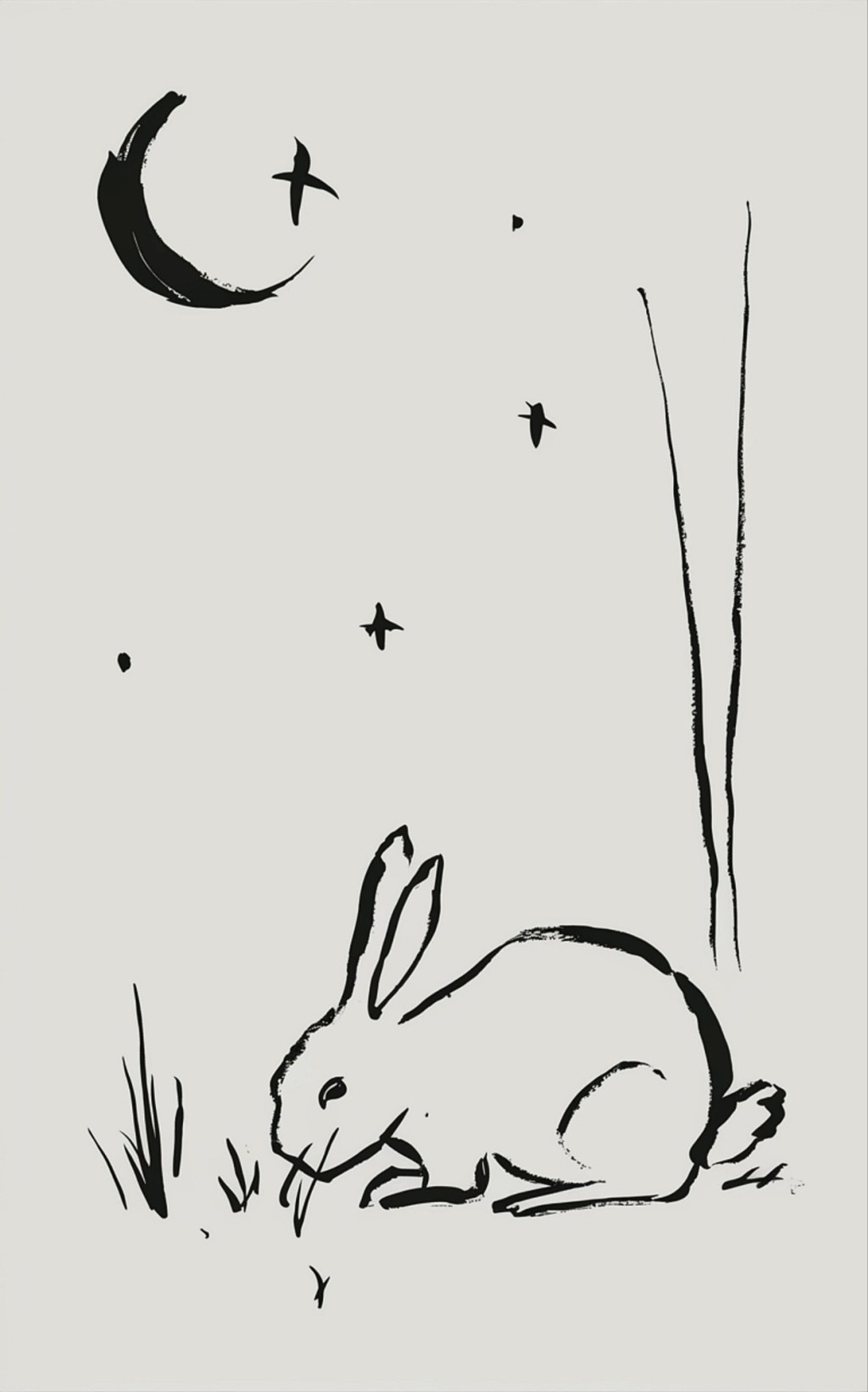
In the simplicity of a few black lines capturing a rabbit’s form, we find the simple truth that nature speaks through balance. Every curve and angle in the natural world seems to fall precisely where it should, as if guided by an invisible hand that knows exactly when to bend and when to stretch, when to soar and when to rest.
Tap the image and you can buy cards or prints in redbubble
Consider how a rabbit’s form combines gentle curves with decisive lines – the soft arch of its back flowing into the alert angle of its ears, the delicate tuck of its feet beneath the rounded mass of its body. These elements don’t just coexist; they converse with each other in a visual harmony that feels inevitably right.
The ancient Chinese principle of feng shui recognized this natural balance centuries ago. It speaks of qi – the vital force that flows through all things – and how it moves in curves, like water finding its path downhill or wind shaping stones over millennia. Sharp angles and straight lines exist in nature too, but they’re almost always softened by organic curves, like the straight trunk of a tree dissolving into the graceful arc of its branches.
This balance appears everywhere we look: in the spiral of a nautilus shell that follows the golden ratio, in the branching patterns of lightning that mirror the veins of a leaf, in the way a falcon’s wing curves exactly as needed to catch the wind. Nature doesn’t calculate these designs; they emerge from the fundamental forces that shape our world, each finding its perfect expression through countless iterations over time.
Even in chaos, nature finds balance. A hurricane’s spiral, violent as it may be, follows the same mathematical principles as the gentle unfurling of a fern frond. The jagged line of a mountain range creates its own kind of harmony with the sky, each peak and valley notes on a stave creating a balanced tune that feels complete and right.
Perhaps this is why minimalist art, like my rabbit drawing, can capture something so profound. By reducing form to its essential elements, it reveals the underlying balance that makes natural design so compelling. In those few decisive lines, we see not just a rabbit, but a piece of fundamental harmony that runs through all things – the perfect tension between straight and curved, between movement and stillness, between complexity and simplicity.
It reminds us that true balance isn’t static – it’s a dynamic dance of opposing forces finding their perfect equilibrium, like the eternal cycle of yin and yang. In this way, every natural form becomes a lesson in harmony, teaching us that beauty often lies not in elaboration, but in finding that exquisite point where nothing needs to be added and nothing needs to be taken away.
If you find my photography or my writing inspiring and uplifting, consider supporting what I do. Buy me a coffee on Ko-fi. Your support makes a difference in my life and helps me create more of what you, and I, like. Thank you!Tap to view my redbubble gallery.
Once again, I find myself running. The corridors shift beneath my feet, stretching, bending, distorting as though they belong not to the material world but to the unconscious itself—shapeless, fluid, dictated by forces unknown to my waking mind. And yet, I know with certainty that behind me, just at my heels, is the rabbit.
It is a creature of no real threat. Small, brown, its form is innocent, even benign. It does not snarl, does not leap toward me with aggression. It speaks only a single word:
“Run.”
And so I do. I flee through this labyrinth, though I do not know from what. The rabbit, too, is running—but is it pursuing me or warning me? Or is it simply the manifestation of my own unconscious, given form in this nocturnal theater of repression?
The animal figure, the chase, the command—each element is symbolic, drawing from the deep well of my psyche. The rabbit, so often a symbol of fertility, of innocence, of uncontrollable instinct, stands as a representation of something primal within me. It urges me onward, yet it is not the true source of my terror. No, the true fear lies in the unseen, the thing that lurks beyond, the thing that both the rabbit and I are escaping.
Could it be the manifestation of a suppressed desire? A latent anxiety? Am I fleeing some forbidden impulse, one too dangerous to acknowledge in waking life? Or is this rabbit the embodiment of duty, of expectation—some force within me that demands I move forward, though I do not know why, nor toward what?
The dream repeats, night after night, and yet its meaning eludes me, slipping through my fingers like sand. Perhaps I do not wish to know. Perhaps the mind protects itself from revelations too unbearable to face. And yet, I know this much:
I run not from the rabbit, but from what it represents. And so long as I do not turn to face it, I shall remain forever in flight.
If you find this content inspiring and uplifting, consider supporting what I do. Buy me a coffee on Ko-fi. Your support makes a difference in my life and helps me create more of what you, and I, like. Thank you!Tap to view my redbubble gallery.
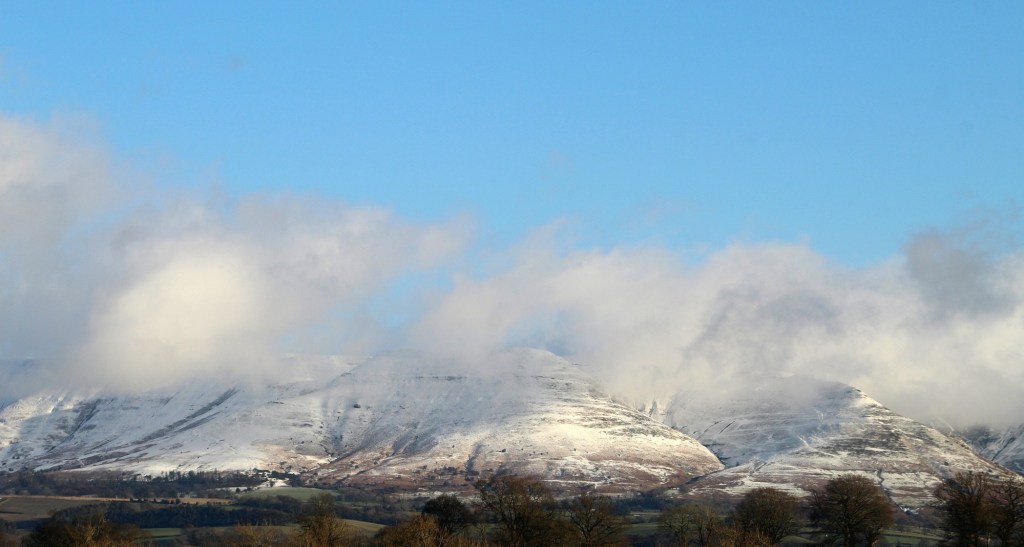
The Brecon Beacons loomed in the distance, their snow-capped peaks smudged by a veil of mist. I snapped a picture from the base, and the image felt as though I was staring at an unattainable dream—a far-off cathedral built for gods, not mortals like me.
Brecon Beacons January 2025
The peaks seemed untouchable, enshrined in a kind of holy fog, as if they were hiding some secret I wasn’t meant to know. But what else could I do? I tightened my laces and started walking.
The trail began innocently enough, a gradual incline, a whisper of mud clinging to my boots, and the wind humming a tune, as if to say ‘this place is not for you’. Step by step, the Beacons grew taller and stranger. The snowline hovered above me like an unspoken threat, a reminder that everything good in life comes with its sharp edges and cold hands. I wondered if I’d even make it. I wondered now why I’d started at all.
Somewhere just below the snowline, I stopped to catch my breath. That’s when I saw it. A deer. Small, delicate, its legs like question marks frozen in mid-thought. It stared at me for a moment, eyes wide, then leapt away into the trees, vanishing like a memory you can’t quite hold onto. I watched the spot where it disappeared, as if waiting for it to come back and explain itself. But it didn’t. And why should it? Some things are meant to be glimpsed, not understood.
Snow-capped peaks above, Cold trials test weary feet— I walk through the doubt.
The higher I climbed, the thicker the mist became. I felt like I was walking into a dream, one of those nonsensical ones where the setting changes as soon as you think you’ve figured it out. The snow crunched under my boots, and the world shrank to the size of my next step. The peaks I had seen from below were gone, swallowed by the fog. For a while, I thought I might be swallowed, too.
It was harder than I thought it would be, and I wasn’t sure I’d make it. But isn’t that how life feels sometimes? Like you’re staring up at some impossibly high peak, the path ahead hidden in mist, and every step forward feels like a gamble. But still, you keep going. Not because you’re sure you’ll make it, but because there’s nowhere to turn back to.
Then, suddenly, I was there. The mist broke like a spell lifting, and the summit unfolded in front of me. The snow glittered in the sunlight, and the peaks stretched out like an unrolled map. It was vast and beautiful and sharp-edged, and for the first time in hours, I felt like I could breathe.
Looking back down the trail, I thought of the image I’d taken at the base. That distant, unreachable peak was now beneath my feet. The mist that had seemed so impenetrable was gone, burned away by nothing more than time and effort. I thought about the deer, how it had stopped just long enough to remind me that there is beauty in the world and how it had raised my spirits to keep going.
The walk back down was easier, as it always is. But I couldn’t stop thinking about how the summit had felt. Like a small, personal victory. Like proof that the peaks in life—the ones that feel impossibly far away, hidden by fog and fear—are often closer than we think.
You just have to keep walking.
If you find this content inspiring and uplifting, consider supporting what I do. Buy me a coffee on Ko-fi. Your support makes a difference in my life and helps me create more of what you, and I, like. Thank you!Tap to view my redbubble gallery.
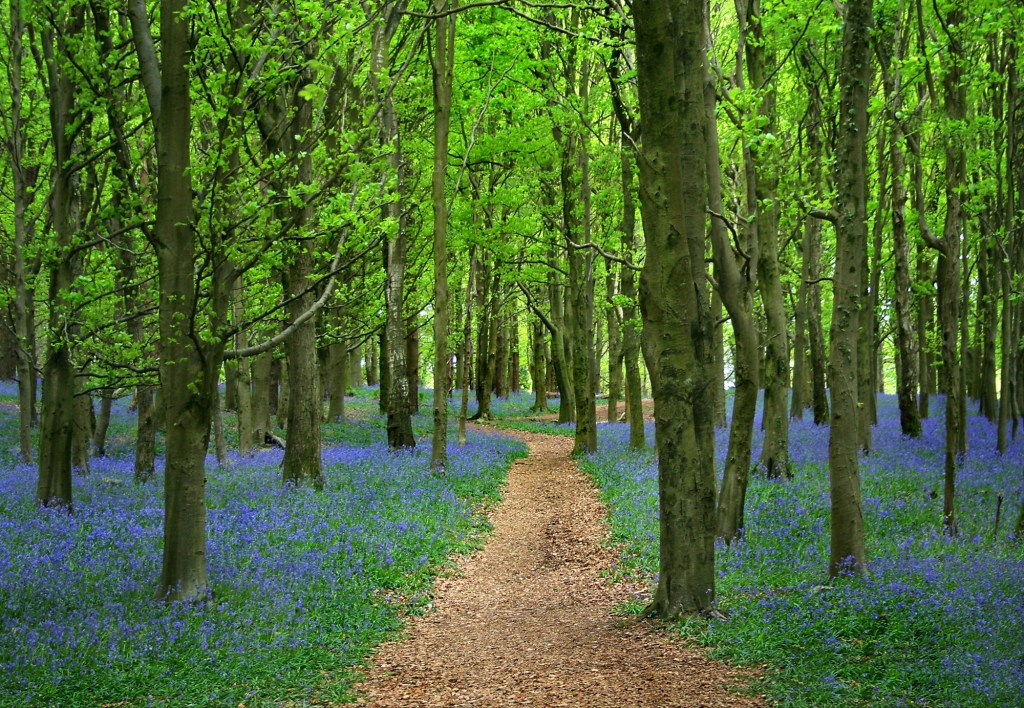
The air—it’s alive. It hums, doesn’t it? Or maybe it’s in my head. No, no, it’s real, vibrating in my chest, crawling through my skin like tiny electric sparks. Is this how air used to feel? Clean, wet, soft like velvet. Not the choking, recycled stuff, scraped thin by machines. My chest feels raw, unprepared for it, like I’ve swallowed something too pure for my body.
Pure Bliss
And the trees—heavens, the trees. They stretch forever, all the way up, vanishing into green shadows and sunlight, folding together like lace. Too tall. Too wide. Too much. My eyes can’t hold them all at once. I try. I can’t. I blink, and they shift, ripple, like they’re breathing. The bark, cracked and grooved like skin—no, like stone—but warmer, alive, alive, alive. My fingers press against it. It presses back. Does it know I’m here? Does it care?
I don’t trust this. It’s too perfect. Too much light, too much green, too much life. It’s like a story I heard when I was a kid. Forests with wolves and deer and wind that whispers. People who walked barefoot on the dirt, dirt that smelled like rain. It was a bedtime lie, wasn’t it? They said we killed it. Burned it. Paved it over and left it for dead. And yet here it is, here I am, knees sinking into the moss. Moss—soft like the fabric of dreams, cool under my palms.
Dream. Yes, that’s it. This is a dream. It has to be. A glitch. My mind spinning out, a defense mechanism. The tether’s broken, I see the matrix. I’ll wake up. I’ll wake up back in the gray, the hum of machines in my ears. No birds. No birds there. But I hear them here—high, sharp, calling out into the endless green. Birds. I almost laugh. They’re real. Or I’ve invented them. Can I invent sound this beautiful?
The smell—merciful earth, what is that smell? It’s dirt, yes, but sweeter, richer, like something blooming. Flowers? Do flowers have a smell? Not the ones we grew in the domes, sterile and waxy, pretty but hollow. These are alive, pulsing like veins in the air, like a thousand tiny hearts opening up at once. Too much. It’s too much. I close my eyes, but the forest doesn’t leave. It presses into me, through me, like it wants to crawl inside my lungs, nestle into my ribs
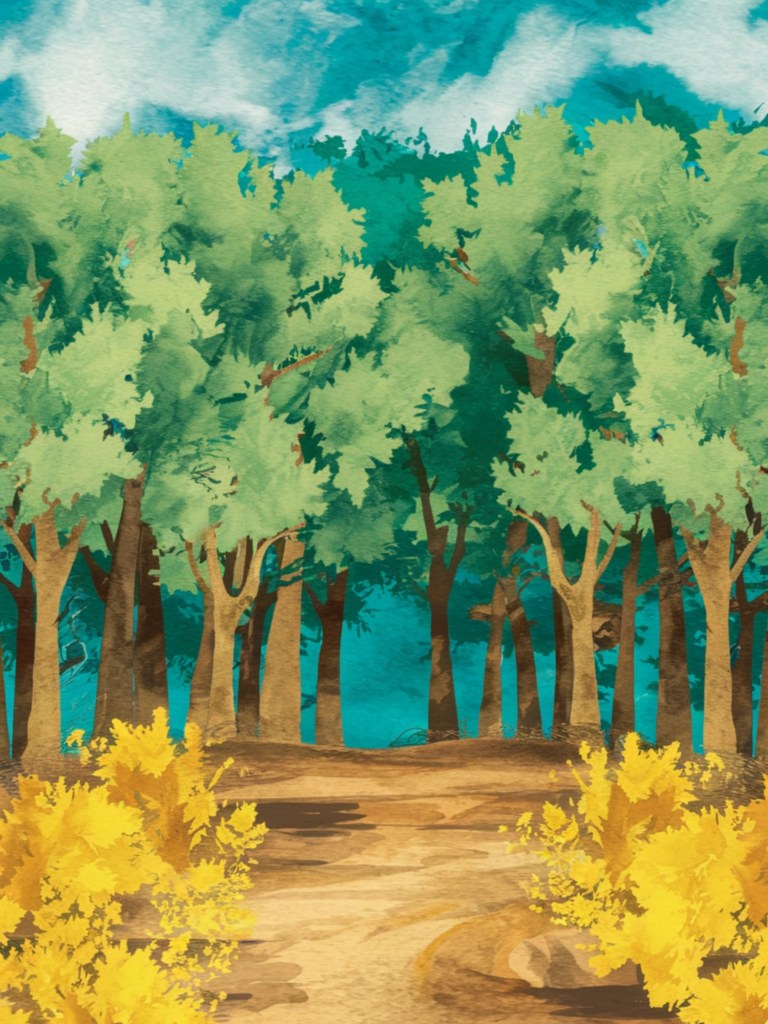
Woods Imagined
I can’t go back. How can I go back? They’ll laugh. They won’t understand. They’ll say, Oh, Aaron, the tether scrambled your mind. Forests? Sure. We had those. Once. And what did they do for us? They won’t smell this, feel this. They’ll never know how it moves, how it whispers. I could try to tell them, but the words wouldn’t come. They’re caught in my throat, tangled like the vines wrapping around the trees, twisting upward, desperate for the light.
The wind. It moves like a sigh, brushing my skin. It knows me. Does it know what I’ve come from? What I’ve left behind? I taste salt, but I’m not crying. Am I? Maybe the forest is crying. Maybe it remembers what’s coming. What’s already happened. Or maybe it’s laughing, laughing at me, a man from the hollow future, standing here like a ghost in a world too alive to make sense.
I sit. No, I collapse. My legs are shaking, useless. The moss takes me, cradles me like it’s been waiting. The air is thicker now, heavier, like it’s wrapping around me. A cocoon. I want to stay here. Let it swallow me whole. Let it keep me. The tether can break, and I’ll drift here forever, lost in this green dream.
A sound—a bird, maybe? Or a branch snapping. Too sharp to be the wind. I twist, searching, but there’s nothing, only more trees. Endless trees. Watching me. Whispering to me. I think I hear words. No, not words. Something older, deeper. The pulse of roots in the soil. The creak of branches holding the sky. They know. They know what we’ve done.
“I’m sorry,” I say aloud, my voice thin, swallowed by the forest. It feels like a lie. The words aren’t enough. Nothing is enough. My hand touches the ground—soft, cool, alive—and I want to sink into it, vanish into the earth like water. Let me stay. Let me forget what we became.
The wind rises again, stronger this time, carrying the scent of leaves and damp earth. It washes over me, through me. My head is heavy. My eyes close. I’m floating. No—sinking. Sinking into the moss, the soil, the hum of the trees. The air thickens around me, soft as a blanket.
“Let me stay,” I whisper, though I don’t know who I’m asking. The forest answers with silence, the kind that hums, vibrates, breathes. My chest aches with it. My heart beats too fast. Or maybe it’s slowing. Or maybe it’s the forest’s heart now, and mine is gone.
I’ll wake up soon, back in the gray. Won’t I? But the wind doesn’t let go. The moss holds tight. The light filters through my eyelids, green and gold, and I think—maybe I won’t wake up. Maybe I was never awake at all.
If you find this content inspiring and uplifting, consider supporting what I do. Buy me a coffee on Ko-fi. Your support makes a difference in my life and helps me create more of what you, and I, like. Thank you!Tap to view my redbubble gallery.
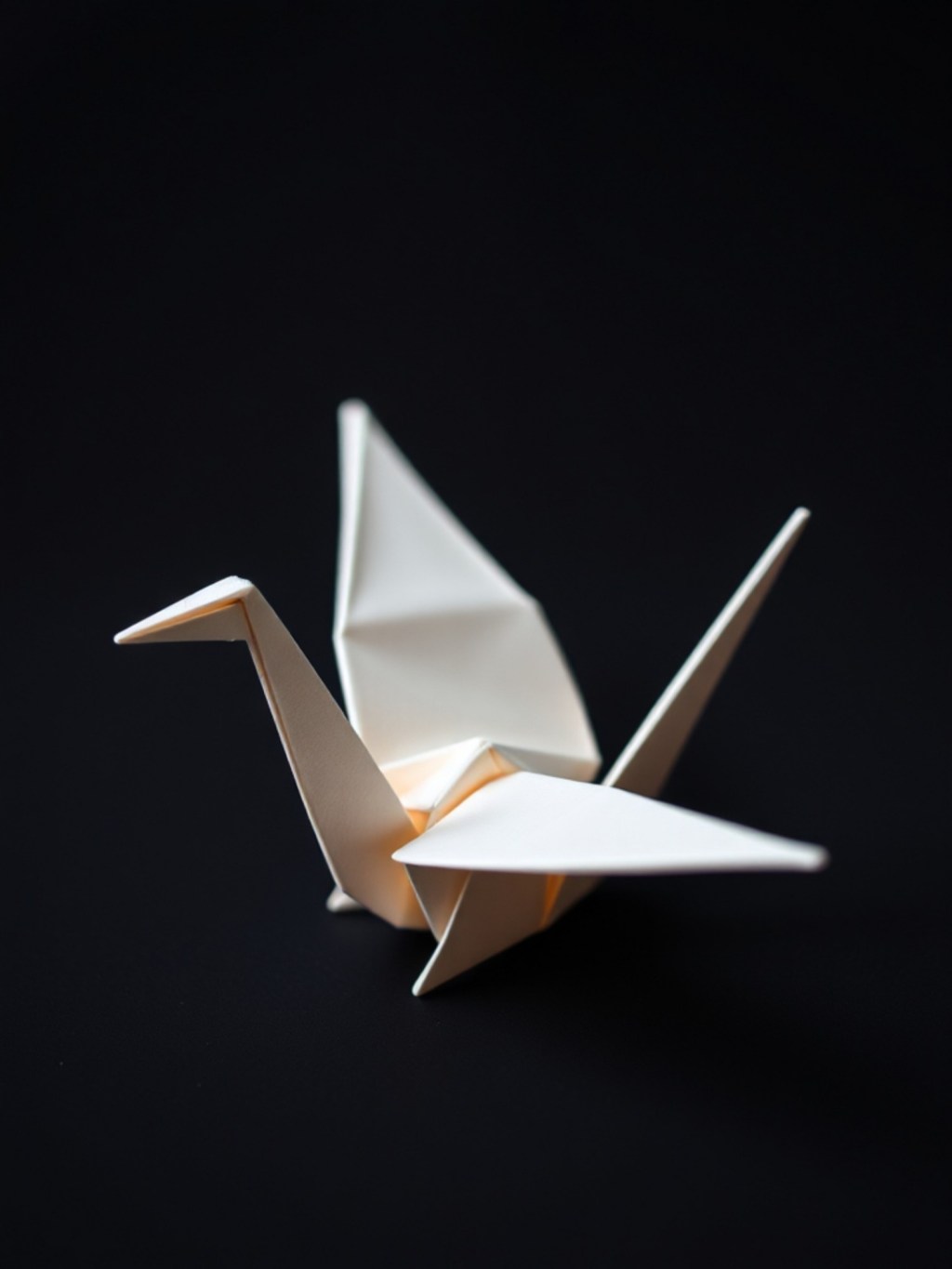
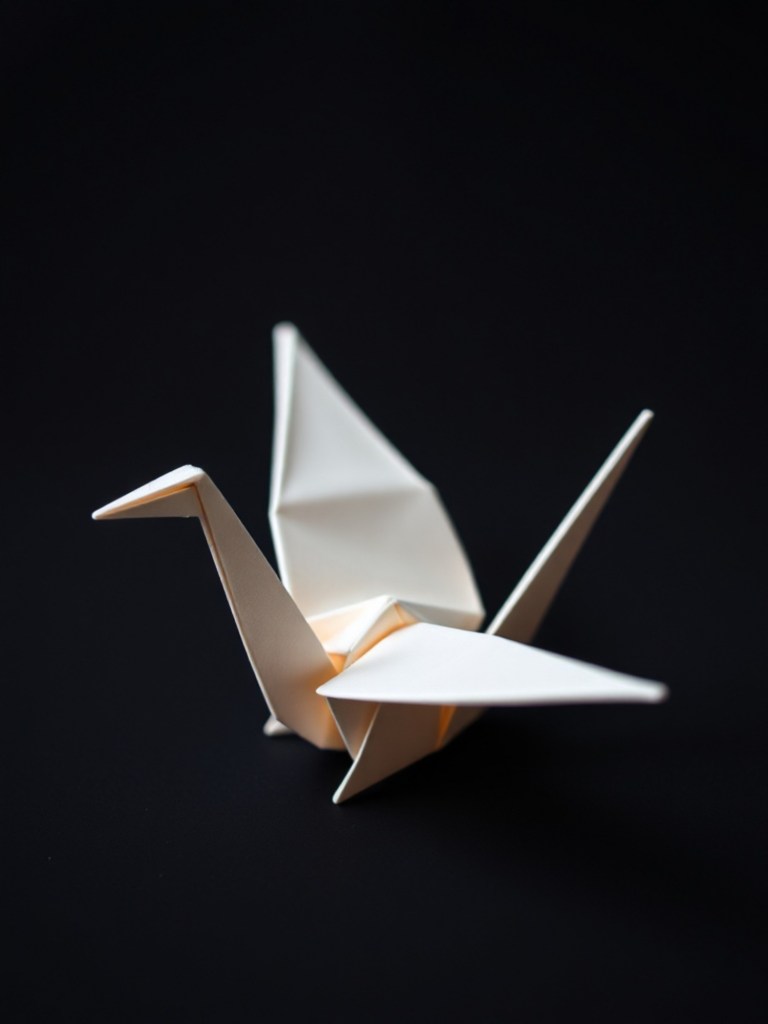
In my thirty-seventh year, the origami cranes began to speak to me. Not with words exactly, but in the way the paper would crease under my fingers, each fold a whisper of something I’d forgotten I knew.
I’d started folding them in the depths of what I can only call a peculiar darkness—the kind that seeps in slowly, like water through the walls of an aging house.
My wife had left two years before, taking her collection of jazz records and leaving behind only the mechanical tick of our Western-style clock and the ghost of John Coltrane’s saxophone that seemed to linger in the curtains. I spent my days translating technical manuals and my nights staring at the ceiling, counting the shadows that gathered there like memories I couldn’t quite grasp.
The first crane was an accident. I found the square of paper in my coat pocket—probably a receipt I’d meant to keep—and my hands remembered what my mind had forgotten from grade school. Muscle memory is strange that way, like a record that keeps playing even after the power goes out.
Every evening after that, I would fold one crane. Just one. The paper had to be exactly six inches square, and I would only use white paper, though sometimes in the lamplight it looked the color of moonlight on snow. I didn’t make wishes or count towards a thousand. I simply folded, letting my fingers find their way through the valleys and mountains of paper.
Strange things began to happen, as they often do in this world. The bakery down the street started giving me an extra pastry with my morning coffee. A cat with eyes the color of old coins began waiting for me outside my apartment. I found myself humming tunes I’d never heard before.
But the real change was in the space between breaths, in the moments when the paper seemed to fold itself, when the crane would look at me with its pointed paper eyes and I could feel something unfolding inside my chest—something that had been creased and compressed for so long I’d forgotten it was there.
One morning, I realized I couldn’t remember the last time I’d counted shadows on my ceiling. The darkness hadn’t disappeared—it had transformed, like paper under patient hands, into something with wings.
They say grace finds you in unexpected ways. For some, it comes in hymns or prayers or moments of divine intervention. For me, it came in squares of white paper and the quiet meditation of folding something beautiful out of nothing at all. Each crane was a small rebellion against chaos, a tiny perfect thing in an imperfect world.
Now, when people ask me why I still fold cranes—my apartment filled with their paper presence—I never quite know what to say. How do you explain that salvation sometimes comes not in grand gestures but in small, repeated acts of creation? That grace isn’t always amazing in the traditional sense, but in the way it sneaks up on you, one fold at a time, until you look up one day and realize you’ve learned to fly?
Tell me if you have an “origami crane” that has helped you.
If you find this content inspiring and uplifting, consider supporting what I do. Buy me a coffee on Ko-fi. Your support makes a difference in my life and helps me create more of what you, and I, like. Thank you!Tap to view my redbubble gallery.
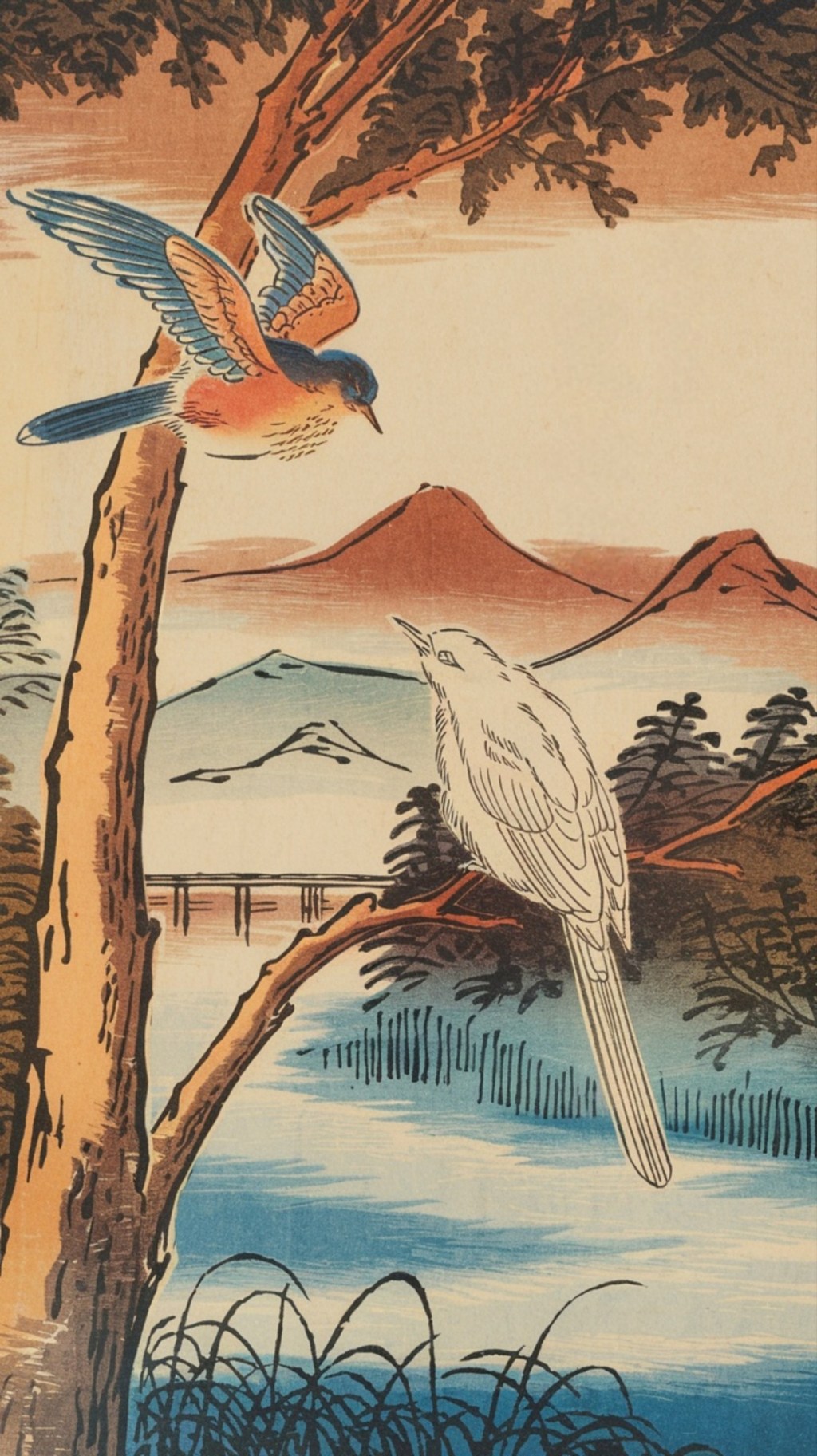
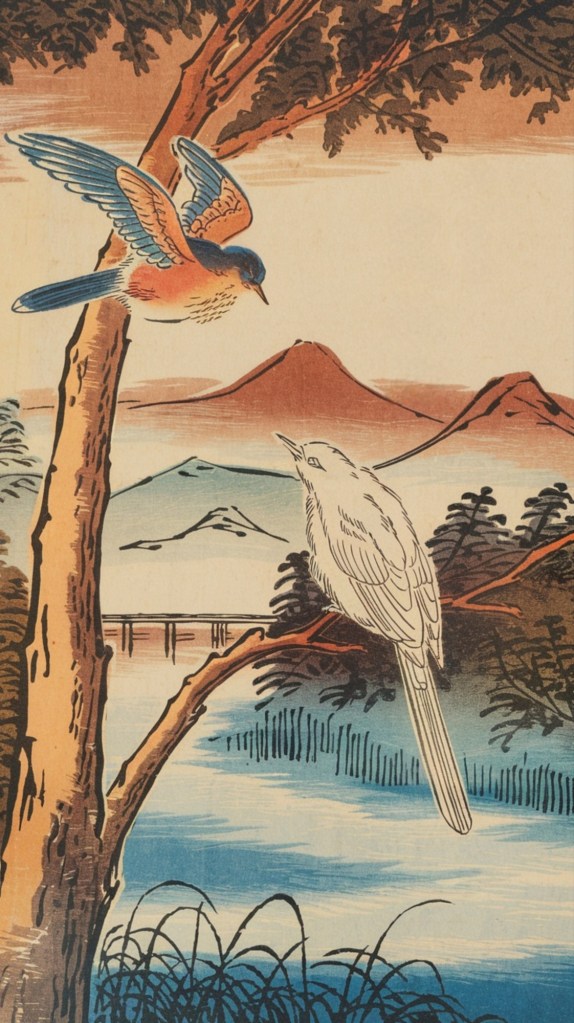
On the crooked branch of an old persimmon tree, two birds sat. Above them, the sky hummed with the thick silence that comes before rain. Below, the world stretched out in its tangled changing vastness — branches pushing into the air, rivers pulling toward the sea, everything moving, endlessly moving.
Coloured in
The older bird sat still, though her stillness was not absence but fullness, like a pebble on a riverbed. Her feathers flickered as the light moved through the leaves: verdigrised copper, smoldering reds, gold like old coins freshly dug from the heavy earth. Beside her, the younger bird shifted restlessly, her lines barely holding their shape. Her body was not feather but form, a sketch in soft charcoal, smudged at the edges where rain or doubt had touched her. She stared down at her faint chest, as hollow as a question half-asked.
“Mother,” she said suddenly, sharply, her voice like the crack of a twig snapping underfoot. “When will I have feathers like yours?” Her gaze darted toward her mother’s chest, to that molten glow of red-gold plumage. Her own outline flickered faintly, like breath on glass. “I’m tired of being incomplete.”
Her mother did not turn at first. She watched the wind, the movement of invisible things. She watched the unseen, as mothers often do. Then she shifted her gaze to her child, her eyes dark and soft as old ink.
“You think I was born like this?” she asked quietly, though there was no question in her voice. She lifted her wings, slowly, and they caught the light like embers stirred in ash. “These colours were not mine. They came to me. Rain gave me the gray. The sun laid gold on my back. The berries left their red behind. All of it stayed.” She lowered her wings, slow as the setting sun.
The pencil bird frowned, running her beak down her delicate frame, as if she could draw herself maor fully into the world. “But how?” she asked, her eyes wide and sharp with hunger. “How did it stay?”
Her mother turned fully now to her child, gaze like stone, gaze like earth, gaze like home. “I didn’t chase it,” she said. “I stayed. The storm comes. You stay. The sun burns. You stay. The world scratches at you with its teeth and thorns, but still, you stay.” Her beak tapped lightly against the bark of the branch. “You let it mark you.”
The faint bird flinched. *Let it mark me?* She glanced down at her pale, clean outline. There was nothing on her, nothing in her, but faint graphite lines. The world had not touched her. She had not let it.
“Fly,” her mother said, with the softness of rain before it falls.
“Where?” the juvenile bird asked, eyes darting upward to the open, terrifying sky.
“Anywhere.”
“And if I get lost?”
Her mother leaned closer, so close the faint breath of her voice swept across her daughter’s hollow cheek. “You will,” she said. “That is the only way you’ll know where you are.”
The child blinked, heart sharp and wild as a drumbeat. She glanced up at the vast, open sky, so full of directionless blue, then down at her faint, brittle wings. Her breath came fast and tight. *But I’m not ready,* she thought. *I’m still a sketch. I’ll disappear out there.*
But her mother had already tucked her beak into her chest, as though she had seen this all before and had said what needed to be said.
So the pencil bird spread her thin, hollow wings and leapt.
At first, it was bliss. The wind held her like a string cradles a kite. The sun dripped warmth down her back. *This is it,* she thought, turning in wide arcs, her shadow a pale outline below her. *This is what it means to fly.* She flew harder, faster, slicing through the air like a blade, her heart thudding with the thrill of it. *If I just keep flying, I’ll become real.*
But the world does not let anyone fly unmarked.
The clouds gathered with the heavy, aching slowness of something inevitable. At first, they were soft as wool, but soon they grew dense, sharp-edged, swollen with their own weight. The air thickened. The first drop of rain hit her back like a stone. Then another. Then hundreds.
*Go back,* she thought. *Go back to the branch. You’ll be ruined.* Her wings trembled. Her outline blurred, as though the rain was an eraser working her out of the world. She was dissolving, line by line, stroke by stroke. The old fear rose in her: *I will vanish.*
Her mother’s voice echoed through the storm, her voice like a huge murmuration of starling filling the air: *Don’t run from the storms.*
So she didn’t. She flew straight into the rain, her body battered by drops that felt like knives. Her wings shuddered. Her heart thudded in her head louder than the thunder. She thought she might fall. But she didn’t. She didn’t.
When she emerged from the storm, she landed on the branch of a cedar tree, breath heaving, wings shaking. She looked down at herself, expecting to see ruin, expecting to see the faint, hollow outline of a bird erased from existence. But there, on her back, was a streak of silver-gray, soft as the edge of a storm cloud.
*This wasn’t here before.*
She touched it, ran her beak over it. It didn’t smear. It stayed.
Time passed. It always does.
The days that followed were not kind. The sun baked her back until she felt her wings would burn away. Hunger gnawed at her until her chest ached, and when she landed near a thorny Briar, the thorns clawed at her wings. She bit into the wrong berry first — bitter, sharp, unbearable. She spat it out. But the next berry was sweet as honey. The red juice stained her beak, dripped down her chest. She wiped it away, but a faint rust-coloured mark stayed.
The sun gave her heat. The berries gave her red. The thorns gave her scars.
She flew beneath a hawk’s shadow, and when she escaped, her wing throbbed from the rake of its claws. The mark it left was not a wound. It was a line — faint, blue-black, permanent.
*When did I change?* she thought, glancing at herself one day. Her chest was no longer hollow. Her wings no longer weightless. The sketch of her was gone. Instead, she was filled with colour — shadow-gray, storm-blue, berry-red, thorn-black. She had not asked for any of it. But it had come to her all the same.
*This is what she meant.*
One evening, she returned to the persimmon tree. Her landing was sharp, deliberate, her wings folding in tight with the precision of something that has been tested. Her mother glanced up, gaze steady as ever.
“Back so soon?” her mother asked, eyes filled with quiet knowing.
The young bird glanced at her wings, her chest, her tail. She hadn’t realized it, but she no longer looked away from herself. Her feathers were no longer faint. No longer hollow. They were full, heavy with shadow and flame, earth and ash. She felt the weight of them, but it was not a burden. It was the weight of being real.
Her mother turned to face her fully now, tilting her head as if inspecting something distant and beautiful.
“Look at you,” she said softly. Her voice was full of something like pride, but older, deeper. Something like recognition.
The young bird flexed her wings. She saw it now — not just the colour but the story it told. The silver of the storm. The red of the berries. The blue of the hawk’s shadow. Her eyes burned, but not with tears. She could feel it all at once — the weight of the storm, the taste of the berries, the ache of the thorns — everything that had ever touched her was still with her, in her, as vivid as flame.
Her mother leaned in close, her beak at her cheek. “Welcome back,” she whispered.
They sat side by side as the sun spilled itself across the sky, orange into red, red into gold, gold into night. Their feathers caught the light as it passed, both of them burning softly in its glow.
Her mother’s eyes closed, content. The young bird glanced down at her chest once more, at the colours she had not chased but gathered, each one a mark of having stayed.
Her chest was not hollow anymore. And in that moment, she knew it never had been.
If you find this content inspiring and uplifting, consider supporting what I do. Buy me a coffee on Ko-fi. Your support makes a difference in my life and helps me create more of what you, and I, like. Thank you!Tap to view my redbubble gallery.
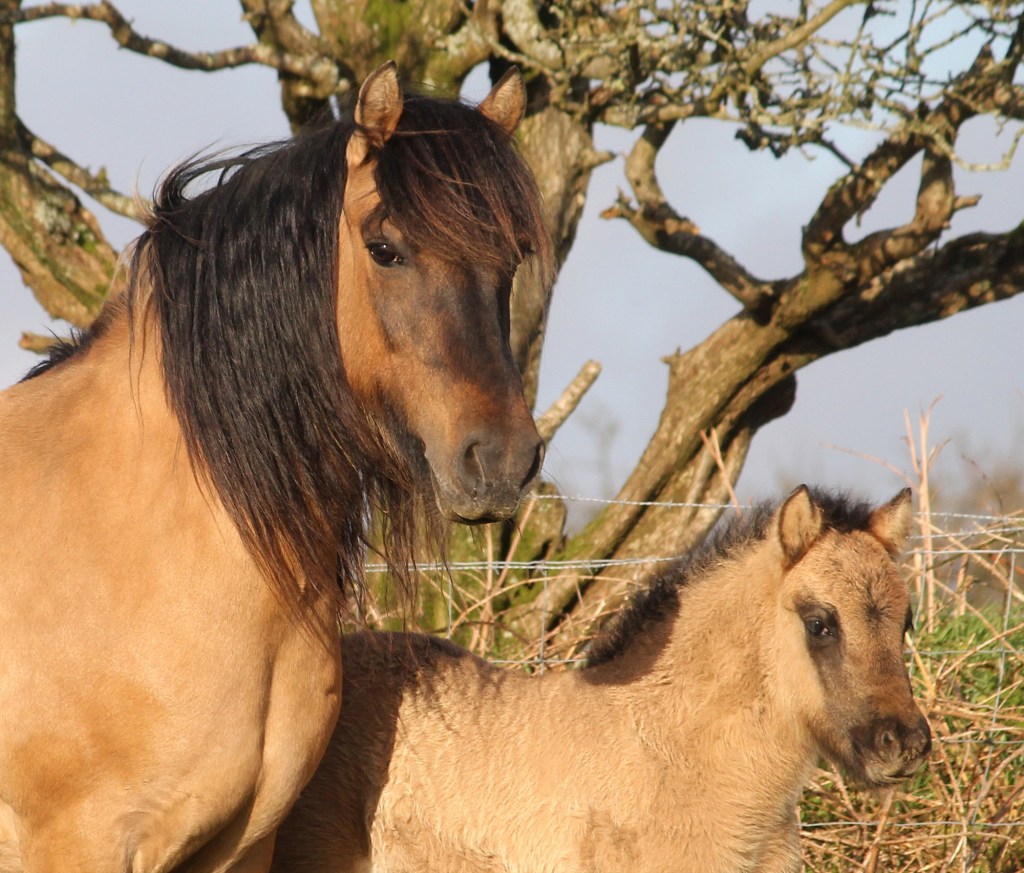
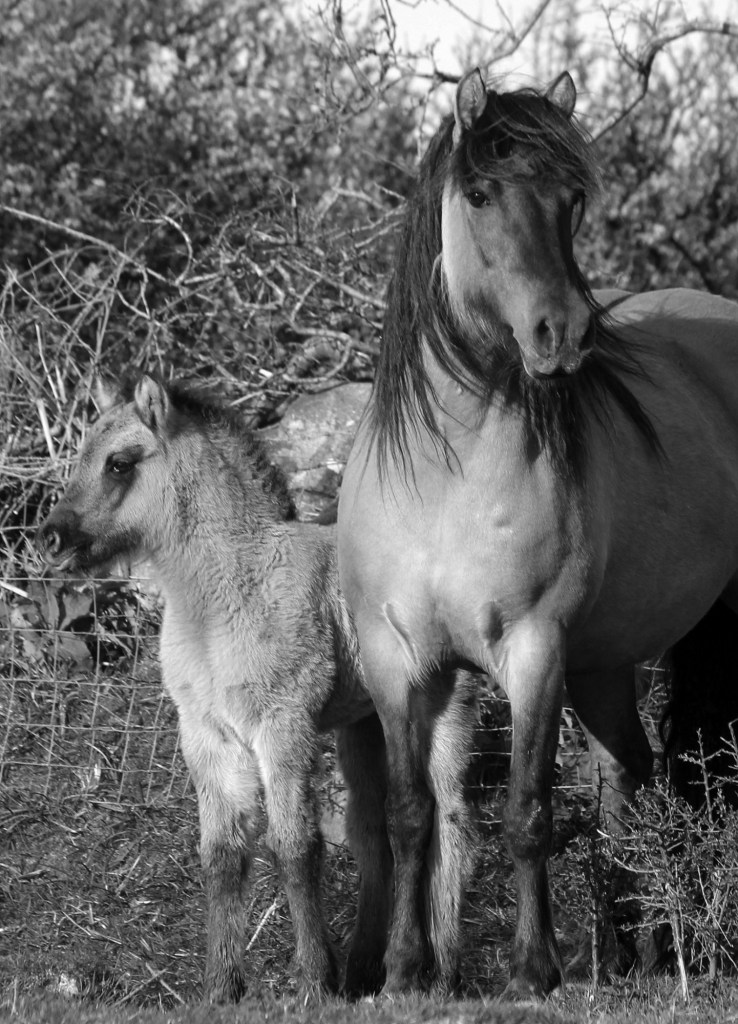
The foal bolted. Little streak of chaos, its legs seemed far too long and far too skinny to carry it as fast as it went, but there it was, defying reason, defying physics, defying the well-worn patience of its mother.
My friend’s horses
The mare sighed, the sound a mix of exasperation and resignation, the kind only mothers and gods know. She had been a mother before. She would be a mother again. But this foal, this particular foal, had a spark to it. A dangerous spark. She chased.
It was all fields at first. Bright fields, green as the idea of springtime, endless as optimism. The foal ran, leaping in arcs that could shame any rainbow. The mare followed, heart thrumming with equal parts fear and pride. The foal laughed—yes, laughed—and that laughter was an arrow to the mare’s chest. How could a laugh be so beautiful and so terrifying? She couldn’t explain it, but she knew. Every gallop brought the foal closer to something: a boundary, an edge, an end.
The woods came next. Dark and gnarled and full of secrets. The foal’s gait changed. Slower, but still determined. The mare followed, watching as her child learned to weave through brambles, sidestep dangers, and chase beams of light. There was a wolf once. The mare saw it before the foal did, and her heart stopped, her legs faltered. But the foal—clever little spark—saw it too, and instead of fear, it showed defiance. A stomp, a whinny, and the wolf slinked away. The mare breathed again, though not deeply. She didn’t have time for deep breaths anymore.
The foal found a river next. Fast and cold and impossible to stop. It charged headlong into the current, and the mare’s pulse spiked. Water was not grass, not earth. Water was a thief. It could take a foal and never give it back. She plunged in after, her hooves finding no purchase, only faith. The foal splashed and stumbled, and the mare thought: *this is the end*. But no. The foal found footing on the other side and pranced up the bank, triumphant. The mare dragged herself onto dry land, shaking and coughing, wondering how many more times she could survive her child’s survival.
Hills rose in the distance. The foal raced up the first with the energy of youth, the energy of something that didn’t know yet that energy runs out. The mare chased, slower now. Her legs ached. The foal reached the crest and reared up, silhouetted against a sun that suddenly seemed lower in the sky.
It was a horse now. Not a foal, not anymore. Strong and sleek, full of life. It ran down the hill into the valley below, and the mare followed. She was not strong and sleek. Not anymore.
The horse ran. Through fields again, these ones golden, full of a warmth that felt like goodbye. The mare tried to keep up, tried to call out, but her voice was a whisper and her legs were lead. The horse—her foal, her spark—didn’t stop, didn’t turn. It ran into the horizon, where the sun sank lower, lower, gone.
The mare stood still. She couldn’t run anymore. Her body wouldn’t let her. But she watched. She would always watch. Because that’s what mothers do. They run after their children until they can’t, and then they stay where they are, watching, hoping, remembering.
And then, after a long while, the mare lay down in the field. It was soft. Softer than she expected. She closed her eyes.
And the foal, who was never a foal, who was always running, always running, ran on.
If you find this content inspiring and uplifting, consider supporting what I do. Buy me a coffee on Ko-fi. Your support makes a difference in my life and helps me create more of what you like. Thank you!Tap to view my redbubble gallery.
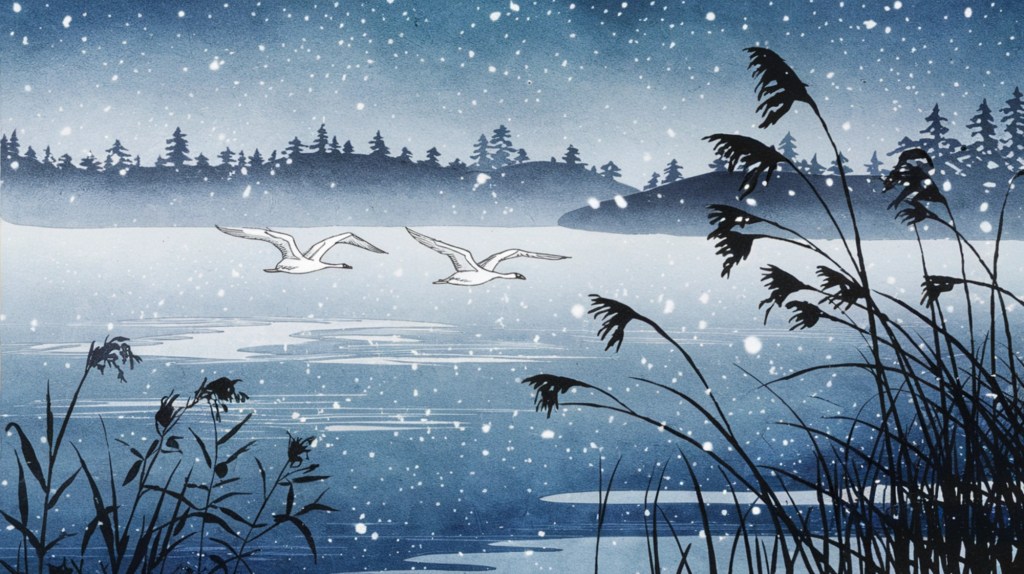
Ice covers the lake Swans sing of what they’ve forgotten— Silent wings remember.
On a brittle December morning, Yuki stood at the edge of the frozen lake. The air felt sharp, like the edge of a paper freshly torn, and the snow under her boots crackled softly. In the distance, two swans flew low over the water, their wings slicing the pale winter light. She watched them, transfixed, as they moved in perfect unison, like dancers following an invisible thread.
Yuki had come to the lake every winter since she could remember, drawn by something she couldn’t name. She wasn’t the sort of person who believed in omens or ghosts. But there was a weight in the air here, a kind of gravitational pull, as if something important had happened long ago and the echo of it still hung in the frozen reeds.
The swans flew in a slow arc, circling the lake as if searching for something lost. Then, without warning, one of them let out a low, mournful cry. It wasn’t a sound Yuki had ever heard before—not quite bird, not quite human. The sound folded into the winter air, spreading out across the lake in waves. She felt it in her chest, as if the cry had carved out a hollow space there and filled it with snow.
“You heard it too, didn’t you?”
The voice startled her. She turned and saw an old man standing a few feet away, bundled in a dark coat that hung loose around his frame. His face was pale and deeply lined, like a map of forgotten places.
“The swan’s song,” he said, nodding toward the lake. “Not many people can hear it.”
Yuki hesitated, unsure if she should answer. “It sounded… sad,” she said finally.
The man chuckled softly, a dry, papery sound. “That’s because it is. They only sing like that in winter, you know. When they remember.”
“Remember what?”
He didn’t answer right away. Instead, he gazed out at the swans, now gliding silently over the water. “There’s a story about this lake,” he said after a while. “A strange one. Do you want to hear it?”
Yuki nodded, though she wasn’t sure why.
“They say that long ago, this was a place where people came to forget. The lake would take your memories, all of them, and bury them beneath the ice. Some people came willingly, hoping to escape grief or regret. Others were brought here against their will, their memories stolen as punishment for something they’d done. Either way, the lake kept their secrets.
“But memory is a stubborn thing. It doesn’t just disappear. It sinks, yes, but it doesn’t die. And in the winter, when the lake freezes over, those lost memories rise to the surface. That’s what the swans are singing about. They’re the ones who guard the memories, you see. They carry them in their wings, their feathers, their song. But the burden is heavy. Too heavy. So every winter, they cry out. Not to us, but to each other. To say: *I remember too.*”
The man fell silent. Yuki stared at the swans, her breath fogging in the cold air. The idea was absurd, of course. Swans as guardians of forgotten memories? And yet, the longer she watched them, the more she felt that there was something beneath their wings, something vast and unseen, like the dark waters beneath the ice.
When she turned back, the man was gone. There were no footprints in the snow where he had stood.
For weeks afterward, Yuki couldn’t stop thinking about the swans and their song. She returned to the lake every day, but the man never reappeared, and the swans remained silent. Still, she felt as if the lake had left something inside her, a quiet ache she couldn’t name.
Late one night, she dreamed of flying over the lake, her body weightless and cold. She could hear the swans crying below her, their voices weaving together in a language she almost understood. When she woke, her pillow was damp, and her throat ached, as if she had been singing in her sleep.
It wasn’t sadness, exactly, that stayed with her after that. It was more like a memory of sadness, something faint and indistinct, like the outline of a figure walking away through falling snow.
And every winter after, when she heard the distant cry of the swans, she would pause, her breath catching in her chest, and wonder what it was they were trying to say.
Let me know how this piece leaves you feeling and what it makes you think about.
If you find this content inspiring and uplifting, consider supporting what I do. Buy me a coffee on Ko-fi. Your support makes a difference in my life and helps me create more of what you like. Thank you!Tap to view my redbubble gallery.
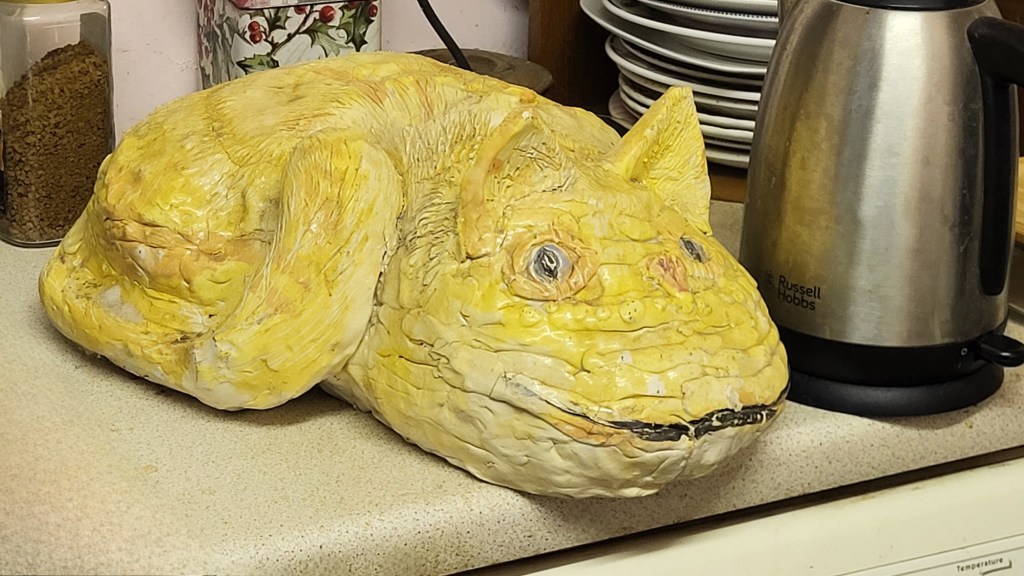
A riddle here, a riddle there, Cithrus vanishes in mid-air. A wink, a grin, a fleeting sound, He’s nowhere, but still all around.
Teabag Puss
This ceramic CheshireCat sits in my kitchen, watching over my tea bags, its sly grin watching me each time I make a cup of tea. A gift from a little old lady at a curious antique shop—it did more than decorate my home—it ignited my imagination. Staring into its mischievous eyes, I couldn’t help but wonder: what is the story behind this enigmatic creature? What brought it to the tangled paths of Wonderland, and why does it wear that eternal grin? Thus began the tale I wove for it.
Long before Wonderland became the chaotic realm Alice stumbled into, it was a serene, magical land brimming with balance. The Cheshire Cat was not always a smiling phantom; once, he was a young feline with fur as ordinary as the ones who lounge under sunny trees. His name was Cithrus, and he belonged to a powerful family of mystics known as the Moonlit Council. These beings were guardians of Wonderland’s equilibrium, able to manipulate its surreal laws to protect the harmony between whimsy and reason.
Cithrus, however, was different. He was curious about the parts of Wonderland others feared or ignored—the uncharted lands where time had no meaning, the forests where trees whispered riddles, and the skies where stars swapped places on a whim. His unrelenting curiosity often brought trouble, as he frequently bent the rules of their order, pushing Wonderland to the brink of chaos with his experiments.
One day, Cithrus discovered a mysterious rift deep in the Everlaughing Woods, a place where laughter echoed but no soul could be seen. This rift pulsed with forbidden magic, a source of limitless possibility but terrible consequence. Against the warnings of his kin, Cithrus ventured inside. The magic of the rift granted him extraordinary powers, transforming him into the shape-shifting, grinning being we now know. He could now vanish at will, hover in midair, and see truths others couldn’t fathom. But the magic came at a cost—his physical form began to fade, and his emotions detached from the constraints of mortality.
Banished from the Moonlit Council for his recklessness, Cithrus roamed Wonderland as an outsider. Rather than despair, he embraced his new existence, relishing in the freedom and absurdity of his world. Over time, his wit, riddles, and sly demeanor made him a guide of sorts to those who wandered into Wonderland. Some said he loved unraveling people’s minds with his cryptic wisdom; others believed he simply enjoyed the company, as strange and fleeting as it was.
The Cheshire Cat’s perpetual grin, some say, is his way of masking the loneliness of being unanchored in a nonsensical world. Others argue it’s a celebration of the chaos he unleashed—his way of reminding Wonderland that rules, like smiles, can disappear in an instant.
As I walk from the room, feeling the ceramic cat’s eyes on me, I smile at the thought of Cithrus, once a seeker of knowledge, now an eternal enigma. Perhaps he’d approve of my story. Whatever happens, I’m sure he’s already smiling, pleased that his legend continues to grow.
If you find this content inspiring and uplifting, consider supporting what I do. Buy me a coffee on Ko-fi. Your support makes a difference in my life and helps me create more of what you like. Thank you!Tap to view my redbubble gallery.
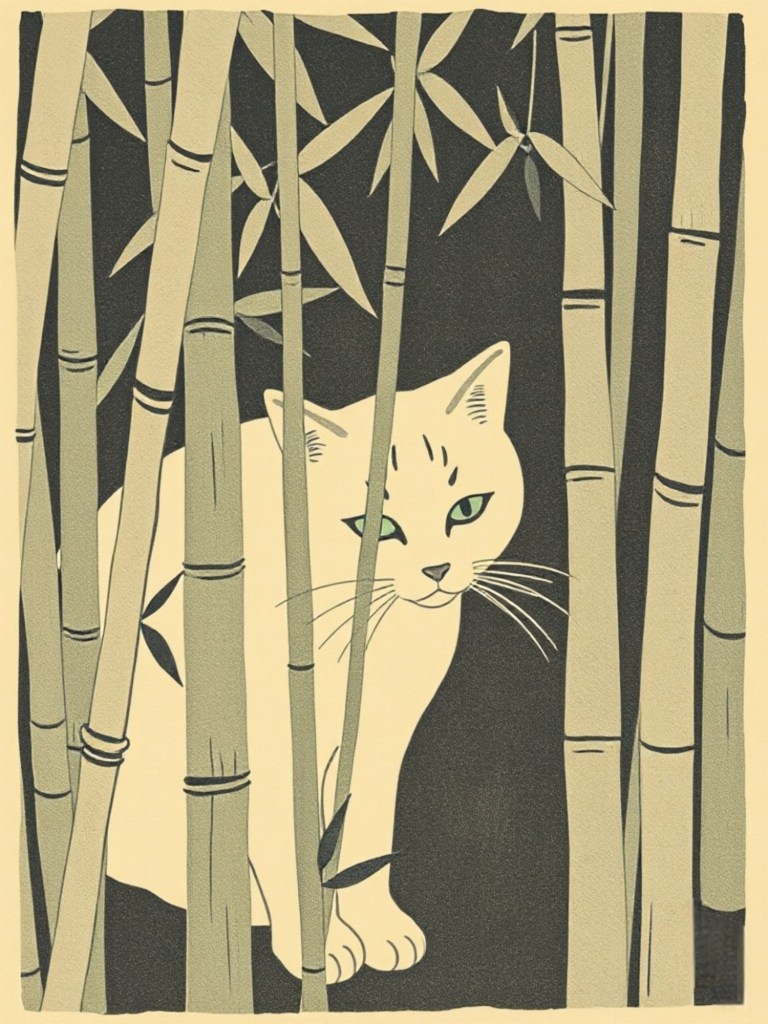
Let’s talk about cats and humans. Specifically, how the furry little weirdos somehow manage to strut through life like the universe is their personal concierge, while we humans spiral into a bottomless pit of “What ifs” and “Oh no’s.” It’s like we got the short end of the cosmic stick when it comes to outlooks. Cats? They’re pronoia personified (or catified?), blissfully convinced the world is out to shower them with treats, cozy napping spots, and adoration. Meanwhile, humans are busy clutching their tin-foil hats, muttering about how the universe is definitely planning something nefarious.
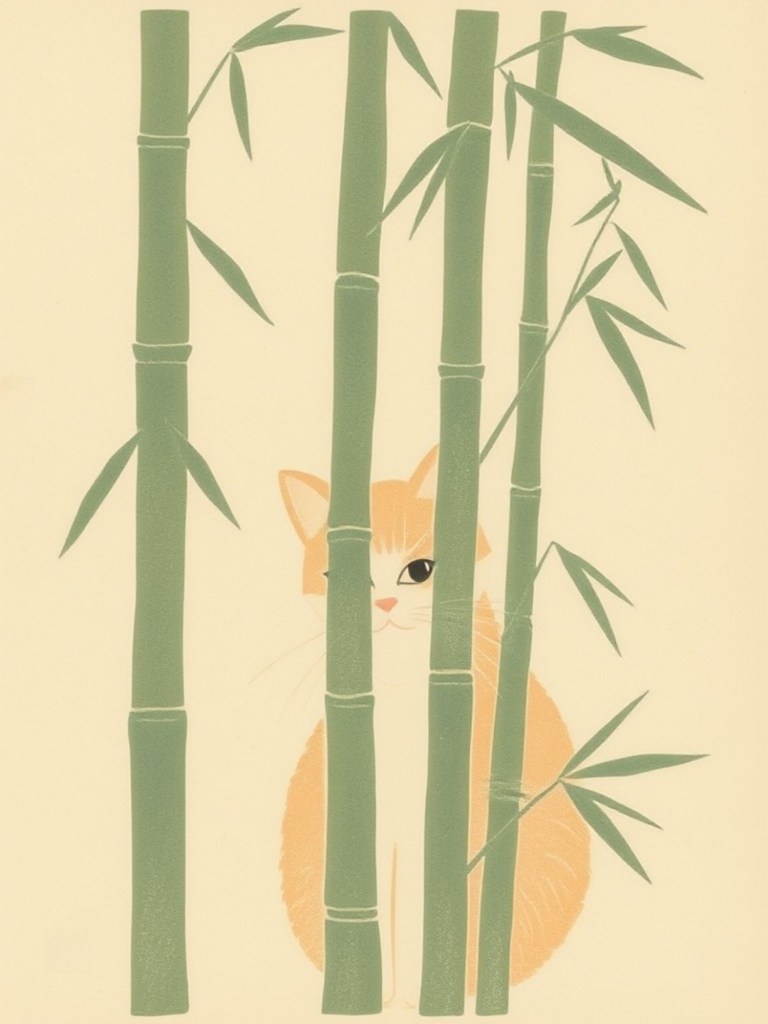
Peekaboo
Pronoia (noun) /ˌproʊˈnɔɪ.ə/ The belief or sense that the universe is conspiring in your favor, actively working to bring you good fortune, happiness, and opportunities. Example: “With pronoia guiding their every move, the cat confidently sat under the table, certain that a piece of ham would eventually fall just for them.” (Contrast with paranoia, the belief that the universe is conspiring against you.)
Picture this: You’re in your kitchen, minding your own business, and you drop a piece of ham. Before you can even say “five-second rule,” your cat materializes out of thin air like a tiny, furry magician. In their mind, that ham didn’t just *fall*—it was delivered. A gift from the cosmos, just for them. And if you try to take it back? Well, prepare for a look that could wither your soul. Cats don’t believe in accidents; they believe in destiny. Specifically, *their* destiny, where everything good inevitably flows their way.
I can see you
Now, contrast that with us. You drop the same ham, and what’s your first thought? “Oh no, what if it’s contaminated?” Or maybe, “What if someone saw me? Do I look clumsy?” Or, if you’re me, it’s “Great, now the ham gods are angry.” See the difference? Cats assume life is working for them. We assume life is conspiring against us. And honestly, I’m not saying cats are smarter than us, but they’re definitely less stressed.
I once read this article about how humans are hardwired for paranoia because it helped our ancestors survive. You know, spotting saber-toothed tigers lurking in the bushes or deciding not to eat the funny-looking berries that made Cousin Oog act a little too “creative” at the last cave party. But here’s the thing: there are no saber-toothed tigers anymore. There’s just email. And deadlines. And the horrifying realization that your boss read your Slack message but hasn’t replied yet. We’ve evolved past the berries, but not the spiraling.
Cats, though? They didn’t get the memo. They’re still out here living their best pronoid lives. Ever seen a cat climb into a box? It’s not just a box—it’s a castle, a fortress, a space shuttle to Mars. Every shadow on the wall is an adventure. Every sunbeam is a spotlight meant to highlight their glory. Cats genuinely believe they’re the Beyoncé of mammals, and honestly? They’re not wrong.
Meanwhile, humans are sitting here going, “What if my box collapses? What if the sunbeam’s carcinogenic? What if someone thinks I look stupid climbing into this metaphorical box?” It’s exhausting. We’re exhausting. I once saw my cat chase a moth for twenty minutes, miss it entirely, and still walk away looking smug, like *not* catching it was the plan all along. Can you imagine if we lived like that? If we just shrugged off our failures and strutted away like, “Yeah, that’s exactly how I wanted it to go”?
Here’s the kicker, though: maybe we could learn a thing or two from cats. Not the part where they knock your water glass off the table just to prove they can—nobody needs that kind of chaos energy—but the part where they genuinely believe the world is a good place. Maybe the universe isn’t out to get us. Maybe it’s just dropping random pieces of ham, and it’s up to us to decide if it’s a gift or a trap.
So next time life hands you a metaphorical ham slice, channel your inner cat. Take it, eat it (unless it’s actually on the floor; we’re not savages), and assume it’s exactly what you deserve. Because honestly? It probably is.
If you find this content inspiring and uplifting, consider supporting what I do. Buy me a coffee on Ko-fi. Your support makes a difference in my life and helps me create more of what you like. Thank you!Tap to view my redbubble gallery.
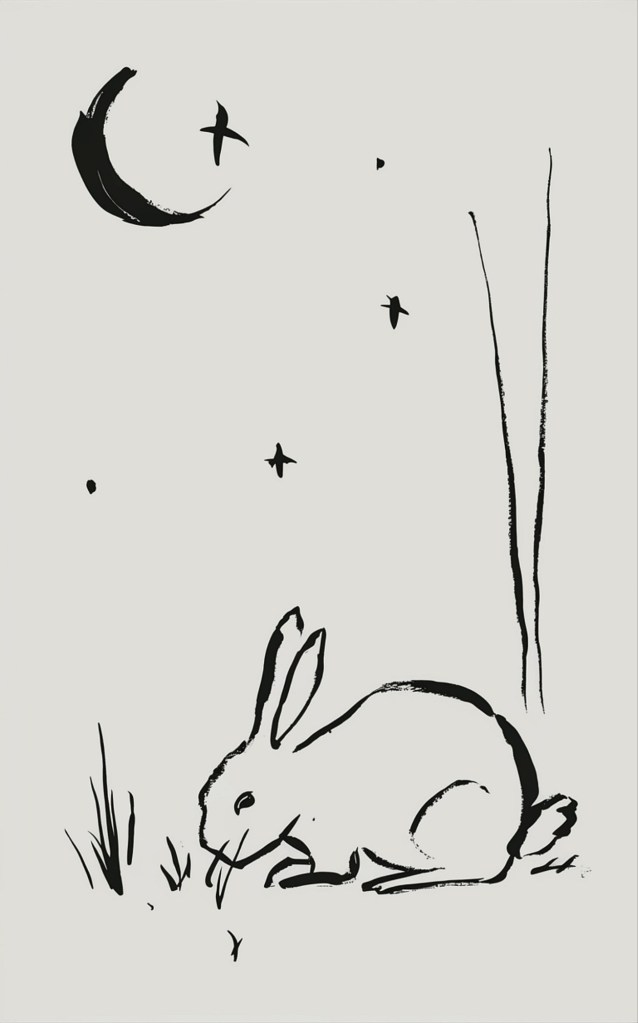


 Horse’s steady gazeStrengthful eyes that dare to meetChallenge accepted Courage is the strength to face… Read more: Darkness, Power and Beauty
 Daffodil so brightGolden petals, sunshine’s kissHope blooms anew As I wander through the garden, the… Read more: The Daffodil’s Song: A Lyrical Tribute to the Wonders of Spring
 The Graceful Lines of an Acanthus Leaf. Acanthus is a genus of flowering plants native… Read more: Acanthus: A Versatile Plant with a Rich Cultural Heritage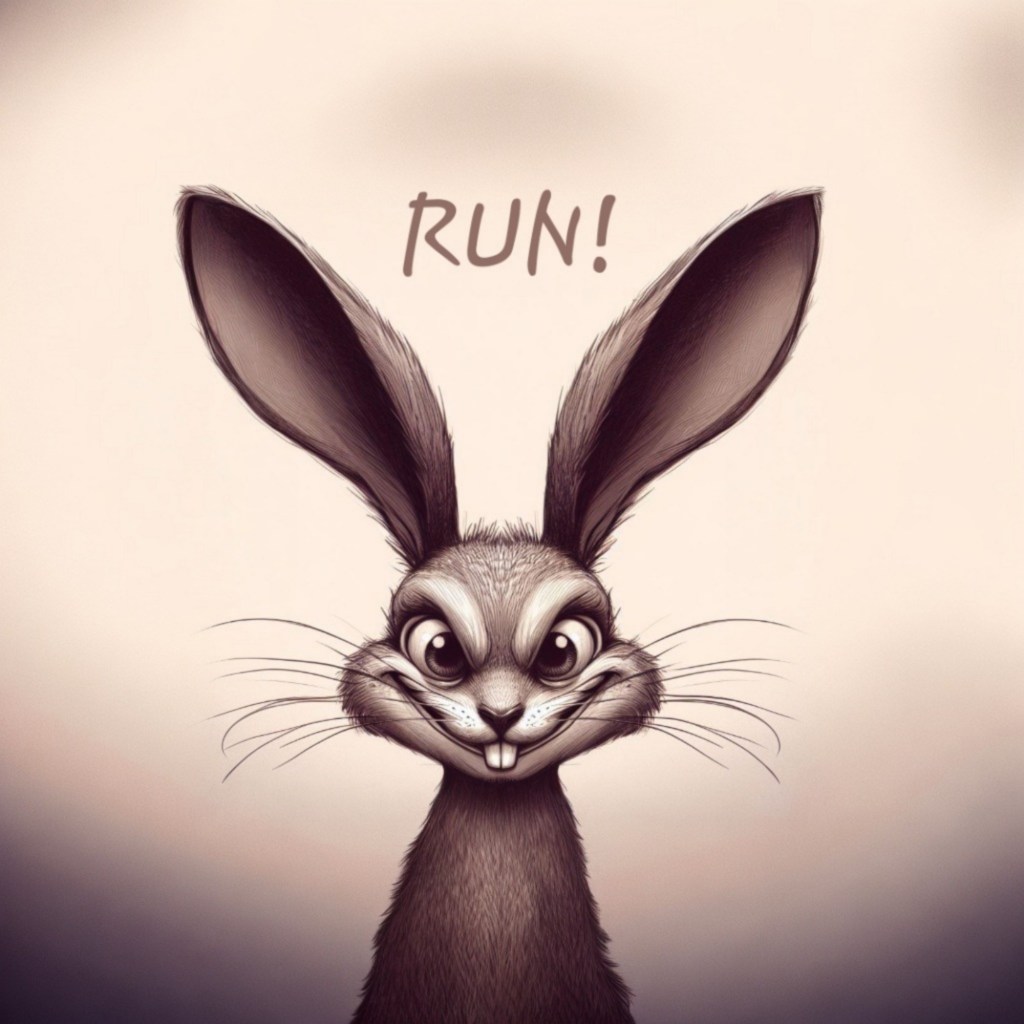

 Anthony's Literary Lens
You must be logged in to post a comment.