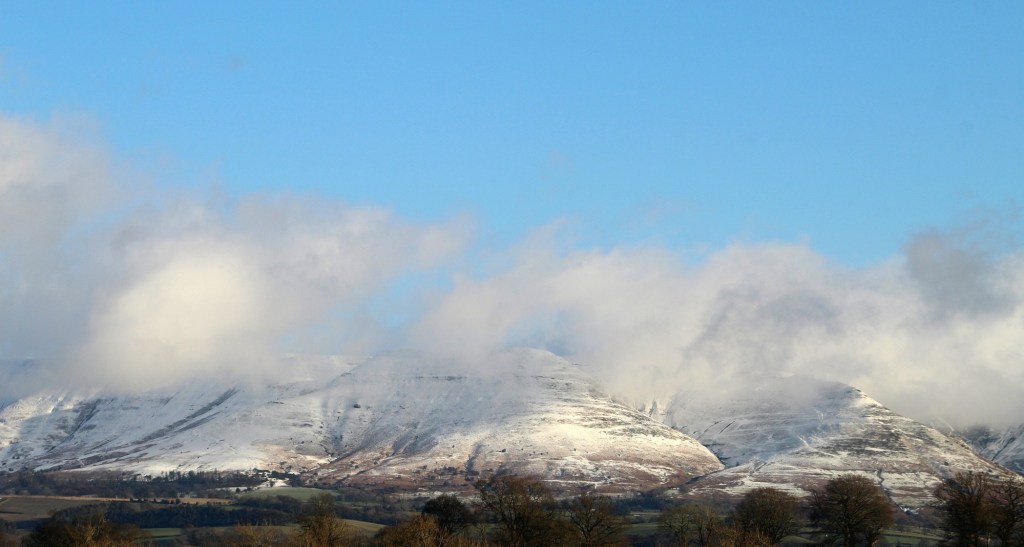
The Brecon Beacons loomed in the distance, their snow-capped peaks smudged by a veil of mist. I snapped a picture from the base, and the image felt as though I was staring at an unattainable dream—a far-off cathedral built for gods, not mortals like me.
Brecon Beacons January 2025
The peaks seemed untouchable, enshrined in a kind of holy fog, as if they were hiding some secret I wasn’t meant to know. But what else could I do? I tightened my laces and started walking.
The trail began innocently enough, a gradual incline, a whisper of mud clinging to my boots, and the wind humming a tune, as if to say ‘this place is not for you’. Step by step, the Beacons grew taller and stranger. The snowline hovered above me like an unspoken threat, a reminder that everything good in life comes with its sharp edges and cold hands. I wondered if I’d even make it. I wondered now why I’d started at all.
Somewhere just below the snowline, I stopped to catch my breath. That’s when I saw it. A deer. Small, delicate, its legs like question marks frozen in mid-thought. It stared at me for a moment, eyes wide, then leapt away into the trees, vanishing like a memory you can’t quite hold onto. I watched the spot where it disappeared, as if waiting for it to come back and explain itself. But it didn’t. And why should it? Some things are meant to be glimpsed, not understood.
Snow-capped peaks above, Cold trials test weary feet— I walk through the doubt.
The higher I climbed, the thicker the mist became. I felt like I was walking into a dream, one of those nonsensical ones where the setting changes as soon as you think you’ve figured it out. The snow crunched under my boots, and the world shrank to the size of my next step. The peaks I had seen from below were gone, swallowed by the fog. For a while, I thought I might be swallowed, too.
It was harder than I thought it would be, and I wasn’t sure I’d make it. But isn’t that how life feels sometimes? Like you’re staring up at some impossibly high peak, the path ahead hidden in mist, and every step forward feels like a gamble. But still, you keep going. Not because you’re sure you’ll make it, but because there’s nowhere to turn back to.
Then, suddenly, I was there. The mist broke like a spell lifting, and the summit unfolded in front of me. The snow glittered in the sunlight, and the peaks stretched out like an unrolled map. It was vast and beautiful and sharp-edged, and for the first time in hours, I felt like I could breathe.
Looking back down the trail, I thought of the image I’d taken at the base. That distant, unreachable peak was now beneath my feet. The mist that had seemed so impenetrable was gone, burned away by nothing more than time and effort. I thought about the deer, how it had stopped just long enough to remind me that there is beauty in the world and how it had raised my spirits to keep going.
The walk back down was easier, as it always is. But I couldn’t stop thinking about how the summit had felt. Like a small, personal victory. Like proof that the peaks in life—the ones that feel impossibly far away, hidden by fog and fear—are often closer than we think.
You just have to keep walking.
If you find this content inspiring and uplifting, consider supporting what I do. Buy me a coffee on Ko-fi. Your support makes a difference in my life and helps me create more of what you, and I, like. Thank you!Tap to view my redbubble gallery.
The air—it’s alive. It hums, doesn’t it? Or maybe it’s in my head. No, no, it’s real, vibrating in my chest, crawling through my skin like tiny electric sparks. Is this how air used to feel? Clean, wet, soft like velvet. Not the choking, recycled stuff, scraped thin by machines. My chest feels raw, unprepared for it, like I’ve swallowed something too pure for my body.
Pure Bliss
And the trees—heavens, the trees. They stretch forever, all the way up, vanishing into green shadows and sunlight, folding together like lace. Too tall. Too wide. Too much. My eyes can’t hold them all at once. I try. I can’t. I blink, and they shift, ripple, like they’re breathing. The bark, cracked and grooved like skin—no, like stone—but warmer, alive, alive, alive. My fingers press against it. It presses back. Does it know I’m here? Does it care?
I don’t trust this. It’s too perfect. Too much light, too much green, too much life. It’s like a story I heard when I was a kid. Forests with wolves and deer and wind that whispers. People who walked barefoot on the dirt, dirt that smelled like rain. It was a bedtime lie, wasn’t it? They said we killed it. Burned it. Paved it over and left it for dead. And yet here it is, here I am, knees sinking into the moss. Moss—soft like the fabric of dreams, cool under my palms.
Dream. Yes, that’s it. This is a dream. It has to be. A glitch. My mind spinning out, a defense mechanism. The tether’s broken, I see the matrix. I’ll wake up. I’ll wake up back in the gray, the hum of machines in my ears. No birds. No birds there. But I hear them here—high, sharp, calling out into the endless green. Birds. I almost laugh. They’re real. Or I’ve invented them. Can I invent sound this beautiful?
The smell—merciful earth, what is that smell? It’s dirt, yes, but sweeter, richer, like something blooming. Flowers? Do flowers have a smell? Not the ones we grew in the domes, sterile and waxy, pretty but hollow. These are alive, pulsing like veins in the air, like a thousand tiny hearts opening up at once. Too much. It’s too much. I close my eyes, but the forest doesn’t leave. It presses into me, through me, like it wants to crawl inside my lungs, nestle into my ribs
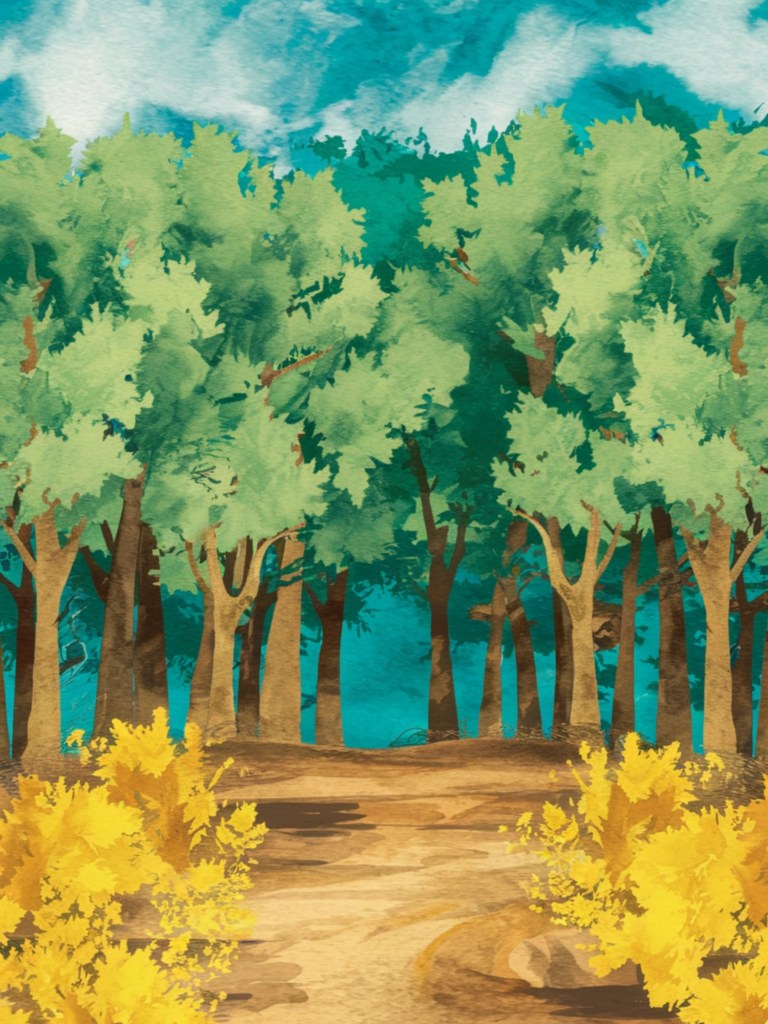
Woods Imagined
I can’t go back. How can I go back? They’ll laugh. They won’t understand. They’ll say, Oh, Aaron, the tether scrambled your mind. Forests? Sure. We had those. Once. And what did they do for us? They won’t smell this, feel this. They’ll never know how it moves, how it whispers. I could try to tell them, but the words wouldn’t come. They’re caught in my throat, tangled like the vines wrapping around the trees, twisting upward, desperate for the light.
The wind. It moves like a sigh, brushing my skin. It knows me. Does it know what I’ve come from? What I’ve left behind? I taste salt, but I’m not crying. Am I? Maybe the forest is crying. Maybe it remembers what’s coming. What’s already happened. Or maybe it’s laughing, laughing at me, a man from the hollow future, standing here like a ghost in a world too alive to make sense.
I sit. No, I collapse. My legs are shaking, useless. The moss takes me, cradles me like it’s been waiting. The air is thicker now, heavier, like it’s wrapping around me. A cocoon. I want to stay here. Let it swallow me whole. Let it keep me. The tether can break, and I’ll drift here forever, lost in this green dream.
A sound—a bird, maybe? Or a branch snapping. Too sharp to be the wind. I twist, searching, but there’s nothing, only more trees. Endless trees. Watching me. Whispering to me. I think I hear words. No, not words. Something older, deeper. The pulse of roots in the soil. The creak of branches holding the sky. They know. They know what we’ve done.
“I’m sorry,” I say aloud, my voice thin, swallowed by the forest. It feels like a lie. The words aren’t enough. Nothing is enough. My hand touches the ground—soft, cool, alive—and I want to sink into it, vanish into the earth like water. Let me stay. Let me forget what we became.
The wind rises again, stronger this time, carrying the scent of leaves and damp earth. It washes over me, through me. My head is heavy. My eyes close. I’m floating. No—sinking. Sinking into the moss, the soil, the hum of the trees. The air thickens around me, soft as a blanket.
“Let me stay,” I whisper, though I don’t know who I’m asking. The forest answers with silence, the kind that hums, vibrates, breathes. My chest aches with it. My heart beats too fast. Or maybe it’s slowing. Or maybe it’s the forest’s heart now, and mine is gone.
I’ll wake up soon, back in the gray. Won’t I? But the wind doesn’t let go. The moss holds tight. The light filters through my eyelids, green and gold, and I think—maybe I won’t wake up. Maybe I was never awake at all.
If you find this content inspiring and uplifting, consider supporting what I do. Buy me a coffee on Ko-fi. Your support makes a difference in my life and helps me create more of what you, and I, like. Thank you!Tap to view my redbubble gallery.
A dimly lit, cavernous room filled with a hum of forgotten technology. The walls are adorned with corroded panels and remnants of old agricultural tools, now museum pieces.
In the center, a flickering hologram of a weathered farmer in overalls and a straw hat stands tall, with a soft blue glow. The figure’s voice is calm yet sorrowful, echoing in the hollow space. Surrounding the hologram are silent spectators, young faces illuminated by its ghostly light, their clothes sleek and utilitarian, suggesting a world of automation and detachment from nature.
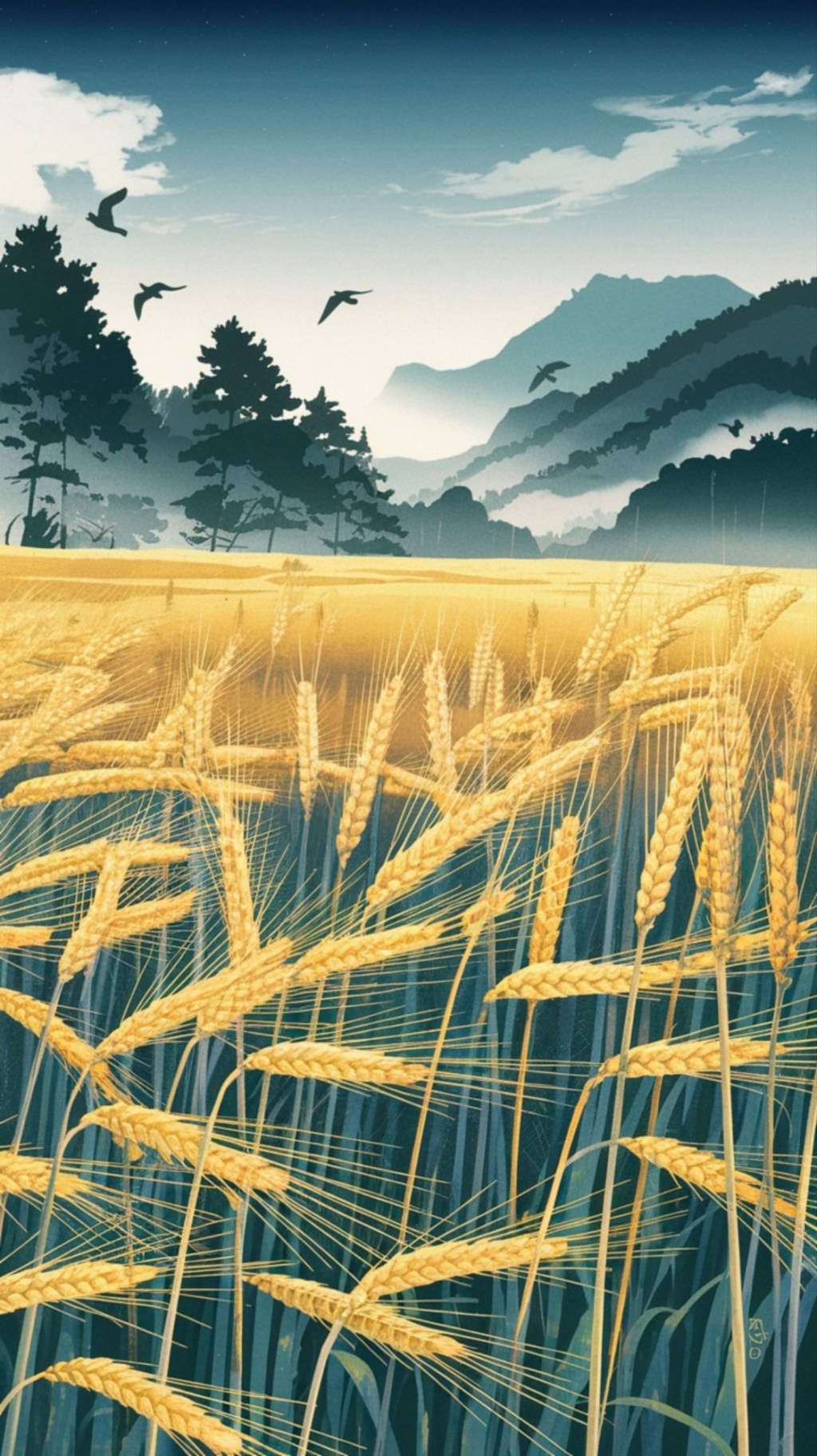
“Once, this was the way of things. The cycle of seasons guided us, taught us patience and survival. Fields of wheat—golden and swaying under the sun—were not just crops. They were life. They were bread, sustenance, and hope.
But you… you’ve forgotten. Forgotten the smell of freshly turned soil. Forgotten the feel of grain in your hands, the ache of laboring beneath a harvest moon. You’ve lost the wisdom that every seed planted is a promise made to the future.
You live now in towers that pierce the clouds, eating foods conjured from machines, grown in chemical vats. Convenience has replaced resilience. No longer do you store grain against the coming of winter. No longer do you prepare, for winter itself has been engineered out of your world. And yet, you are colder than ever.
Do you know what wheat meant? It meant warmth. It meant survival through the bitter months. We threshed it, stored it, guarded it. We sang songs to it, blessed it. Not because it was easy, but because it was essential. There is no joy without effort, no nourishment without toil.
And winter—it wasn’t just a season. It was a reckoning. It taught us humility. When the land went barren, when the frost claimed the earth, we relied on what we had prepared. It bound us together, made us grateful for every loaf.
But now, you press buttons. You summon sustenance from nowhere. Tell me, what will you do when the machines fail? When the systems you depend on falter, and the winds howl again, and the earth beneath your feet remembers its power?
You must return to the soil. Not for nostalgia, but for necessity. Plant. Harvest. Store. Learn again what it means to endure, to thrive by your own hands. If you do not, winter will come—not the winter of old, but one far colder, far more unyielding.
The wheat waits for you. The earth waits for you. Listen to them, before it’s too late.”
(The hologram flickers, its image momentarily distorting before stabilizing, the faint sound of wind and rustling wheat echoing from unseen speakers. The room is silent, the weight of the message settling over the onlookers like the frost of a long-forgotten winter.)
If you find this content inspiring and uplifting, consider supporting what I do. Buy me a coffee on Ko-fi. Your support makes a difference in my life and helps me create more of what you, and I, like. Thank you!Tap to view my redbubble gallery.
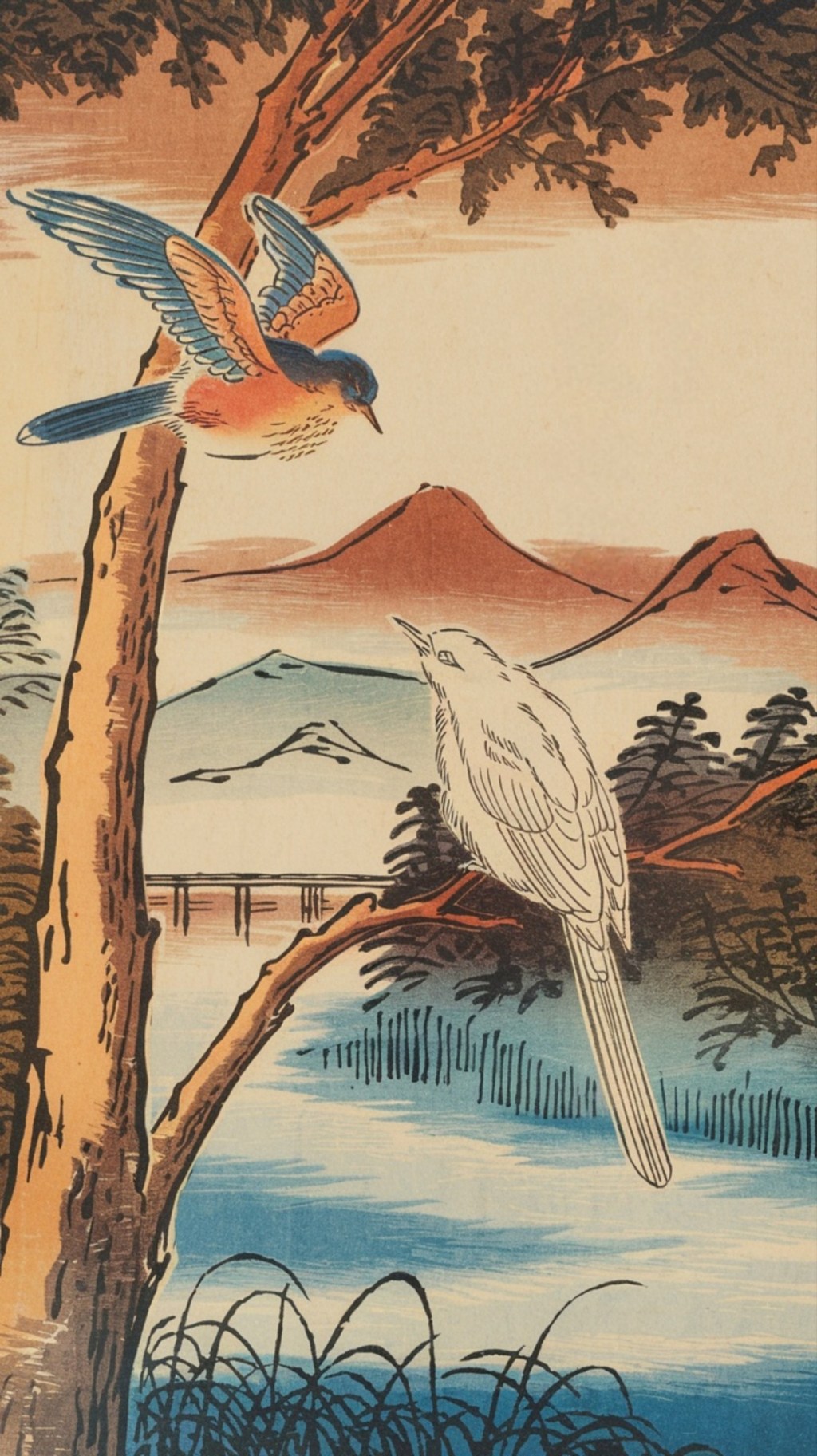
On the crooked branch of an old persimmon tree, two birds sat. Above them, the sky hummed with the thick silence that comes before rain. Below, the world stretched out in its tangled changing vastness — branches pushing into the air, rivers pulling toward the sea, everything moving, endlessly moving.
Coloured in
The older bird sat still, though her stillness was not absence but fullness, like a pebble on a riverbed. Her feathers flickered as the light moved through the leaves: verdigrised copper, smoldering reds, gold like old coins freshly dug from the heavy earth. Beside her, the younger bird shifted restlessly, her lines barely holding their shape. Her body was not feather but form, a sketch in soft charcoal, smudged at the edges where rain or doubt had touched her. She stared down at her faint chest, as hollow as a question half-asked.
“Mother,” she said suddenly, sharply, her voice like the crack of a twig snapping underfoot. “When will I have feathers like yours?” Her gaze darted toward her mother’s chest, to that molten glow of red-gold plumage. Her own outline flickered faintly, like breath on glass. “I’m tired of being incomplete.”
Her mother did not turn at first. She watched the wind, the movement of invisible things. She watched the unseen, as mothers often do. Then she shifted her gaze to her child, her eyes dark and soft as old ink.
“You think I was born like this?” she asked quietly, though there was no question in her voice. She lifted her wings, slowly, and they caught the light like embers stirred in ash. “These colours were not mine. They came to me. Rain gave me the gray. The sun laid gold on my back. The berries left their red behind. All of it stayed.” She lowered her wings, slow as the setting sun.
The pencil bird frowned, running her beak down her delicate frame, as if she could draw herself maor fully into the world. “But how?” she asked, her eyes wide and sharp with hunger. “How did it stay?”
Her mother turned fully now to her child, gaze like stone, gaze like earth, gaze like home. “I didn’t chase it,” she said. “I stayed. The storm comes. You stay. The sun burns. You stay. The world scratches at you with its teeth and thorns, but still, you stay.” Her beak tapped lightly against the bark of the branch. “You let it mark you.”
The faint bird flinched. *Let it mark me?* She glanced down at her pale, clean outline. There was nothing on her, nothing in her, but faint graphite lines. The world had not touched her. She had not let it.
“Fly,” her mother said, with the softness of rain before it falls.
“Where?” the juvenile bird asked, eyes darting upward to the open, terrifying sky.
“Anywhere.”
“And if I get lost?”
Her mother leaned closer, so close the faint breath of her voice swept across her daughter’s hollow cheek. “You will,” she said. “That is the only way you’ll know where you are.”
The child blinked, heart sharp and wild as a drumbeat. She glanced up at the vast, open sky, so full of directionless blue, then down at her faint, brittle wings. Her breath came fast and tight. *But I’m not ready,* she thought. *I’m still a sketch. I’ll disappear out there.*
But her mother had already tucked her beak into her chest, as though she had seen this all before and had said what needed to be said.
So the pencil bird spread her thin, hollow wings and leapt.
At first, it was bliss. The wind held her like a string cradles a kite. The sun dripped warmth down her back. *This is it,* she thought, turning in wide arcs, her shadow a pale outline below her. *This is what it means to fly.* She flew harder, faster, slicing through the air like a blade, her heart thudding with the thrill of it. *If I just keep flying, I’ll become real.*
But the world does not let anyone fly unmarked.
The clouds gathered with the heavy, aching slowness of something inevitable. At first, they were soft as wool, but soon they grew dense, sharp-edged, swollen with their own weight. The air thickened. The first drop of rain hit her back like a stone. Then another. Then hundreds.
*Go back,* she thought. *Go back to the branch. You’ll be ruined.* Her wings trembled. Her outline blurred, as though the rain was an eraser working her out of the world. She was dissolving, line by line, stroke by stroke. The old fear rose in her: *I will vanish.*
Her mother’s voice echoed through the storm, her voice like a huge murmuration of starling filling the air: *Don’t run from the storms.*
So she didn’t. She flew straight into the rain, her body battered by drops that felt like knives. Her wings shuddered. Her heart thudded in her head louder than the thunder. She thought she might fall. But she didn’t. She didn’t.
When she emerged from the storm, she landed on the branch of a cedar tree, breath heaving, wings shaking. She looked down at herself, expecting to see ruin, expecting to see the faint, hollow outline of a bird erased from existence. But there, on her back, was a streak of silver-gray, soft as the edge of a storm cloud.
*This wasn’t here before.*
She touched it, ran her beak over it. It didn’t smear. It stayed.
Time passed. It always does.
The days that followed were not kind. The sun baked her back until she felt her wings would burn away. Hunger gnawed at her until her chest ached, and when she landed near a thorny Briar, the thorns clawed at her wings. She bit into the wrong berry first — bitter, sharp, unbearable. She spat it out. But the next berry was sweet as honey. The red juice stained her beak, dripped down her chest. She wiped it away, but a faint rust-coloured mark stayed.
The sun gave her heat. The berries gave her red. The thorns gave her scars.
She flew beneath a hawk’s shadow, and when she escaped, her wing throbbed from the rake of its claws. The mark it left was not a wound. It was a line — faint, blue-black, permanent.
*When did I change?* she thought, glancing at herself one day. Her chest was no longer hollow. Her wings no longer weightless. The sketch of her was gone. Instead, she was filled with colour — shadow-gray, storm-blue, berry-red, thorn-black. She had not asked for any of it. But it had come to her all the same.
*This is what she meant.*
One evening, she returned to the persimmon tree. Her landing was sharp, deliberate, her wings folding in tight with the precision of something that has been tested. Her mother glanced up, gaze steady as ever.
“Back so soon?” her mother asked, eyes filled with quiet knowing.
The young bird glanced at her wings, her chest, her tail. She hadn’t realized it, but she no longer looked away from herself. Her feathers were no longer faint. No longer hollow. They were full, heavy with shadow and flame, earth and ash. She felt the weight of them, but it was not a burden. It was the weight of being real.
Her mother turned to face her fully now, tilting her head as if inspecting something distant and beautiful.
“Look at you,” she said softly. Her voice was full of something like pride, but older, deeper. Something like recognition.
The young bird flexed her wings. She saw it now — not just the colour but the story it told. The silver of the storm. The red of the berries. The blue of the hawk’s shadow. Her eyes burned, but not with tears. She could feel it all at once — the weight of the storm, the taste of the berries, the ache of the thorns — everything that had ever touched her was still with her, in her, as vivid as flame.
Her mother leaned in close, her beak at her cheek. “Welcome back,” she whispered.
They sat side by side as the sun spilled itself across the sky, orange into red, red into gold, gold into night. Their feathers caught the light as it passed, both of them burning softly in its glow.
Her mother’s eyes closed, content. The young bird glanced down at her chest once more, at the colours she had not chased but gathered, each one a mark of having stayed.
Her chest was not hollow anymore. And in that moment, she knew it never had been.
If you find this content inspiring and uplifting, consider supporting what I do. Buy me a coffee on Ko-fi. Your support makes a difference in my life and helps me create more of what you, and I, like. Thank you!Tap to view my redbubble gallery.
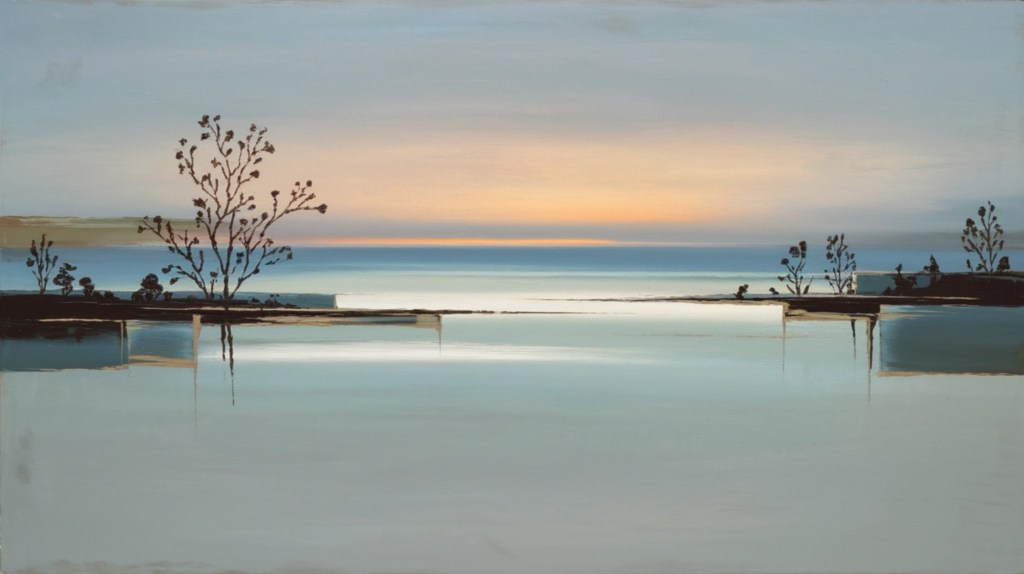
O sovereign silence, you are the unbounded sea—calm as prayer, smooth as polished glass, hiding universes beneath your paper-thin, trembling skin!
What lies beneath the calm
Your surface speaks nothing, whispers everything—a magnificent deception of stillness that breathes with the ancient rhythms of unmapped depths. What terrible beauties writhe in the midnight corridors of your hidden heart, what storms rage in the cavernous kingdoms below your glass-smooth appearance?
You are landscape and secret, horizon and abyss—your calm is the most violent language, your silence a thunderous confession. Beneath that crystalline surface, whole worlds collapse and reform, civilizations of emotion ebb and flow, surge and retreat, while your exterior remains unbroken, a perfect mirror reflecting nothing of the magnificent tumult that churns in your lightless realms. Each gesture a calm wave, each breath a measured tide—yet I sense the leviathans of unspoken feeling turning in your deepest waters, massive and magnificent and utterly unknown.
Who are you, ocean-hearted one, with your immaculate exterior and your savage, unknowable self? Your stillness is not peace, but the most profound rebellion—a defiance against revelation, a landscape of emotion too profound for mere language to breach.
What feelings do you get from this painting?
If you find this content inspiring and uplifting, consider supporting what I do. Buy me a coffee on Ko-fi. Your support makes a difference in my life and helps me create more of what you, and I, like. Thank you!Tap to view my redbubble gallery.
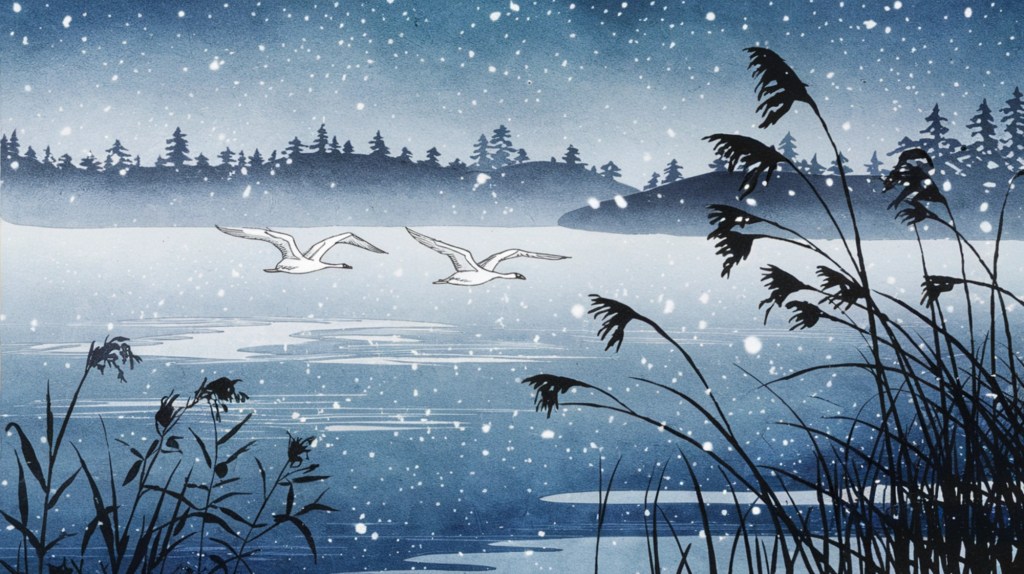
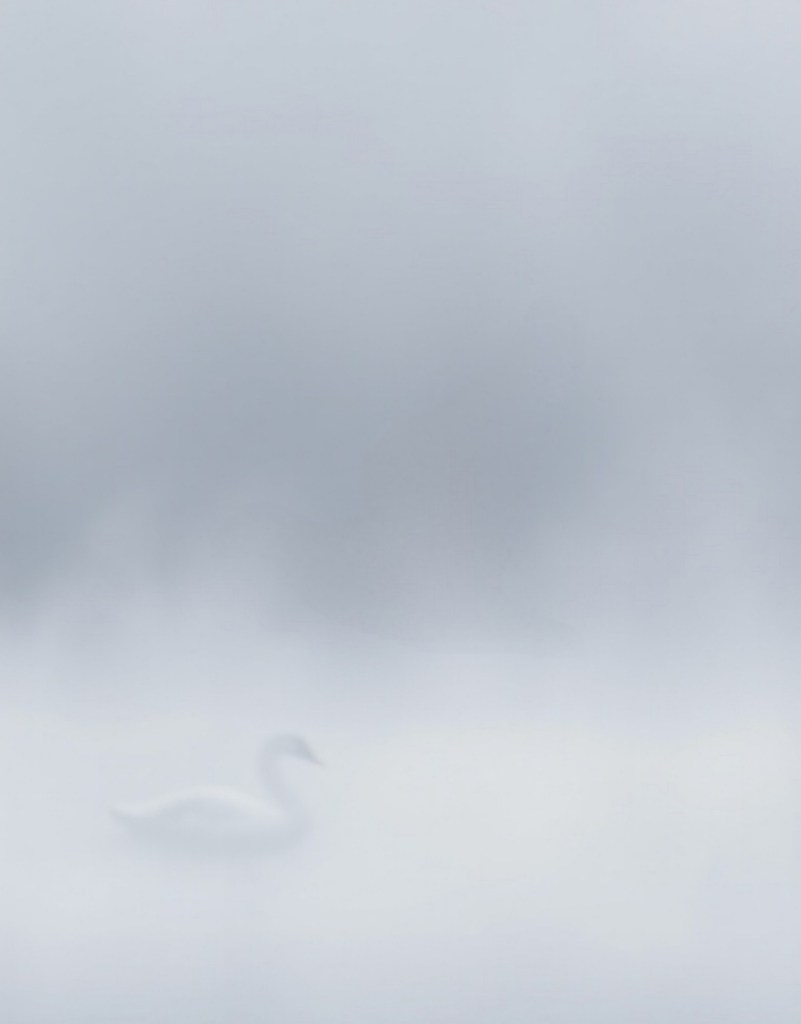
Ice covers the lake Swans sing of what they’ve forgotten— Silent wings remember.
On a brittle December morning, Yuki stood at the edge of the frozen lake. The air felt sharp, like the edge of a paper freshly torn, and the snow under her boots crackled softly. In the distance, two swans flew low over the water, their wings slicing the pale winter light. She watched them, transfixed, as they moved in perfect unison, like dancers following an invisible thread.
Yuki had come to the lake every winter since she could remember, drawn by something she couldn’t name. She wasn’t the sort of person who believed in omens or ghosts. But there was a weight in the air here, a kind of gravitational pull, as if something important had happened long ago and the echo of it still hung in the frozen reeds.
The swans flew in a slow arc, circling the lake as if searching for something lost. Then, without warning, one of them let out a low, mournful cry. It wasn’t a sound Yuki had ever heard before—not quite bird, not quite human. The sound folded into the winter air, spreading out across the lake in waves. She felt it in her chest, as if the cry had carved out a hollow space there and filled it with snow.
“You heard it too, didn’t you?”
The voice startled her. She turned and saw an old man standing a few feet away, bundled in a dark coat that hung loose around his frame. His face was pale and deeply lined, like a map of forgotten places.
“The swan’s song,” he said, nodding toward the lake. “Not many people can hear it.”
Yuki hesitated, unsure if she should answer. “It sounded… sad,” she said finally.
The man chuckled softly, a dry, papery sound. “That’s because it is. They only sing like that in winter, you know. When they remember.”
“Remember what?”
He didn’t answer right away. Instead, he gazed out at the swans, now gliding silently over the water. “There’s a story about this lake,” he said after a while. “A strange one. Do you want to hear it?”
Yuki nodded, though she wasn’t sure why.
“They say that long ago, this was a place where people came to forget. The lake would take your memories, all of them, and bury them beneath the ice. Some people came willingly, hoping to escape grief or regret. Others were brought here against their will, their memories stolen as punishment for something they’d done. Either way, the lake kept their secrets.
“But memory is a stubborn thing. It doesn’t just disappear. It sinks, yes, but it doesn’t die. And in the winter, when the lake freezes over, those lost memories rise to the surface. That’s what the swans are singing about. They’re the ones who guard the memories, you see. They carry them in their wings, their feathers, their song. But the burden is heavy. Too heavy. So every winter, they cry out. Not to us, but to each other. To say: *I remember too.*”
The man fell silent. Yuki stared at the swans, her breath fogging in the cold air. The idea was absurd, of course. Swans as guardians of forgotten memories? And yet, the longer she watched them, the more she felt that there was something beneath their wings, something vast and unseen, like the dark waters beneath the ice.
When she turned back, the man was gone. There were no footprints in the snow where he had stood.
For weeks afterward, Yuki couldn’t stop thinking about the swans and their song. She returned to the lake every day, but the man never reappeared, and the swans remained silent. Still, she felt as if the lake had left something inside her, a quiet ache she couldn’t name.
Late one night, she dreamed of flying over the lake, her body weightless and cold. She could hear the swans crying below her, their voices weaving together in a language she almost understood. When she woke, her pillow was damp, and her throat ached, as if she had been singing in her sleep.
It wasn’t sadness, exactly, that stayed with her after that. It was more like a memory of sadness, something faint and indistinct, like the outline of a figure walking away through falling snow.
And every winter after, when she heard the distant cry of the swans, she would pause, her breath catching in her chest, and wonder what it was they were trying to say.
Let me know how this piece leaves you feeling and what it makes you think about.
If you find this content inspiring and uplifting, consider supporting what I do. Buy me a coffee on Ko-fi. Your support makes a difference in my life and helps me create more of what you like. Thank you!Tap to view my redbubble gallery.
So, Welsh. Yeah, it’s a real language, and no, it’s not just random consonants tossed into a Scrabble bag. It’s one of the oldest languages in Europe, spoken in Wales, where people know their sheep as good as their weather forecast (usually rain). But seriously, it’s a living, breathing language with a rich history and, let’s be honest, a bit of a PR problem. I mean, have you ever tried convincing someone that *Llanfairpwllgwyngyllgogerychwyrndrobwllllantysiliogogogoch* is a legitimate place and not the sound of a cat walking across a keyboard?
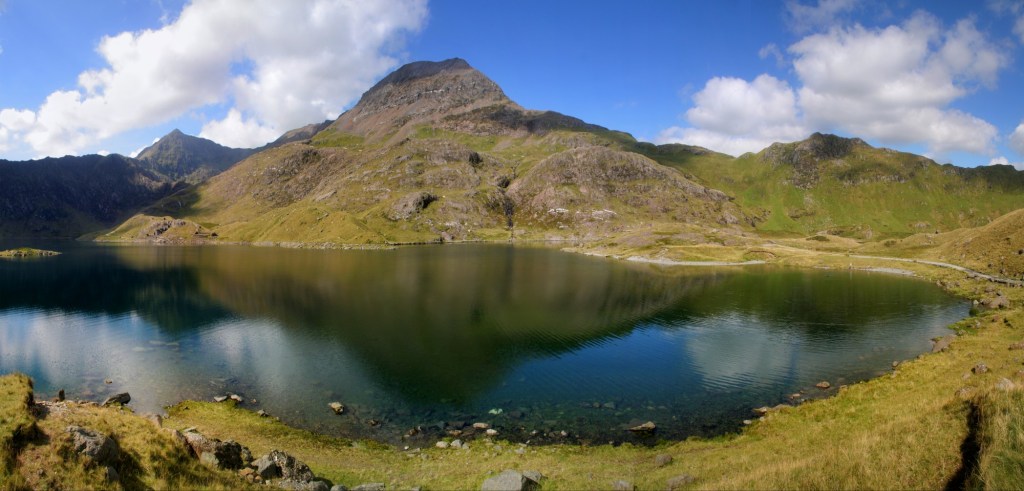
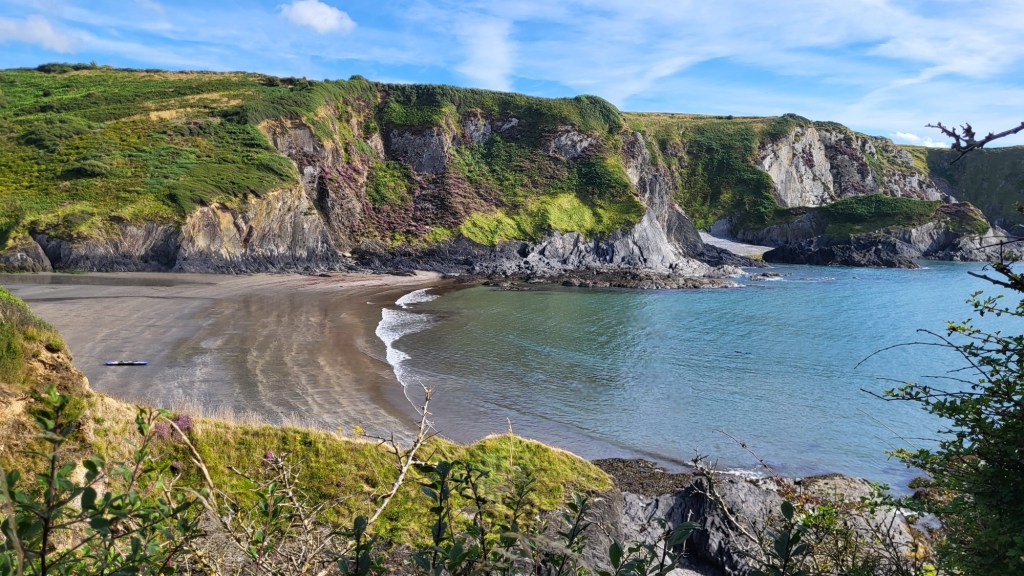
Abermawr BeachLlyn Llydaw. With Snowdon in the background
Welsh, or ‘Cymraeg’ as the locals call it (pronounced “kum-RAIG,” by the way), is one of the Celtic languages. Think Gaelic, but with more ll’s, which, in case you were wondering, is not just a double “L.” It’s a soft, breathy sound that feels like trying to whisper to someone with a mouthful of marshmallows. It’s oddly satisfying once you get the hang of it.
For Welsh people, the language isn’t just words; it’s identity. It’s how they connect to their ancestors, their culture, and their sense of place in the world. Speaking Welsh is like wearing a badge that says, “I survived centuries of cultural suppression, and all I got was this vowel-deficient language.” But they wear that badge proudly.
Now, let’s talk about how it sounds. Welsh has this sing-song quality that makes everything sound like it should be sung from the top of a windy hill in a BBC period drama. Even the most mundane phrases feel poetic. Take “Sut wyt ti?” which means “How are you?” It’s pronounced something like “Sit OO-ee tea,” and it makes you feel like you should answer with a sonnet instead of a shrug.
Then there’s the word ‘hiraeth’. Oh, hiraeth. It’s one of those untranslatable words that’ll make you feel all philosophical and deep. It roughly means a longing for a home you can’t return to, or maybe one that never really existed. It’s the emotional equivalent of looking at an old photo and feeling like your heart’s been dunked in tea.
But not everything in Welsh is wistful and poetic. Some words are just plain fun to say. Like ‘popty ping’, which is slang for microwave. Yes, ‘popty ping’. How can you not love a language where heating leftovers sounds like a kid naming a spaceship?
Want to impress your friends? Try this: say ‘diolch’ (DEE-olkh). That’s “thank you.” Or ‘iechyd da’ (yeh-CHID dah), which is “cheers.” But watch out for that “ch.” It’s like clearing your throat, but, you know, politely.
Learning Welsh is like joining an exclusive club. Sure, it’s a small club, but it’s mighty. And the members? They’ll welcome you with open arms because every new speaker is a little victory for a language that’s survived against the odds.
So, whether you’re planning a trip to Wales, have Welsh roots, or just want to spice up your life with some extra consonants, give Welsh a shot. You might not master the ‘ll’ sound on day one, but you’ll definitely feel like you’re part of something special. And who knows? You might even find yourself yelling “Cymru am byth!” (“Wales forever!”) at a rugby match one day.
Until then, ‘hwyl fawr’! That’s “goodbye” in Welsh, and it’s pronounced, well… just trust me on this one.
If you find this content inspiring and uplifting, consider supporting what I do. Buy me a coffee on Ko-fi. Your support makes a difference in my life and helps me create more of what you like. Thank you!Tap to view my redbubble gallery.
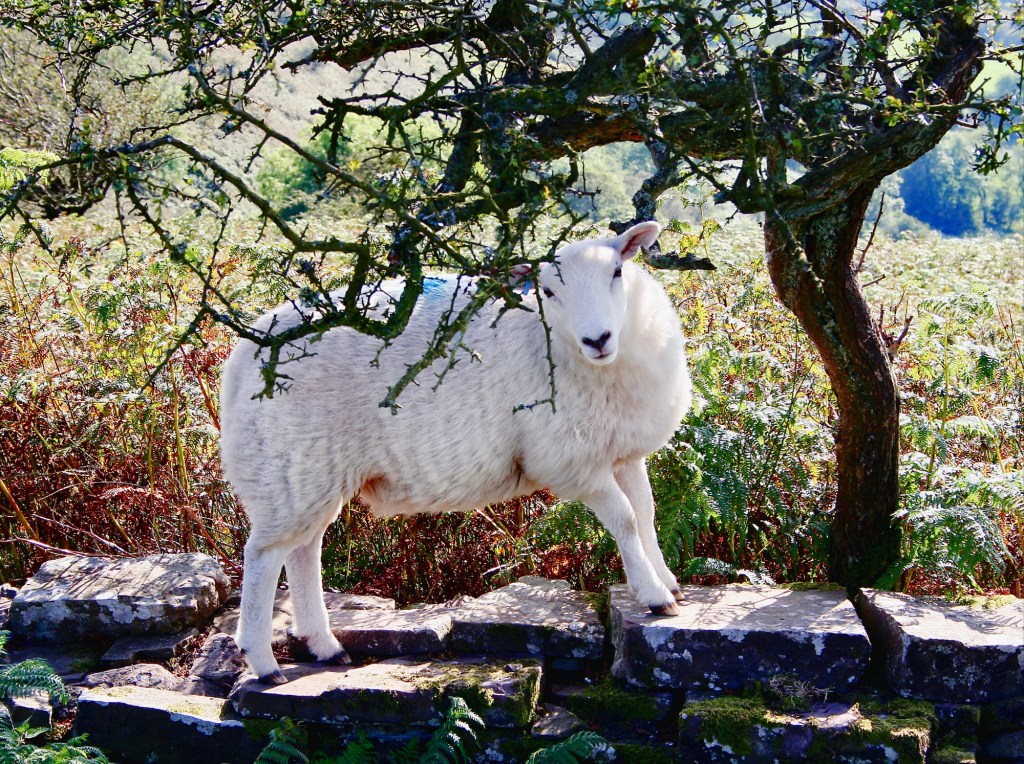
Wales in stillness breathes, Sheep beneath the twisted tree, Time folds into now.
Sheep, Stones, and Sunlight
There is a moment in every journey where time seems to pause. For me, it happened in the quiet Welsh countryside, where a simple sheep under a gnarled tree stopped me in my tracks. The air was crisp, carrying the scent of moss and bracken, and the landscape stretched wide, untamed yet inviting. This single, unassuming scene—of stone walls, dappled sunlight, and the curious gaze of an animal—felt like a distillation of everything Wales represents.
The sheep, a quintessential emblem of this land, stood framed by a spindly tree that clung to the rocky ground. It had the air of an accidental guardian, standing atop ancient stones as if overseeing a realm where history, nature, and humanity blend seamlessly. It didn’t flee or flinch when I approached with my camera, just watched with an intensity that made me feel like the visitor I was. And in that exchange, wordless and fleeting, I felt an unexpected sense of calm.
It’s easy to rush through life, ticking off sights and experiences like items on a to-do list. But here, in this quiet moment, I was reminded of the value of stillness. Of the beauty in ordinary things. The lichen-covered stones beneath the sheep’s hooves hinted at stories far older than mine—walls built by hands long gone, dividing fields that have seen generations of life. The sunlight filtering through the tree branches cast shifting patterns on the ground, a reminder of time’s gentle, inevitable flow.
Wales has a way of grounding you. Its hills and valleys aren’t just landscapes; they’re vessels of memory. The sheep, as ubiquitous as they are, embody this spirit. They are not just creatures grazing absentmindedly—they are part of the rhythm of the land, living symbols of its enduring character.
As I walked away from the scene, I felt lighter. The world seemed a little quieter, my thoughts a little clearer. That single sheep, perched on its stone stage, had given me something unexpected: perspective. It reminded me that not all moments need to be grand to be meaningful. Sometimes, it’s in the simplest of scenes that we find what we didn’t know we were looking for.
And that’s the magic of Wales—a place where even the smallest details invite you to slow down, look closer, and feel more deeply.
If you find this content inspiring and uplifting, consider supporting what I do. Buy me a coffee on Ko-fi. Your support makes a difference in my life and helps me create more of what you like. Thank you!Tap to view my redbubble gallery.
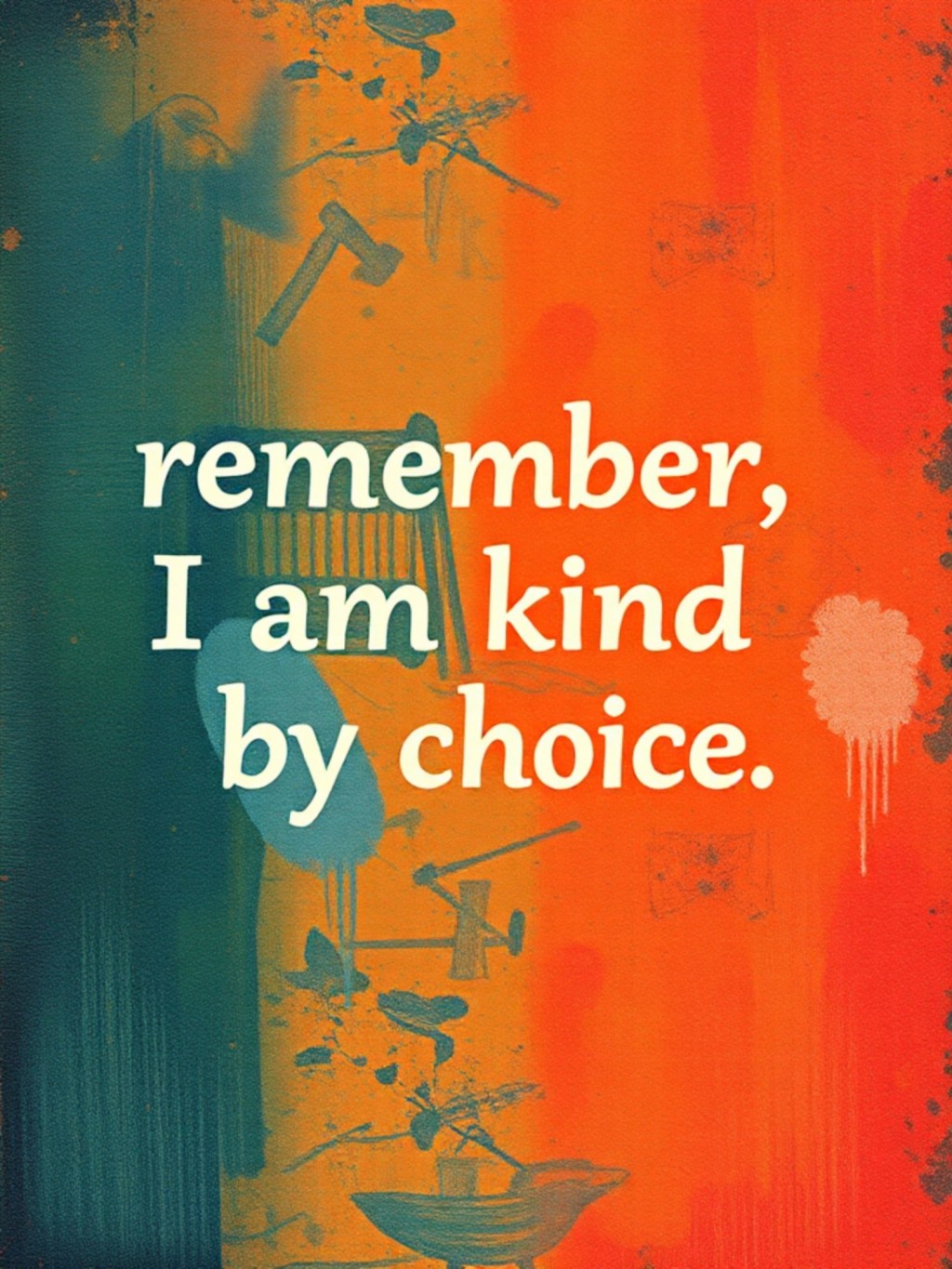
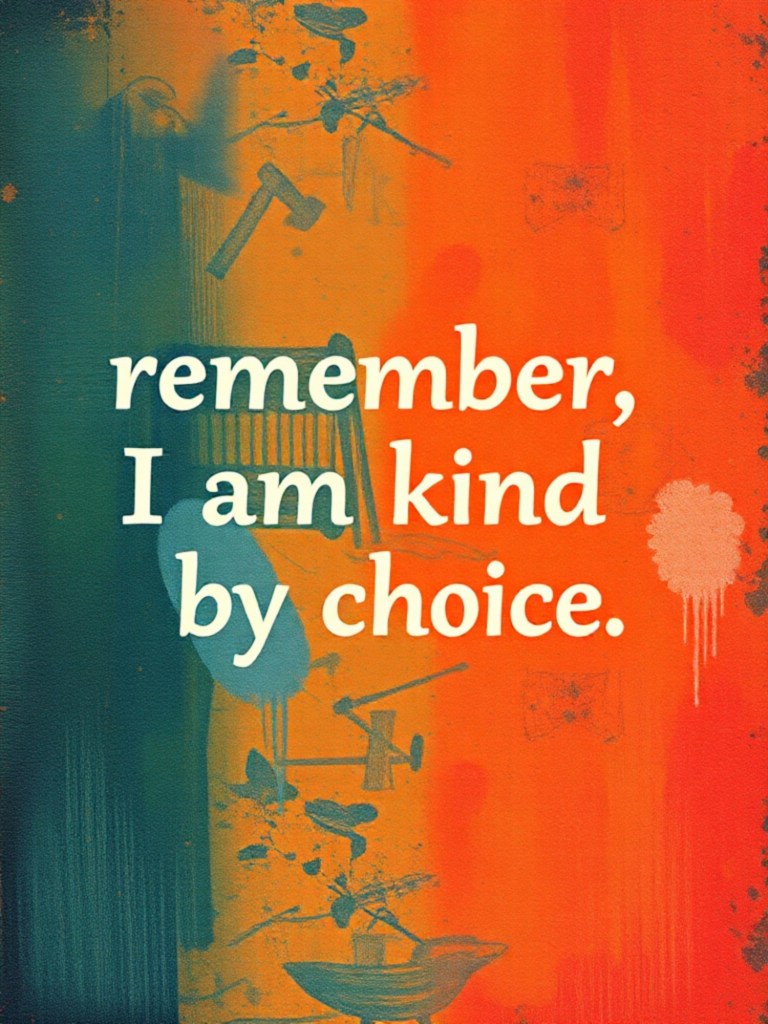
Kindness waits unseen, a seed planted in the gaps— soft rebellion grows.
Ethereal
Kindness is a choice. Not a reflex, not an inheritance, but a deliberate act of defiance. I remind myself of this often, especially on days when the world feels jagged and raw, like a half-shattered window that refuses to break or mend.
Buy my print on red bubble
There are moments—sharp, vivid moments—when I could so easily let anger, irritation, or indifference take the reins. The barista forgets my order; the driver cuts me off on the motorway; the email arrives, dripping with condescension. But somewhere in the labyrinth of my chest, a voice stirs, calm yet firm. “Choose,” it says. “Remember.”
It is not an instinct. Instinct is survival, and survival is often cruel. But kindness is the quiet art of holding a mirror to the world and refusing to reflect its harshness. It’s not about sainthood or martyrdom—I don’t believe in halos. It’s about balance. About knowing that, even in chaos, you can plant something tender.
There’s a man who sits by the park near my flat, always in the same frayed jacket, his hands like dry riverbeds. Once, I walked past him without a second glance. Another day, I handed him an orange, its skin bright as a distant star. We didn’t speak. He didn’t need to thank me. What mattered was the act itself—the quiet offering to the unseen universe.
Kindness, I think, is a language best spoken without words. It’s in the unspoken patience as a stranger fumbles for coins at the till, or the way you pause to let someone else’s story unfold without rushing to add your own. It’s in forgiving yourself, too, for the days when kindness feels like an impossible weight.
There’s a certain magic in the spaces between things—the gaps in reality where something inexplicable hums. Kindness lives there, too. It’s not flashy. It doesn’t ask for applause. It exists in the quiet, persistent decision to hold the world gently, even when it feels like it’s slipping through your fingers.
Remember, I am kind by choice. Not because the world deserves it, but because I do. Because the act of choosing shapes me. Because I’ve seen what grows in the absence of kindness, and it’s a garden I refuse to tend.
If you find this content inspiring and uplifting, consider supporting what I do. Buy me a coffee on Ko-fi. Your support makes a difference in my life and helps me create more of what you like. Thank you!Tap to view my redbubble gallery.
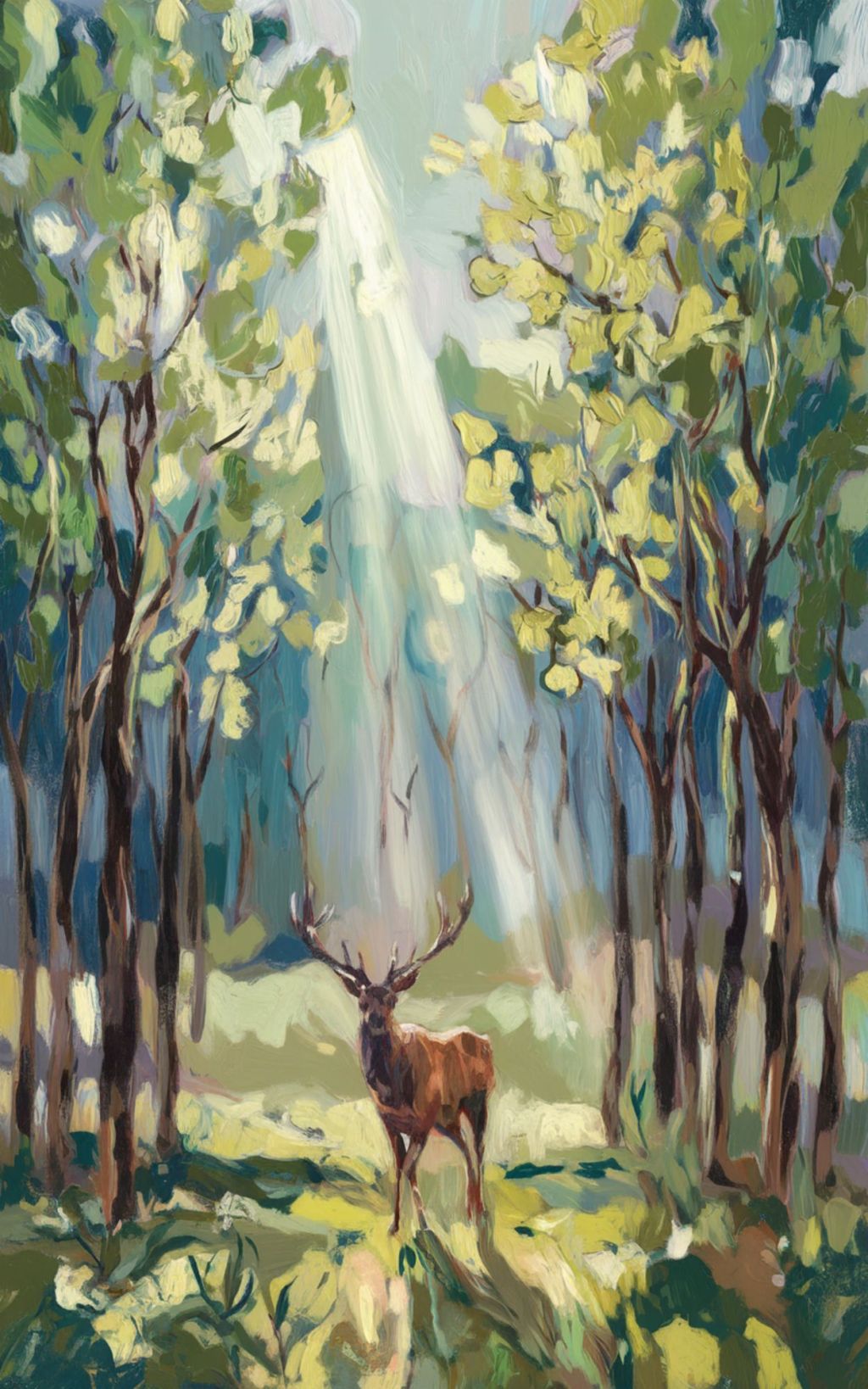
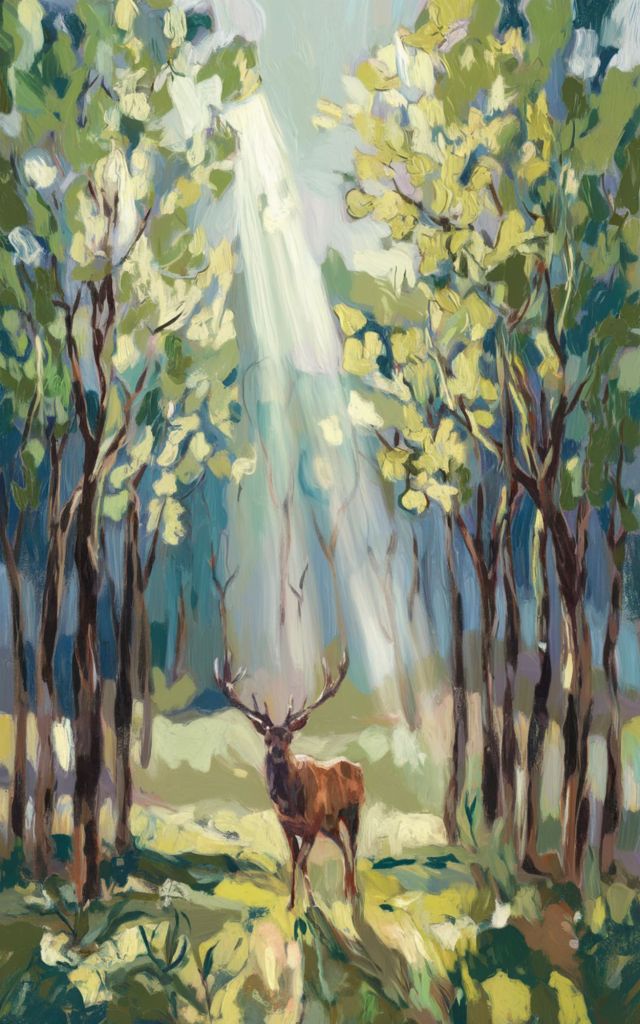
Sunlight spills like breath, ancient trees hold quiet watch, stag stands, still as stone.
In the quiet hush of morning, a single stag stands alone in a secluded forest clearing, his figure outlined in gentle streams of light that filter down from the canopy above. Each ray seeps through the branches and leaves, softening as it falls, wrapping him in a halo that seems both eternal and fleeting. His antlers, branches of bone and time, reach into the air with a majestic calmness, each point a marker of seasons come and gone, each curve a silent record of survival and adaptation. His coat is rich, a mix of earth-browns and shadows, blending into the woods yet catching the light just enough to stand apart, to be noticed.
This moment—the stag, the sunlight, the stillness—is a scene millions of years in the making, a perfect portrait painted by evolution’s quiet hand. From the simplest of life forms, driven by the need to survive, to the elegance of this creature, whose every feature has been shaped by time itself, life has woven something wondrous. The stag’s heightened senses, his graceful frame, even the natural lines of his form, all serve a purpose, yet they come together to create something beyond mere function. They become beauty. And beauty, too, has its place in evolution, for it draws us near, inspires us to protect, to connect, to pause and simply be present.
We, too, are shaped by evolution’s design, moulded not only to see but to feel, to wonder, and to appreciate. Perhaps, in a way, our perception of beauty is a survival instinct itself—a way to recognize harmony, to find peace in nature’s rhythms, to feel at home in the world that bore us. Standing in the clearing, we understand our role in this continuum. This moment of quiet awe is a part of something larger—a shared heritage with this stag, this forest, this light. In that silent connection, beauty becomes a bridge across time, binding us to all that has come before and all that will follow.
And so we stand, quietly watching, breathing, and being, as the stag lifts his head, his gaze piercing yet soft, both knowing and unknowing. In this clearing, we glimpse the rare gift that evolution has left us: the capacity to see beauty not only in what we need but in all that simply is.
What scene takes your breath away?
If you find this content inspiring and uplifting, consider supporting what I do. Buy me a coffee on Ko-fi. Your support makes a difference in my life and helps me create more of what you like. Thank you!Tap to view my redbubble gallery.


 Horse’s steady gazeStrengthful eyes that dare to meetChallenge accepted Courage is the strength to face… Read more: Darkness, Power and Beauty
 Daffodil so brightGolden petals, sunshine’s kissHope blooms anew As I wander through the garden, the… Read more: The Daffodil’s Song: A Lyrical Tribute to the Wonders of Spring
 The Graceful Lines of an Acanthus Leaf. Acanthus is a genus of flowering plants native… Read more: Acanthus: A Versatile Plant with a Rich Cultural Heritage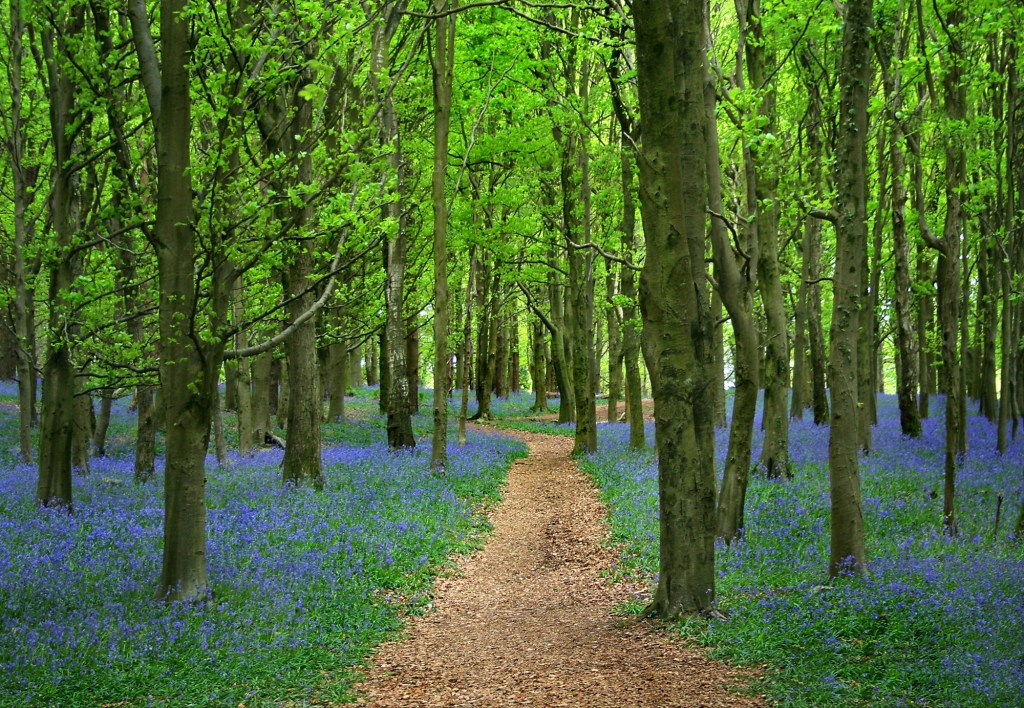

 Anthony's Literary Lens
You must be logged in to post a comment.