Tag: Pembrokeshire

  • The Neolithic Burial Chambers of Pembrokeshire

    The Neolithic Burial Chambers of Pembrokeshire

    Pembrokeshire is home to some of Wales’ most impressive ancient monuments. These Neolithic burial chambers were built by farming communities over 5,000 years ago, and they’re still standing today. From the famous Pentre Ifan with its massive capstone that seems to defy gravity, to the quirky Carreg Coetan Arthur tucked between houses in Newport. Each one tells us something about the people who lived here thousands of years before castles and churches existed.
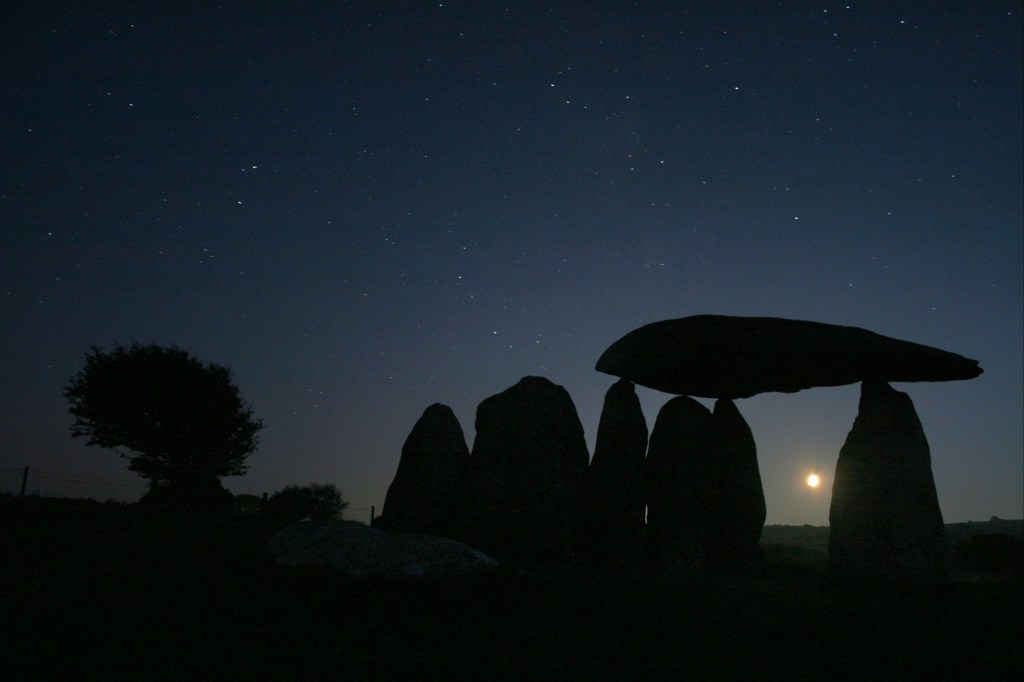
    Pentre Ifan
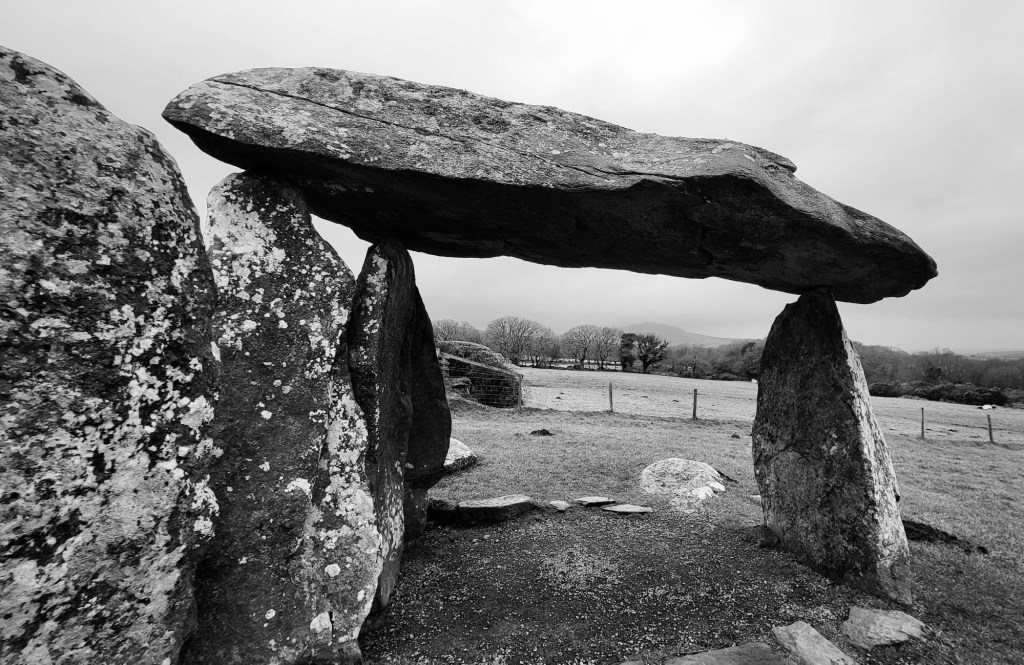
    My own photo of Pentre Efan taken a few years ago

    Pentre Ifan
    The largest and best preserved Neolithic burial chamber in Wales, dating from around 3500 BC. Located near Newport in north Pembrokeshire, it features a giant 16½ft/5m capstone balanced on three uprights.
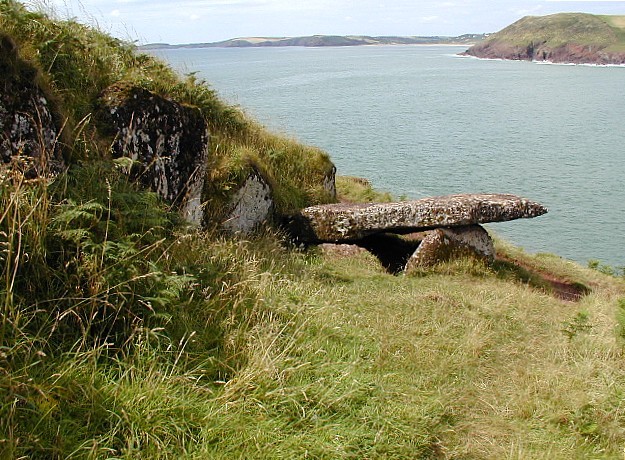
    King’s Quoit

    King’s Quoit
    A Neolithic burial chamber located in Manorbier, 5 miles east of Pembroke. The capstone measures 4 metres by 2.5 metres and 0.5 metres thick, supported partly by rising ground and partly by two upright stones.
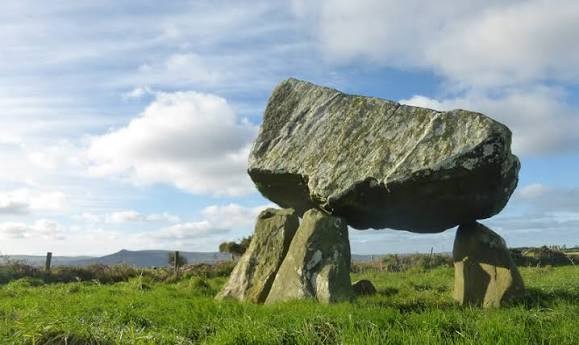
    Llech y Drybedd

    Llech y Drybedd
    A Neolithic chambered tomb consisting of a huge capstone supported on three upright stones, located in a farm field just west of Moylgrove.
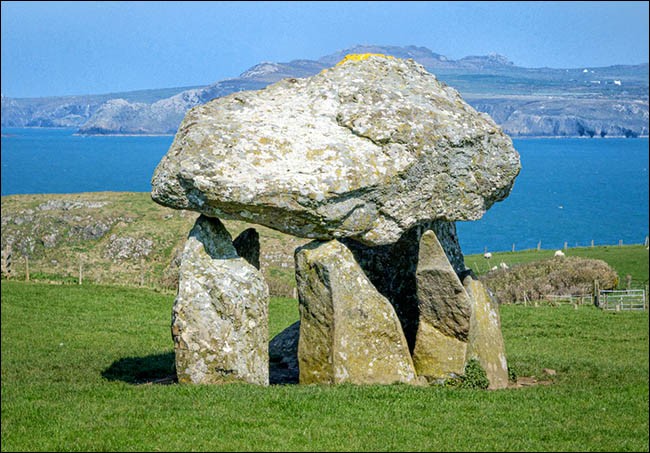
    Carreg Samson

    Carreg Samson
    One of the most impressive burial chambers in South Wales, constructed around 5,500 years ago near Abercastle. It has six upright stones, three of which support a massive capstone measuring 4.7 metres by 2.7 metres
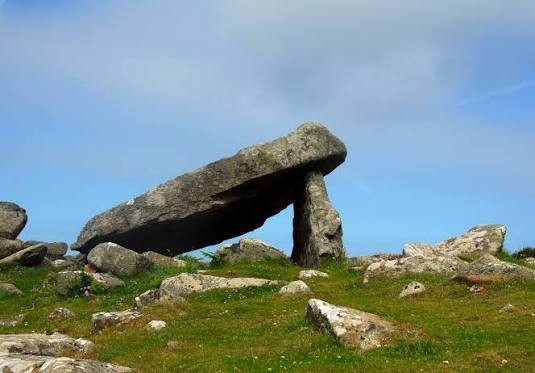
    Coetan Arthur (Arthur’s Quoit)

    Coetan Arthur (Arthur’s Quoit)
    A Neolithic burial chamber from around 3,000 BC located on St David’s Head. The capstone measures 6 meters by 2.5 meters with the upright stone around 1.5 meters high.
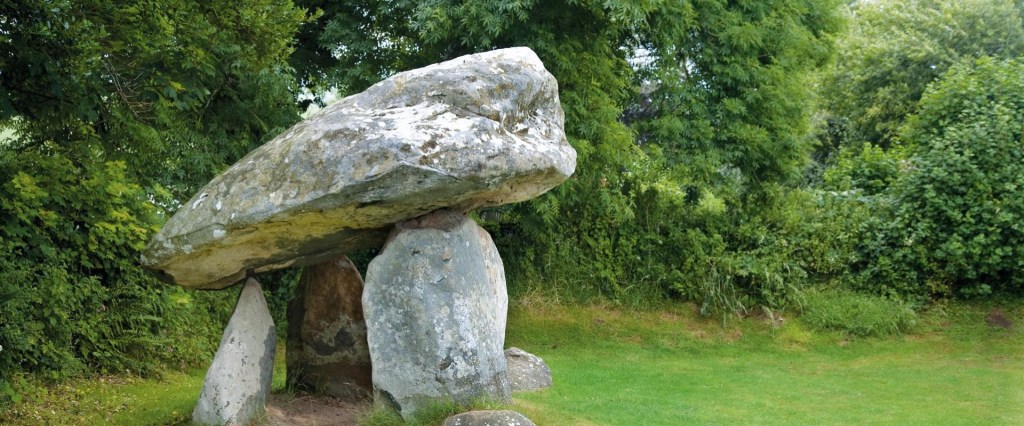
    Carreg Coetan Arthur

    Carreg Coetan Arthur
    A small mushroom-like chamber in Newport, sitting amongst houses in a small enclosure, overlooking the estuary.


    If you find my photography or my writing inspiring and uplifting, consider supporting what I do. Buy me a coffee on Ko-fi.
    Your support makes a difference in my life and helps me create more of what you, and I, like. Thank you!
    Tap here for a list of 100 endangered animals and plants.

    100 endangered plant and animal species

    * Abies beshanzuensis (Baishan fir) – Plant (Tree) – Baishanzu Mountain, Zhejiang, China – Three mature individuals

    * Actinote zikani – Insect (butterfly) – Near São Paulo, Atlantic forest, Brazil – Unknown numbers

    * Aipysurus foliosquama (Leaf scaled sea-snake) – Reptile – Ashmore Reef and Hibernia Reef, Timor Sea – Unknown numbers * Amanipodagrion gilliesi (Amani flatwing) – Insect (damselfly) – Amani-Sigi Forest, Usamabara Mountains, Tanzania – < 500 individuals * Antisolabis seychellensis – Insect – Morne Blanc, Mahé island, Seychelles – Unknown numbers * Antilophia bokermanni (Araripe manakin) – Bird – Chapado do Araripe, South Ceará, Brazil – 779 individuals * Aphanius transgrediens (Aci Göl toothcarp) – Fish – south-eastern shore of former Lake Aci, Turkey – Few hundred pairs * Aproteles bulmerae (Bulmer’s fruit bat) – Mammal – Luplupwintern Cave, Western Province, Papua New Guinea – 150 * Ardea insignis (White bellied heron) – Bird – Bhutan, North East India and Myanmar – 70–400 individuals * Ardeotis nigriceps (Great Indian bustard) – Bird – Rajasthan, Gujarat, Maharashtra, Andhra Pradesh, Karnataka and Madhya, India – 50–249 mature individuals * Astrochelys yniphora (Ploughshare tortoise) – Reptile – Baly Bay region, northwestern Madagascar – 440–770 * Atelopus balios (Rio Pescado stubfoot toad) – Amphibian – Azuay, Cañar and Guyas provinces, south-western Ecuador – Unknown numbers * Aythya innotata (Madagascar pochard) – Bird – volcanic lakes north of Bealanana, Madagascar – 80 mature individuals * Azurina eupalama (Galapagos damsel fish) – Fish – Unknown numbers – Unknown numbers * Bahaba taipingensis (Giant yellow croaker) – Fish – Chinese coast from Yangtze River, China to Hong Kong – Unknown numbers * Batagur baska (Common batagur) – Reptile (turtle) – Bangladesh, Cambodia, India, Indonesia and Malaysia – Unknown numbers * Bazzania bhutanica – Plant – Budini and Lafeti Khola, Bhutan – 2 sub-populations * Beatragus hunteri (Hirola) – Mammal (antelope) – South-east Kenya and possibly south-west Somalia – < 1,000 individuals * Bombus franklini (Franklin’s bumblebee) – Insect (bee) – Oregon and California – Unknown numbers * Brachyteles hypoxanthus (Northern muriqui / Woolly spider monkey) – Mammal (primate) – Atlantic forest, south-eastern Brazil – < 1,000 * Bradypus pygmaeus (Pygmy three-toed sloth) – Mammal – Isla Escudo de Veraguas, Panama – < 500 * Callitriche pulchra – Plant (freshwater) – pool on Gavdos, Greece – Unknown numbers * Calumma tarzan (Tarzan’s chameleon) – Reptile – Anosibe An’Ala region, eastern Madagascar – < 100 * Cavia intermedia (Santa Catarina’s guinea pig) – Mammal (rodent) – Moleques do Sul Island, Santa Catarina, Brazil – 40–60 * Cercopithecus roloway (Roloway guenon) – Mammal (primate) – Côte d’Ivoire – Unknown numbers * Coleura seychellensis (Seychelles sheath-tailed bat) – Mammal (bat) – Two small caves on Silhouette and Mahé, Seychelles – < 100 * Cryptomyces maximus (Willow blister) – Fungi – Pembrokeshire, United Kingdom – Unknown numbers * Cryptotis nelsoni (Nelson’s small-eared shrew) – Mammal (shrew) – Volcán San Martín Tuxtla, Veracruz, Mexico – Unknown numbers * Cyclura collei (Jamaican iguana / Jamaican rock iguana) – Reptile – Hellshire Hills, Jamaica – Unknown numbers * Daubentonia madagascariensis (Aye-aye) – Mammal (primate) – Deciduous forest, East Madagascar – Unknown numbers * Dendrophylax fawcettii (Cayman Islands ghost orchid) – Plant (orchid) – Ironwood Forest, George Town, Grand Cayman – Unknown numbers * Dicerorhinus sumatrensis (Sumatran rhino) – Mammal (rhino) – Sabah, Sarawak and Peninsular Malaysia, Kalimantan and Sumatra, Indonesia – < 100 (more recent estimates suggest 34-47) * Diomedea amsterdamensis (Amsterdam albatross) – Bird – Breeds on Plateuau des Tourbières, Amsterdam Island, Indian Ocean. – 100 mature individuals * Dioscorea strydomiana (Wild yam) – Plant – Oshoek area, Mpumalanga, South Africa – 200 * Diospyros katendei – Plant (tree) – Kasyoha-Kitomi Forest Reserve, Uganda – 20 individuals in a single population * Dipterocarpus lamellatus – Plant (tree) – Siangau Forest Reserve, Sabah, Malaysia – 12 individuals * Discoglossus nigriventer (Hula painted frog) – Amphibian – Hula Valley, Israel – Unknown numbers * Dombeya mauritiana – Plant – Mauritius – Unknown numbers * Elaeocarpus bojeri (Bois Dentelle) – Plant (tree) – Grand Bassin, Mauritius – < 10 individuals * Eleutherodactylus glandulifer (La Hotte glanded frog) – Amphibian – Massif de la Hotte, Haiti – Unknown numbers * Eleutherodactylus thorectes (Macaya breast-spot frog) – Amphibian – Formon and Macaya peaks, Masif de la Hotte, Haiti – Unknown numbers * Eriosyce chilensis (Chilenito (cactus)) – Plant – Pta Molles and Pichidungui, Chile – < 500 individuals * Erythrina schliebenii (Coral tree) – Plant – Namatimbili-Ngarama Forest, Tanzania – < 50 individuals * Euphorbia tanaensis – Plant (tree) – Witu Forest Reserve, Kenya – 4 mature individuals * Eurynorhyncus pygmeus (Spoon-billed sandpiper) – Bird – Breeds in Russia, migrates along the East Asian-Australasian Flyway to wintering grounds in India, Bangladesh and Myanmar – 100 breeding pairs * Ficus katendei – Plant – Kasyoha-Kitomi Forest Reserve, Ishasha River, Uganda – < 50 mature individuals * Geronticus eremita (Northern bald ibis) – Bird – Breeds in Morocco, Turkey and Syria. Syrian population winters in central Ethiopia. – About 3000 individuals * Gigasiphon macrosiphon – Plant (flower) – Kaya Muhaka, Gongoni and Mrima Forest Reserves, Kenya, Amani Nature Reserve, West Kilombero Scarp Forest Reserve, and Kihansi Gorge, Tanzania – 33 * Gocea ohridana – Mollusc – Lake Ohrid, Macedonia – Unknown numbers * Heleophryne rosei (Table mountain ghost frog) – Amphibian – Table Mountain, Western Cape Province, South Africa – Unknown numbers * Hemicycla paeteliana – Mollusc (land snail) – Jandia peninsula, Fuerteventura, Canary Islands – Unknown numbers * Heteromirafa sidamoensis (Liben lark) – Bird – Liben Plains, southern Ethiopia – 90–256 * Hibiscadelphus woodii – Plant (tree) – Kalalau Valley, Hawaii – Unknown numbers * Hucho perryi (Sakhalin taimen) – Fish – Russian and Japanese rivers, Pacific Ocean between Russia and Japan – Unknown numbers * Johora singaporensis (Singapore freshwater crab) – Crustacean – Bukit Timah Nature Reserve and streamlet near Bukit Batok, Singapore – Unknown numbers * Lathyrus belinensis (Belin vetchling) – Plant – Outskirts of Belin village, Antalya, Turkey – < 1,000 * Leiopelma archeyi (Archey’s frog) – Amphibian – Coromandel peninsula and Whareorino Forest, New Zealand – Unknown numbers * Lithobates sevosus (Dusky gopher frog) – Amphibian – Harrison County, Mississippi, USA – 60–100 * Lophura edwardsi (Edwards’s pheasant) – Bird – Quang Binh, Quang Tri and Thua Thien-Hue, Viet Nam – Unknown numbers * Magnolia wolfii – Plant (tree) – Risaralda, Colombia – 3 * Margaritifera marocana – Mollusc – Oued Denna, Oued Abid and Oued Beth, Morocco – < 250 * Moominia willii – Mollusc (snail) – Silhouette Island, Seychelles – < 500 * Natalus primus (Cuban greater funnel eared bat) – Mammal (bat) – Cueva La Barca, Isle of Pines, Cuba – < 100 * Nepenthes attenboroughii (Attenborough’s pitcher plant) – Plant – Mount Victoria, Palawan, Philippines – Unknown numbers * Nomascus hainanus (Hainan black crested gibbon) – Mammal (primate) – Hainan Island, China – 20 * Neurergus kaiseri (Luristan newt) – Amphibian – Zagros Mountains, Lorestan, Iran – < 1,000 * Oreocnemis phoenix (Mulanje red damsel) – Insect (damselfly) – Mulanje Plateau, Malawi – Unknown numbers * Pangasius sanitwongsei (Pangasid catfish) – Fish – Chao Phraya and Mekong basins in Cambodia, China, Lao PDR, Thailand and Viet Nam – Unknown numbers * Parides burchellanus – Insect (butterfly) – Cerrado, Brazil – < 100 * Phocoena sinus (Vaquita) – Mammal (porpoise) – Northern Gulf of California, Mexico – 12 * Picea neoveitchii (Type of spruce tree) – Plant (tree) – Qinling Range, China – Unknown numbers * Pinus squamata (Qiaojia pine) – Plant (tree) – Qiaojia, Yunnan, China – < 25 * Poecilotheria metallica (Gooty tarantula / Metallic tarantula / Peacock tarantula / Salepurgu) – Spider – Nandyal and Giddalur, Andhra Pradesh, India – Unknown numbers * Pomarea whitneyi (Fatuhiva monarch) – Bird – Fatu Hiva, Marquesas Islands, French Polynesia – 50 * Pristis pristis (Common sawfish) – Fish – Coastal tropical and subtropical waters of Indo-Pacific and Atlantic Oceans. Currently largely restricted to northern Australia – Unknown numbers * Hapalemur simus (Greater bamboo lemur) – Mammal (primate) – Southeastern and southcentral rainforests of Madagascar – 500 * Propithecus candidus (Silky sifaka) – Mammal (primate) – Maroantsetra to Andapa basin, and Marojeju Massif, Madagascar – 100–1,000 * Psammobates geometricus (Geometric tortoise) – Reptile – Western Cape Province, South Africa – Unknown numbers * Pseudoryx nghetinhensis (Saola) – Mammal – Annamite mountains, on the Viet Nam – PDR Laos border – Unknown numbers * Psiadia cataractae – Plant – Mauritius – Unknown numbers * Psorodonotus ebneri (Beydaglari bush-cricket) – Insect – Beydaglari range, Antalaya, Turkey – Unknown numbers * Rafetus swinhoei (Red River giant softshell turtle) – Reptile – Hoan Kiem Lake and Dong Mo Lake, Viet Nam, and Suzhou Zoo, China – 3 * Rhinoceros sondaicus (Javan rhino) – Mammal (rhino) – Ujung Kulon National Park, Java, Indonesia – < 100 * Rhinopithecus avunculus (Tonkin snub-nosed monkey) – Mammal (primate) – Northeastern Vietnam – < 200 * Rhizanthella gardneri (West Australian underground orchid) – Plant (orchid) – Western Australia, Australia – < 100 * Rhynchocyon spp. (Boni giant sengi) – Mammal – Boni-Dodori Forest, Lamu area, Kenya – Unknown numbers * Risiocnemis seidenschwarzi (Cebu frill-wing) – Insect (damselfly) – Rivulet beside the Kawasan River, Cebu, Philippines – Unknown numbers * Rosa arabica – Plant – St Katherine Mountains, Egypt – Unknown numbers, 10 sub-populations * Salanoia durrelli (Durrell’s vontsira) – Mammal (mongoose) – Marshes of Lake Alaotra, Madagascar – Unknown numbers * Santamartamys rufodorsalis (Red crested tree rat) – Mammal (rodent) – Sierra Nevada de Santa Marta, Colombia – Unknown numbers * Scaturiginichthys vermeilipinnis (Red-finned blue-eye) – Fish – Edgbaston Station, central western Queensland, Australia – 2,000–4,000 * Squatina squatina (Angel shark) – Fish – Canary Islands – Unknown numbers * Sterna bernsteini (Chinese crested tern) – Bird – Breeding in Zhejiang and Fujian, China. Outside breeding season in Indonesia, Malaysia, Philippines, Taiwan, Thailand. – < 50 * Syngnathus watermeyeri (Estuarine pipefish) – Fish – Kariega Estuary to East Kleinemonde Estuary, Eastern Cape Province, South Africa – Unknown numbers * Tahina spectabilis (Suicide palm / Dimaka) – Plant – Analalava district, north-western Madagascar – 90 * Telmatobufo bullocki (Bullock’s false toad) – Amphibian (frog) – Nahuelbuta, Arauco Province, Chile – Unknown numbers * Tokudaia muenninki (Okinawa spiny rat) – Mammal (rodent) – Okinawa Island, Japan – Unknown numbers * Trigonostigma somphongsi (Somphongs’s rasbora) – Fish – Mae Khlong basin, Thailand – Unknown numbers * Valencia letourneuxi – Fish – Southern Albania and Western Greece – Unknown numbers * Voanioala gerardii (Forest coconut) – Plant – Masoala peninsula, Madagascar – < 10 * Zaglossus attenboroughi (Attenborough’s echidna) – Mammal – Cyclops Mountains, Papua Province, Indonesia – Unknown numbers

    Tap to view my redbubble gallery.
  • THE SECRET HISTORY WALKING TOUR OF HAVERFORDWEST

    THE SECRET HISTORY WALKING TOUR OF HAVERFORDWEST

    A journey through Little Flanders
    This circular walk (approximately 2 miles) takes you through the hidden Flemish heart of Haverfordwest, from medieval violence to Tudor ambition. Wear comfortable shoes — the town is built on hills — and prepare for a different kind of history lesson.


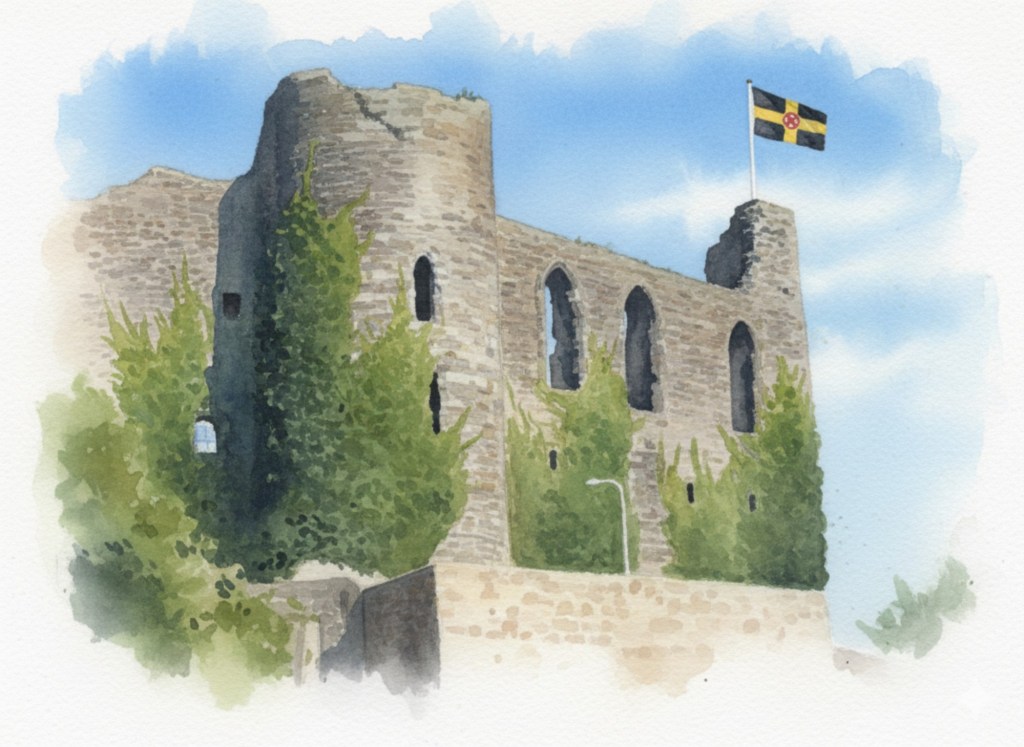
    Haverfordwest castle
    Historic ruins of Haverfordwest Castle

    STOP 1: THE CASTLE RUINS
    Stand at the base of the castle ruins and look out over the town. This is where it all began — but not with the Welsh, and not quite with the Normans.

    THE FLEMISH SECRET
    In the 12th century, Henry I didn’t trust English or Norman lords to hold this strategic position. Instead, he planted Flemish settlers here — refugees and mercenaries from what is now Belgium. The castle’s first “Lord” wasn’t a baron in fancy armour but Tancred the Fleming, a hard man for a hard border.

    For centuries, Haverfordwest was a linguistic island. Walk north five miles and you’d hear Welsh. Walk through the town gates and you’d hear a unique dialect — English, yes, but thick with Flemish words and rhythms. This was Little Flanders, not Little England.

    Look for the remains of the castle’s twin-towered gatehouse. Imagine Flemish merchants, not Welsh princes, walking beneath it.


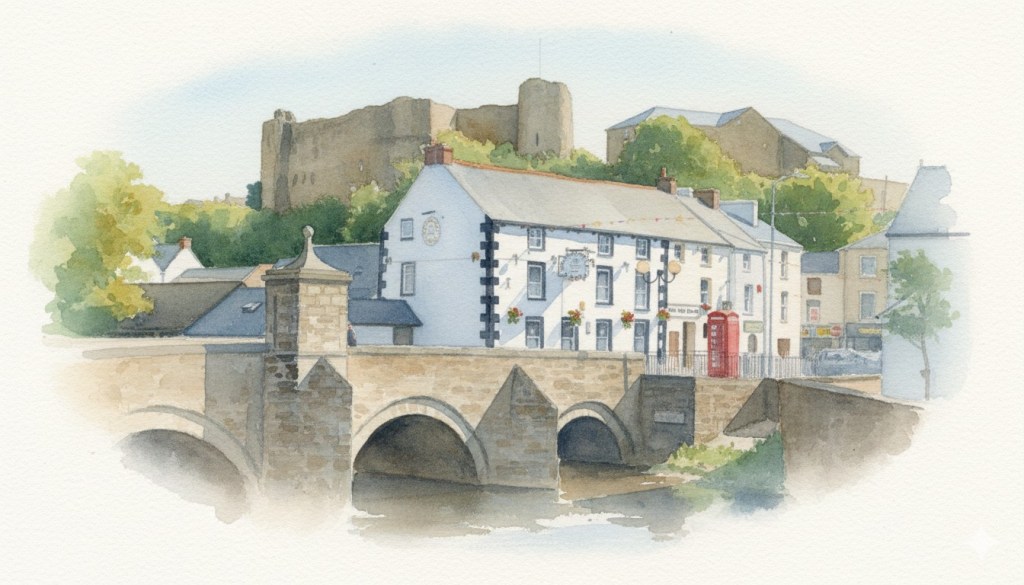
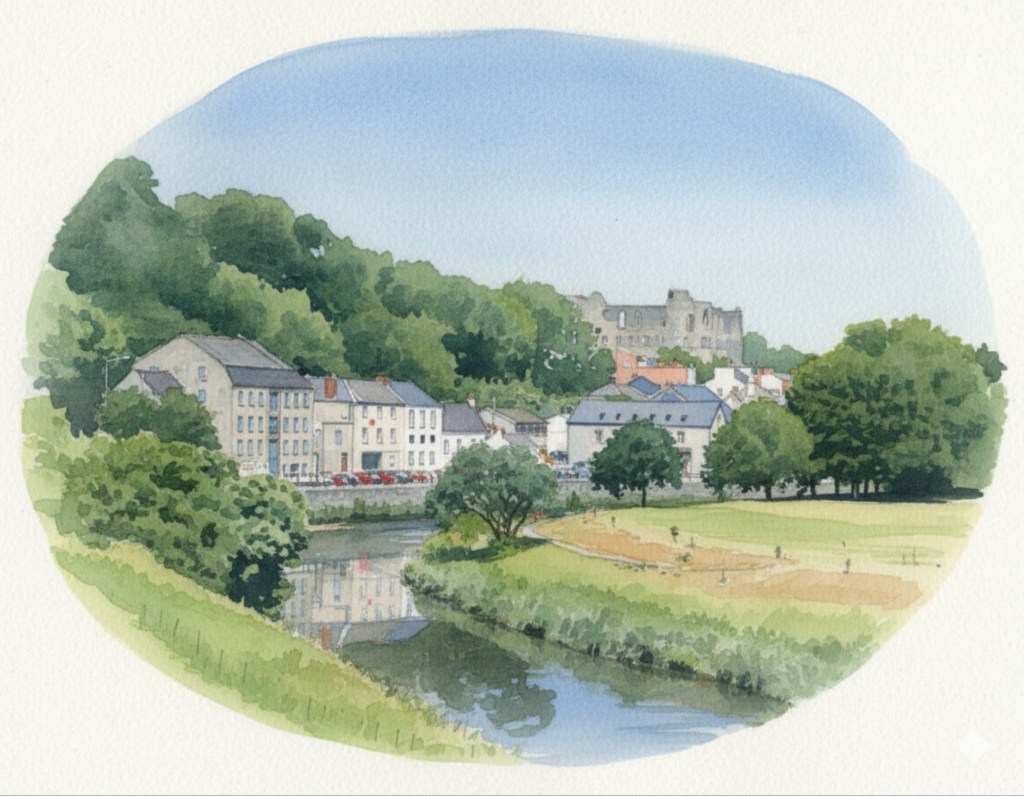
    Scenic view of Haverfordwest, a Welsh town
    Harfordwest. Scenic view of the Welsh town

    STOP 2: FRIARS LANE & THE BLACK FRIARS SITE
    From the castle, walk down Castle Square toward High Street, then turn left down Bridge Street. Look for Friars Lane on your right.

    This narrow lane once led to the Black Friars monastery, dissolved by Henry VIII in 1538. But what archaeologists found here was far from peaceful.

    THE CRIME SCENE
    Over 300 skeletons were excavated from this site. Many showed signs of severe head trauma — not from battle, but from tavern brawls, street fights, and “urban violence.” Medieval Haverfordwest was a frontier boomtown, and it seems the monks buried more than just their brothers.

    THE HOLE IN THE WALL
    Local legend speaks of a literal hole in the monastery wall where friars would pass bread and ale to the poor — a medieval soup kitchen. Today, the pubs of Haverfordwest continue that tradition in spirit, if not in charity.

    Modern landmark: Look for the “Friars Vaults” or any old stonework that hints at monastic foundations.


    St Martin Street Haverfordwest Pembrokeshire
    St Martin Street Haverfordwest Pembrokeshire with the castle in the background

    STOP 3: THE OLD BRIDGE (ST MARTIN’S BRIDGE)
    Continue down Bridge Street to the river. Cross via the newer bridge, then walk downstream to view the Old Bridge from the riverside path.

    This unassuming stone bridge is where a dynasty was born.

    THE TUDOR MARCH
    On August 7, 1485, Henry Tudor landed at Mill Bay with a ragtag army of French mercenaries and Welsh supporters. He needed to reach England fast, before Richard III could crush him. His route? Straight through Haverfordwest and across this ford.

    The bridge you see today dates from 1726, but it sits on the exact crossing point where Henry VII — grandfather of Elizabeth I, founder of the Tudor line — marched toward Bosworth Field and the throne of England. Every British monarch since has descended from the man who crossed this river.

    Pause here. You’re standing where history changed.


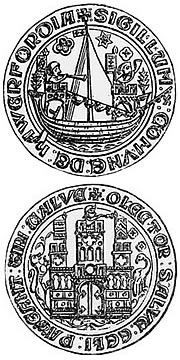
    Haverfordwest borough town seal

    STOP 4: THE GUILDHALL / TOWN HALL
    Retrace your steps back up Bridge Street toward High Street. The Guildhall is near the town centre.

    Most towns have modest seals — a lion, maybe a ship. Haverfordwest went absolutely wild.

    THE BONKERS TOWN SEAL
    Carved into civic memory is one of the most chaotic heraldic designs in Wales: A ship with mariners blowing trumpets
    A castle with a man on the tower also blowing trumpets
    A wyvern (two-legged dragon)
    A lion
    An eagle
    And a Latin inscription that translates roughly to: “O reader, hail! May the gates of Heaven stand open for thee.”

    It’s part warning, part boast, part prayer. This was a town that needed to announce itself loudly — because it was surrounded by people who spoke a different language and followed different lords.

    If the Guildhall is open, ask to see the seal or historical displays inside.


    STOP 5: THE “HAUNTED” HOUSE MYSTERY
    Exact location withheld — but it’s a normal-looking terraced house somewhere in the residential streets off High Street.

    Haverfordwest’s ghosts aren’t confined to the castle. In the late 1980s and early 1990s, a local family documented their experiences in a book titled The Haunting of Haverfordwest — accounts of “shadow men,” unexplained phenomena, and genuine terror in a modern home.

    Why this matters: In a town this old, where Flemish merchants haggled, monks buried brawlers, and a future king crossed the river in secret, the past doesn’t always stay buried. History has layers here, and sometimes those layers bleed through.

    The tour rule: We don’t point out the house. If you live somewhere this old, you learn to live with its ghosts.


    TOUR END
    Return to Castle Square. You’ve circled the heart of Haverfordwest — Flemish capital, Tudor crossroads, frontier boomtown, and haunted survivor. Finish at one of the pubs near the castle — they’re continuing a 900-year-old tradition.

    FINAL THOUGHT
    Most tourists rush through on their way to the beaches. But Haverfordwest isn’t a stop — it’s a story. And now you know the version they don’t put in the guidebooks.


    If you find my photography or my writing inspiring and uplifting, consider supporting what I do. Buy me a coffee on Ko-fi.
    Your support makes a difference in my life and helps me create more of what you, and I, like. Thank you!
    Tap here for a list of 100 endangered animals and plants.

    100 endangered plant and animal species

    * Abies beshanzuensis (Baishan fir) – Plant (Tree) – Baishanzu Mountain, Zhejiang, China – Three mature individuals

    * Actinote zikani – Insect (butterfly) – Near São Paulo, Atlantic forest, Brazil – Unknown numbers

    * Aipysurus foliosquama (Leaf scaled sea-snake) – Reptile – Ashmore Reef and Hibernia Reef, Timor Sea – Unknown numbers * Amanipodagrion gilliesi (Amani flatwing) – Insect (damselfly) – Amani-Sigi Forest, Usamabara Mountains, Tanzania – < 500 individuals * Antisolabis seychellensis – Insect – Morne Blanc, Mahé island, Seychelles – Unknown numbers * Antilophia bokermanni (Araripe manakin) – Bird – Chapado do Araripe, South Ceará, Brazil – 779 individuals * Aphanius transgrediens (Aci Göl toothcarp) – Fish – south-eastern shore of former Lake Aci, Turkey – Few hundred pairs * Aproteles bulmerae (Bulmer’s fruit bat) – Mammal – Luplupwintern Cave, Western Province, Papua New Guinea – 150 * Ardea insignis (White bellied heron) – Bird – Bhutan, North East India and Myanmar – 70–400 individuals * Ardeotis nigriceps (Great Indian bustard) – Bird – Rajasthan, Gujarat, Maharashtra, Andhra Pradesh, Karnataka and Madhya, India – 50–249 mature individuals * Astrochelys yniphora (Ploughshare tortoise) – Reptile – Baly Bay region, northwestern Madagascar – 440–770 * Atelopus balios (Rio Pescado stubfoot toad) – Amphibian – Azuay, Cañar and Guyas provinces, south-western Ecuador – Unknown numbers * Aythya innotata (Madagascar pochard) – Bird – volcanic lakes north of Bealanana, Madagascar – 80 mature individuals * Azurina eupalama (Galapagos damsel fish) – Fish – Unknown numbers – Unknown numbers * Bahaba taipingensis (Giant yellow croaker) – Fish – Chinese coast from Yangtze River, China to Hong Kong – Unknown numbers * Batagur baska (Common batagur) – Reptile (turtle) – Bangladesh, Cambodia, India, Indonesia and Malaysia – Unknown numbers * Bazzania bhutanica – Plant – Budini and Lafeti Khola, Bhutan – 2 sub-populations * Beatragus hunteri (Hirola) – Mammal (antelope) – South-east Kenya and possibly south-west Somalia – < 1,000 individuals * Bombus franklini (Franklin’s bumblebee) – Insect (bee) – Oregon and California – Unknown numbers * Brachyteles hypoxanthus (Northern muriqui / Woolly spider monkey) – Mammal (primate) – Atlantic forest, south-eastern Brazil – < 1,000 * Bradypus pygmaeus (Pygmy three-toed sloth) – Mammal – Isla Escudo de Veraguas, Panama – < 500 * Callitriche pulchra – Plant (freshwater) – pool on Gavdos, Greece – Unknown numbers * Calumma tarzan (Tarzan’s chameleon) – Reptile – Anosibe An’Ala region, eastern Madagascar – < 100 * Cavia intermedia (Santa Catarina’s guinea pig) – Mammal (rodent) – Moleques do Sul Island, Santa Catarina, Brazil – 40–60 * Cercopithecus roloway (Roloway guenon) – Mammal (primate) – Côte d’Ivoire – Unknown numbers * Coleura seychellensis (Seychelles sheath-tailed bat) – Mammal (bat) – Two small caves on Silhouette and Mahé, Seychelles – < 100 * Cryptomyces maximus (Willow blister) – Fungi – Pembrokeshire, United Kingdom – Unknown numbers * Cryptotis nelsoni (Nelson’s small-eared shrew) – Mammal (shrew) – Volcán San Martín Tuxtla, Veracruz, Mexico – Unknown numbers * Cyclura collei (Jamaican iguana / Jamaican rock iguana) – Reptile – Hellshire Hills, Jamaica – Unknown numbers * Daubentonia madagascariensis (Aye-aye) – Mammal (primate) – Deciduous forest, East Madagascar – Unknown numbers * Dendrophylax fawcettii (Cayman Islands ghost orchid) – Plant (orchid) – Ironwood Forest, George Town, Grand Cayman – Unknown numbers * Dicerorhinus sumatrensis (Sumatran rhino) – Mammal (rhino) – Sabah, Sarawak and Peninsular Malaysia, Kalimantan and Sumatra, Indonesia – < 100 (more recent estimates suggest 34-47) * Diomedea amsterdamensis (Amsterdam albatross) – Bird – Breeds on Plateuau des Tourbières, Amsterdam Island, Indian Ocean. – 100 mature individuals * Dioscorea strydomiana (Wild yam) – Plant – Oshoek area, Mpumalanga, South Africa – 200 * Diospyros katendei – Plant (tree) – Kasyoha-Kitomi Forest Reserve, Uganda – 20 individuals in a single population * Dipterocarpus lamellatus – Plant (tree) – Siangau Forest Reserve, Sabah, Malaysia – 12 individuals * Discoglossus nigriventer (Hula painted frog) – Amphibian – Hula Valley, Israel – Unknown numbers * Dombeya mauritiana – Plant – Mauritius – Unknown numbers * Elaeocarpus bojeri (Bois Dentelle) – Plant (tree) – Grand Bassin, Mauritius – < 10 individuals * Eleutherodactylus glandulifer (La Hotte glanded frog) – Amphibian – Massif de la Hotte, Haiti – Unknown numbers * Eleutherodactylus thorectes (Macaya breast-spot frog) – Amphibian – Formon and Macaya peaks, Masif de la Hotte, Haiti – Unknown numbers * Eriosyce chilensis (Chilenito (cactus)) – Plant – Pta Molles and Pichidungui, Chile – < 500 individuals * Erythrina schliebenii (Coral tree) – Plant – Namatimbili-Ngarama Forest, Tanzania – < 50 individuals * Euphorbia tanaensis – Plant (tree) – Witu Forest Reserve, Kenya – 4 mature individuals * Eurynorhyncus pygmeus (Spoon-billed sandpiper) – Bird – Breeds in Russia, migrates along the East Asian-Australasian Flyway to wintering grounds in India, Bangladesh and Myanmar – 100 breeding pairs * Ficus katendei – Plant – Kasyoha-Kitomi Forest Reserve, Ishasha River, Uganda – < 50 mature individuals * Geronticus eremita (Northern bald ibis) – Bird – Breeds in Morocco, Turkey and Syria. Syrian population winters in central Ethiopia. – About 3000 individuals * Gigasiphon macrosiphon – Plant (flower) – Kaya Muhaka, Gongoni and Mrima Forest Reserves, Kenya, Amani Nature Reserve, West Kilombero Scarp Forest Reserve, and Kihansi Gorge, Tanzania – 33 * Gocea ohridana – Mollusc – Lake Ohrid, Macedonia – Unknown numbers * Heleophryne rosei (Table mountain ghost frog) – Amphibian – Table Mountain, Western Cape Province, South Africa – Unknown numbers * Hemicycla paeteliana – Mollusc (land snail) – Jandia peninsula, Fuerteventura, Canary Islands – Unknown numbers * Heteromirafa sidamoensis (Liben lark) – Bird – Liben Plains, southern Ethiopia – 90–256 * Hibiscadelphus woodii – Plant (tree) – Kalalau Valley, Hawaii – Unknown numbers * Hucho perryi (Sakhalin taimen) – Fish – Russian and Japanese rivers, Pacific Ocean between Russia and Japan – Unknown numbers * Johora singaporensis (Singapore freshwater crab) – Crustacean – Bukit Timah Nature Reserve and streamlet near Bukit Batok, Singapore – Unknown numbers * Lathyrus belinensis (Belin vetchling) – Plant – Outskirts of Belin village, Antalya, Turkey – < 1,000 * Leiopelma archeyi (Archey’s frog) – Amphibian – Coromandel peninsula and Whareorino Forest, New Zealand – Unknown numbers * Lithobates sevosus (Dusky gopher frog) – Amphibian – Harrison County, Mississippi, USA – 60–100 * Lophura edwardsi (Edwards’s pheasant) – Bird – Quang Binh, Quang Tri and Thua Thien-Hue, Viet Nam – Unknown numbers * Magnolia wolfii – Plant (tree) – Risaralda, Colombia – 3 * Margaritifera marocana – Mollusc – Oued Denna, Oued Abid and Oued Beth, Morocco – < 250 * Moominia willii – Mollusc (snail) – Silhouette Island, Seychelles – < 500 * Natalus primus (Cuban greater funnel eared bat) – Mammal (bat) – Cueva La Barca, Isle of Pines, Cuba – < 100 * Nepenthes attenboroughii (Attenborough’s pitcher plant) – Plant – Mount Victoria, Palawan, Philippines – Unknown numbers * Nomascus hainanus (Hainan black crested gibbon) – Mammal (primate) – Hainan Island, China – 20 * Neurergus kaiseri (Luristan newt) – Amphibian – Zagros Mountains, Lorestan, Iran – < 1,000 * Oreocnemis phoenix (Mulanje red damsel) – Insect (damselfly) – Mulanje Plateau, Malawi – Unknown numbers * Pangasius sanitwongsei (Pangasid catfish) – Fish – Chao Phraya and Mekong basins in Cambodia, China, Lao PDR, Thailand and Viet Nam – Unknown numbers * Parides burchellanus – Insect (butterfly) – Cerrado, Brazil – < 100 * Phocoena sinus (Vaquita) – Mammal (porpoise) – Northern Gulf of California, Mexico – 12 * Picea neoveitchii (Type of spruce tree) – Plant (tree) – Qinling Range, China – Unknown numbers * Pinus squamata (Qiaojia pine) – Plant (tree) – Qiaojia, Yunnan, China – < 25 * Poecilotheria metallica (Gooty tarantula / Metallic tarantula / Peacock tarantula / Salepurgu) – Spider – Nandyal and Giddalur, Andhra Pradesh, India – Unknown numbers * Pomarea whitneyi (Fatuhiva monarch) – Bird – Fatu Hiva, Marquesas Islands, French Polynesia – 50 * Pristis pristis (Common sawfish) – Fish – Coastal tropical and subtropical waters of Indo-Pacific and Atlantic Oceans. Currently largely restricted to northern Australia – Unknown numbers * Hapalemur simus (Greater bamboo lemur) – Mammal (primate) – Southeastern and southcentral rainforests of Madagascar – 500 * Propithecus candidus (Silky sifaka) – Mammal (primate) – Maroantsetra to Andapa basin, and Marojeju Massif, Madagascar – 100–1,000 * Psammobates geometricus (Geometric tortoise) – Reptile – Western Cape Province, South Africa – Unknown numbers * Pseudoryx nghetinhensis (Saola) – Mammal – Annamite mountains, on the Viet Nam – PDR Laos border – Unknown numbers * Psiadia cataractae – Plant – Mauritius – Unknown numbers * Psorodonotus ebneri (Beydaglari bush-cricket) – Insect – Beydaglari range, Antalaya, Turkey – Unknown numbers * Rafetus swinhoei (Red River giant softshell turtle) – Reptile – Hoan Kiem Lake and Dong Mo Lake, Viet Nam, and Suzhou Zoo, China – 3 * Rhinoceros sondaicus (Javan rhino) – Mammal (rhino) – Ujung Kulon National Park, Java, Indonesia – < 100 * Rhinopithecus avunculus (Tonkin snub-nosed monkey) – Mammal (primate) – Northeastern Vietnam – < 200 * Rhizanthella gardneri (West Australian underground orchid) – Plant (orchid) – Western Australia, Australia – < 100 * Rhynchocyon spp. (Boni giant sengi) – Mammal – Boni-Dodori Forest, Lamu area, Kenya – Unknown numbers * Risiocnemis seidenschwarzi (Cebu frill-wing) – Insect (damselfly) – Rivulet beside the Kawasan River, Cebu, Philippines – Unknown numbers * Rosa arabica – Plant – St Katherine Mountains, Egypt – Unknown numbers, 10 sub-populations * Salanoia durrelli (Durrell’s vontsira) – Mammal (mongoose) – Marshes of Lake Alaotra, Madagascar – Unknown numbers * Santamartamys rufodorsalis (Red crested tree rat) – Mammal (rodent) – Sierra Nevada de Santa Marta, Colombia – Unknown numbers * Scaturiginichthys vermeilipinnis (Red-finned blue-eye) – Fish – Edgbaston Station, central western Queensland, Australia – 2,000–4,000 * Squatina squatina (Angel shark) – Fish – Canary Islands – Unknown numbers * Sterna bernsteini (Chinese crested tern) – Bird – Breeding in Zhejiang and Fujian, China. Outside breeding season in Indonesia, Malaysia, Philippines, Taiwan, Thailand. – < 50 * Syngnathus watermeyeri (Estuarine pipefish) – Fish – Kariega Estuary to East Kleinemonde Estuary, Eastern Cape Province, South Africa – Unknown numbers * Tahina spectabilis (Suicide palm / Dimaka) – Plant – Analalava district, north-western Madagascar – 90 * Telmatobufo bullocki (Bullock’s false toad) – Amphibian (frog) – Nahuelbuta, Arauco Province, Chile – Unknown numbers * Tokudaia muenninki (Okinawa spiny rat) – Mammal (rodent) – Okinawa Island, Japan – Unknown numbers * Trigonostigma somphongsi (Somphongs’s rasbora) – Fish – Mae Khlong basin, Thailand – Unknown numbers * Valencia letourneuxi – Fish – Southern Albania and Western Greece – Unknown numbers * Voanioala gerardii (Forest coconut) – Plant – Masoala peninsula, Madagascar – < 10 * Zaglossus attenboroughi (Attenborough’s echidna) – Mammal – Cyclops Mountains, Papua Province, Indonesia – Unknown numbers

    Tap to view my redbubble gallery.
  • The Church That the Sea Claimed: Cwm-yr-Eglwys

    The Church That the Sea Claimed: Cwm-yr-Eglwys

    Imagine this: it’s 1859, and you’re sheltering from a ferocious storm in the small coastal village of Cwm-yr-Eglwys, Pembrokeshire. The wind howls with a fury you’ve never heard before, and the sea—normally kept at bay by the shore—is rising with terrifying power.

    Cwm-yr-eglwys church Pembrokeshire
    Cwm-yr-eglwys Church, Pembrokeshire

    The Night Everything Changed
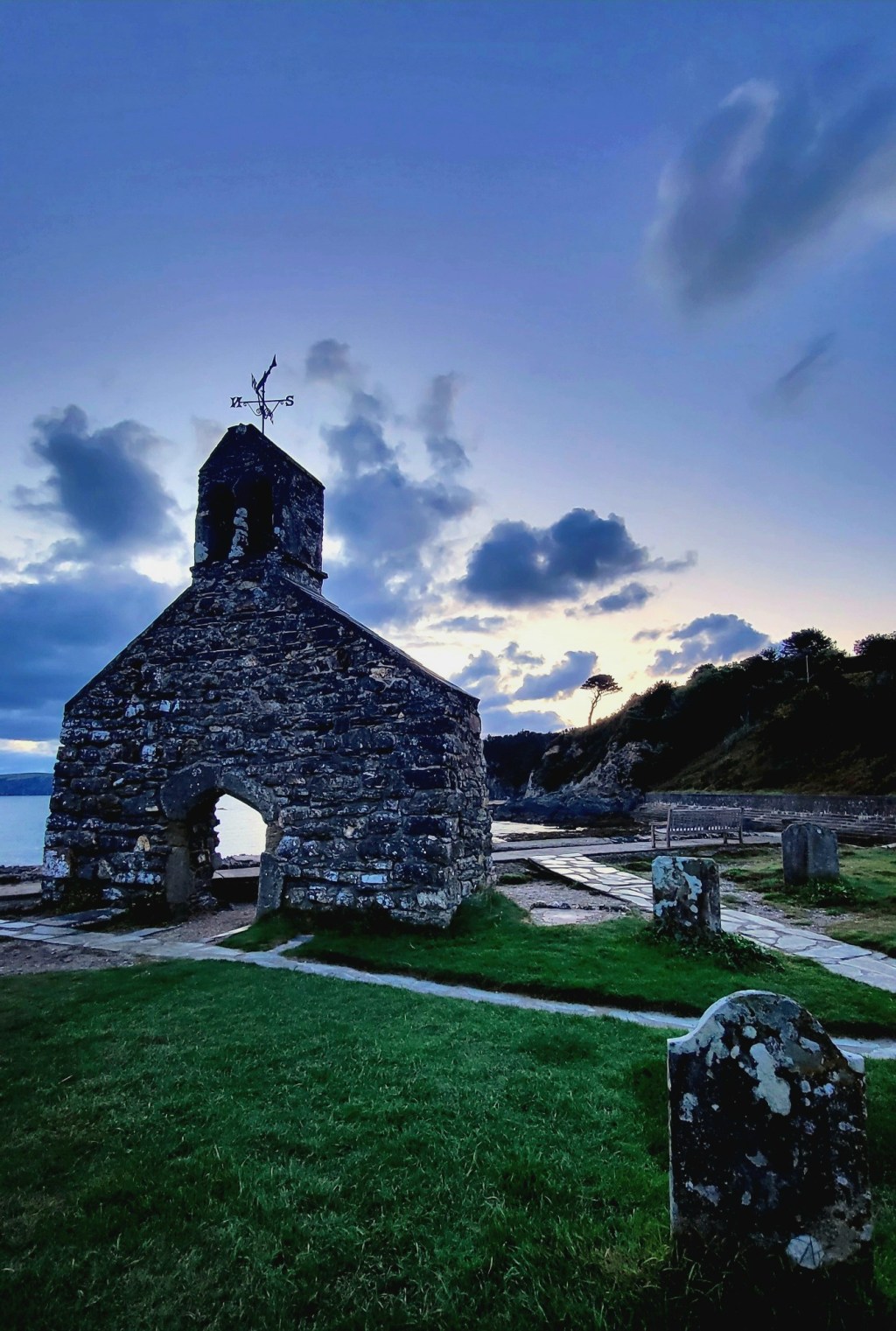
    On October 25, 1859, the Royal Charter Storm struck the Welsh coast with devastating force. Named after the ship wrecked off Anglesey with over 450 souls lost, this tempest brought wind speeds estimated at 100 mph and record-low barometric pressure.

    At Cwm-yr-Eglwys, St Brynach’s Church—a medieval building that had served the community for centuries—faced the full fury of the storm. Massive waves crashed over the sea wall and surged into the building. The roof was torn away, the north wall collapsed, and much of the church was dragged into the sea.

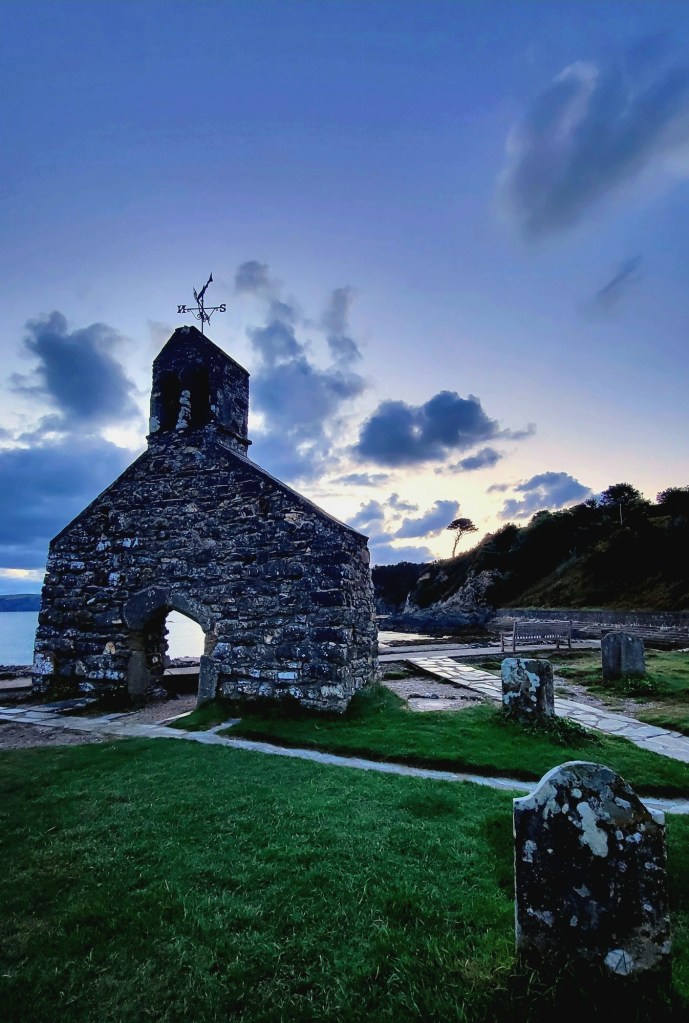
    By morning, only the western gable end with its distinctive bellcote remained standing. Everything else had been claimed by the waves.

    A Fragment That Endures
    St Brynach’s was the heart of this small community—a place where generations had been baptized, married, and buried. After the devastation, it was too damaged to repair, and a new church was eventually built further inland, beyond the reach of the sea.

    The ruins were left where they fell, and over 160 years later, that single wall still stands. Today, it’s one of Pembrokeshire’s most photographed landmarks—a haunting silhouette against the sea, with empty window frames open to the sky and weathered gravestones leaning in the coastal winds.

    Beauty in Loss
    On a calm day, it’s almost impossible to imagine the violence of that October night. But the silent stones tell their story: of a community that built too close to the waves, and of the night when the sea came to reclaim its own.


    If you find my photography or my writing inspiring and uplifting, consider supporting what I do. Buy me a coffee on Ko-fi.
    Your support makes a difference in my life and helps me create more of what you, and I, like. Thank you!
    Tap here for a list of 100 endangered animals and plants.

    100 endangered plant and animal species

    * Abies beshanzuensis (Baishan fir) – Plant (Tree) – Baishanzu Mountain, Zhejiang, China – Three mature individuals

    * Actinote zikani – Insect (butterfly) – Near São Paulo, Atlantic forest, Brazil – Unknown numbers

    * Aipysurus foliosquama (Leaf scaled sea-snake) – Reptile – Ashmore Reef and Hibernia Reef, Timor Sea – Unknown numbers * Amanipodagrion gilliesi (Amani flatwing) – Insect (damselfly) – Amani-Sigi Forest, Usamabara Mountains, Tanzania – < 500 individuals * Antisolabis seychellensis – Insect – Morne Blanc, Mahé island, Seychelles – Unknown numbers * Antilophia bokermanni (Araripe manakin) – Bird – Chapado do Araripe, South Ceará, Brazil – 779 individuals * Aphanius transgrediens (Aci Göl toothcarp) – Fish – south-eastern shore of former Lake Aci, Turkey – Few hundred pairs * Aproteles bulmerae (Bulmer’s fruit bat) – Mammal – Luplupwintern Cave, Western Province, Papua New Guinea – 150 * Ardea insignis (White bellied heron) – Bird – Bhutan, North East India and Myanmar – 70–400 individuals * Ardeotis nigriceps (Great Indian bustard) – Bird – Rajasthan, Gujarat, Maharashtra, Andhra Pradesh, Karnataka and Madhya, India – 50–249 mature individuals * Astrochelys yniphora (Ploughshare tortoise) – Reptile – Baly Bay region, northwestern Madagascar – 440–770 * Atelopus balios (Rio Pescado stubfoot toad) – Amphibian – Azuay, Cañar and Guyas provinces, south-western Ecuador – Unknown numbers * Aythya innotata (Madagascar pochard) – Bird – volcanic lakes north of Bealanana, Madagascar – 80 mature individuals * Azurina eupalama (Galapagos damsel fish) – Fish – Unknown numbers – Unknown numbers * Bahaba taipingensis (Giant yellow croaker) – Fish – Chinese coast from Yangtze River, China to Hong Kong – Unknown numbers * Batagur baska (Common batagur) – Reptile (turtle) – Bangladesh, Cambodia, India, Indonesia and Malaysia – Unknown numbers * Bazzania bhutanica – Plant – Budini and Lafeti Khola, Bhutan – 2 sub-populations * Beatragus hunteri (Hirola) – Mammal (antelope) – South-east Kenya and possibly south-west Somalia – < 1,000 individuals * Bombus franklini (Franklin’s bumblebee) – Insect (bee) – Oregon and California – Unknown numbers * Brachyteles hypoxanthus (Northern muriqui / Woolly spider monkey) – Mammal (primate) – Atlantic forest, south-eastern Brazil – < 1,000 * Bradypus pygmaeus (Pygmy three-toed sloth) – Mammal – Isla Escudo de Veraguas, Panama – < 500 * Callitriche pulchra – Plant (freshwater) – pool on Gavdos, Greece – Unknown numbers * Calumma tarzan (Tarzan’s chameleon) – Reptile – Anosibe An’Ala region, eastern Madagascar – < 100 * Cavia intermedia (Santa Catarina’s guinea pig) – Mammal (rodent) – Moleques do Sul Island, Santa Catarina, Brazil – 40–60 * Cercopithecus roloway (Roloway guenon) – Mammal (primate) – Côte d’Ivoire – Unknown numbers * Coleura seychellensis (Seychelles sheath-tailed bat) – Mammal (bat) – Two small caves on Silhouette and Mahé, Seychelles – < 100 * Cryptomyces maximus (Willow blister) – Fungi – Pembrokeshire, United Kingdom – Unknown numbers * Cryptotis nelsoni (Nelson’s small-eared shrew) – Mammal (shrew) – Volcán San Martín Tuxtla, Veracruz, Mexico – Unknown numbers * Cyclura collei (Jamaican iguana / Jamaican rock iguana) – Reptile – Hellshire Hills, Jamaica – Unknown numbers * Daubentonia madagascariensis (Aye-aye) – Mammal (primate) – Deciduous forest, East Madagascar – Unknown numbers * Dendrophylax fawcettii (Cayman Islands ghost orchid) – Plant (orchid) – Ironwood Forest, George Town, Grand Cayman – Unknown numbers * Dicerorhinus sumatrensis (Sumatran rhino) – Mammal (rhino) – Sabah, Sarawak and Peninsular Malaysia, Kalimantan and Sumatra, Indonesia – < 100 (more recent estimates suggest 34-47) * Diomedea amsterdamensis (Amsterdam albatross) – Bird – Breeds on Plateuau des Tourbières, Amsterdam Island, Indian Ocean. – 100 mature individuals * Dioscorea strydomiana (Wild yam) – Plant – Oshoek area, Mpumalanga, South Africa – 200 * Diospyros katendei – Plant (tree) – Kasyoha-Kitomi Forest Reserve, Uganda – 20 individuals in a single population * Dipterocarpus lamellatus – Plant (tree) – Siangau Forest Reserve, Sabah, Malaysia – 12 individuals * Discoglossus nigriventer (Hula painted frog) – Amphibian – Hula Valley, Israel – Unknown numbers * Dombeya mauritiana – Plant – Mauritius – Unknown numbers * Elaeocarpus bojeri (Bois Dentelle) – Plant (tree) – Grand Bassin, Mauritius – < 10 individuals * Eleutherodactylus glandulifer (La Hotte glanded frog) – Amphibian – Massif de la Hotte, Haiti – Unknown numbers * Eleutherodactylus thorectes (Macaya breast-spot frog) – Amphibian – Formon and Macaya peaks, Masif de la Hotte, Haiti – Unknown numbers * Eriosyce chilensis (Chilenito (cactus)) – Plant – Pta Molles and Pichidungui, Chile – < 500 individuals * Erythrina schliebenii (Coral tree) – Plant – Namatimbili-Ngarama Forest, Tanzania – < 50 individuals * Euphorbia tanaensis – Plant (tree) – Witu Forest Reserve, Kenya – 4 mature individuals * Eurynorhyncus pygmeus (Spoon-billed sandpiper) – Bird – Breeds in Russia, migrates along the East Asian-Australasian Flyway to wintering grounds in India, Bangladesh and Myanmar – 100 breeding pairs * Ficus katendei – Plant – Kasyoha-Kitomi Forest Reserve, Ishasha River, Uganda – < 50 mature individuals * Geronticus eremita (Northern bald ibis) – Bird – Breeds in Morocco, Turkey and Syria. Syrian population winters in central Ethiopia. – About 3000 individuals * Gigasiphon macrosiphon – Plant (flower) – Kaya Muhaka, Gongoni and Mrima Forest Reserves, Kenya, Amani Nature Reserve, West Kilombero Scarp Forest Reserve, and Kihansi Gorge, Tanzania – 33 * Gocea ohridana – Mollusc – Lake Ohrid, Macedonia – Unknown numbers * Heleophryne rosei (Table mountain ghost frog) – Amphibian – Table Mountain, Western Cape Province, South Africa – Unknown numbers * Hemicycla paeteliana – Mollusc (land snail) – Jandia peninsula, Fuerteventura, Canary Islands – Unknown numbers * Heteromirafa sidamoensis (Liben lark) – Bird – Liben Plains, southern Ethiopia – 90–256 * Hibiscadelphus woodii – Plant (tree) – Kalalau Valley, Hawaii – Unknown numbers * Hucho perryi (Sakhalin taimen) – Fish – Russian and Japanese rivers, Pacific Ocean between Russia and Japan – Unknown numbers * Johora singaporensis (Singapore freshwater crab) – Crustacean – Bukit Timah Nature Reserve and streamlet near Bukit Batok, Singapore – Unknown numbers * Lathyrus belinensis (Belin vetchling) – Plant – Outskirts of Belin village, Antalya, Turkey – < 1,000 * Leiopelma archeyi (Archey’s frog) – Amphibian – Coromandel peninsula and Whareorino Forest, New Zealand – Unknown numbers * Lithobates sevosus (Dusky gopher frog) – Amphibian – Harrison County, Mississippi, USA – 60–100 * Lophura edwardsi (Edwards’s pheasant) – Bird – Quang Binh, Quang Tri and Thua Thien-Hue, Viet Nam – Unknown numbers * Magnolia wolfii – Plant (tree) – Risaralda, Colombia – 3 * Margaritifera marocana – Mollusc – Oued Denna, Oued Abid and Oued Beth, Morocco – < 250 * Moominia willii – Mollusc (snail) – Silhouette Island, Seychelles – < 500 * Natalus primus (Cuban greater funnel eared bat) – Mammal (bat) – Cueva La Barca, Isle of Pines, Cuba – < 100 * Nepenthes attenboroughii (Attenborough’s pitcher plant) – Plant – Mount Victoria, Palawan, Philippines – Unknown numbers * Nomascus hainanus (Hainan black crested gibbon) – Mammal (primate) – Hainan Island, China – 20 * Neurergus kaiseri (Luristan newt) – Amphibian – Zagros Mountains, Lorestan, Iran – < 1,000 * Oreocnemis phoenix (Mulanje red damsel) – Insect (damselfly) – Mulanje Plateau, Malawi – Unknown numbers * Pangasius sanitwongsei (Pangasid catfish) – Fish – Chao Phraya and Mekong basins in Cambodia, China, Lao PDR, Thailand and Viet Nam – Unknown numbers * Parides burchellanus – Insect (butterfly) – Cerrado, Brazil – < 100 * Phocoena sinus (Vaquita) – Mammal (porpoise) – Northern Gulf of California, Mexico – 12 * Picea neoveitchii (Type of spruce tree) – Plant (tree) – Qinling Range, China – Unknown numbers * Pinus squamata (Qiaojia pine) – Plant (tree) – Qiaojia, Yunnan, China – < 25 * Poecilotheria metallica (Gooty tarantula / Metallic tarantula / Peacock tarantula / Salepurgu) – Spider – Nandyal and Giddalur, Andhra Pradesh, India – Unknown numbers * Pomarea whitneyi (Fatuhiva monarch) – Bird – Fatu Hiva, Marquesas Islands, French Polynesia – 50 * Pristis pristis (Common sawfish) – Fish – Coastal tropical and subtropical waters of Indo-Pacific and Atlantic Oceans. Currently largely restricted to northern Australia – Unknown numbers * Hapalemur simus (Greater bamboo lemur) – Mammal (primate) – Southeastern and southcentral rainforests of Madagascar – 500 * Propithecus candidus (Silky sifaka) – Mammal (primate) – Maroantsetra to Andapa basin, and Marojeju Massif, Madagascar – 100–1,000 * Psammobates geometricus (Geometric tortoise) – Reptile – Western Cape Province, South Africa – Unknown numbers * Pseudoryx nghetinhensis (Saola) – Mammal – Annamite mountains, on the Viet Nam – PDR Laos border – Unknown numbers * Psiadia cataractae – Plant – Mauritius – Unknown numbers * Psorodonotus ebneri (Beydaglari bush-cricket) – Insect – Beydaglari range, Antalaya, Turkey – Unknown numbers * Rafetus swinhoei (Red River giant softshell turtle) – Reptile – Hoan Kiem Lake and Dong Mo Lake, Viet Nam, and Suzhou Zoo, China – 3 * Rhinoceros sondaicus (Javan rhino) – Mammal (rhino) – Ujung Kulon National Park, Java, Indonesia – < 100 * Rhinopithecus avunculus (Tonkin snub-nosed monkey) – Mammal (primate) – Northeastern Vietnam – < 200 * Rhizanthella gardneri (West Australian underground orchid) – Plant (orchid) – Western Australia, Australia – < 100 * Rhynchocyon spp. (Boni giant sengi) – Mammal – Boni-Dodori Forest, Lamu area, Kenya – Unknown numbers * Risiocnemis seidenschwarzi (Cebu frill-wing) – Insect (damselfly) – Rivulet beside the Kawasan River, Cebu, Philippines – Unknown numbers * Rosa arabica – Plant – St Katherine Mountains, Egypt – Unknown numbers, 10 sub-populations * Salanoia durrelli (Durrell’s vontsira) – Mammal (mongoose) – Marshes of Lake Alaotra, Madagascar – Unknown numbers * Santamartamys rufodorsalis (Red crested tree rat) – Mammal (rodent) – Sierra Nevada de Santa Marta, Colombia – Unknown numbers * Scaturiginichthys vermeilipinnis (Red-finned blue-eye) – Fish – Edgbaston Station, central western Queensland, Australia – 2,000–4,000 * Squatina squatina (Angel shark) – Fish – Canary Islands – Unknown numbers * Sterna bernsteini (Chinese crested tern) – Bird – Breeding in Zhejiang and Fujian, China. Outside breeding season in Indonesia, Malaysia, Philippines, Taiwan, Thailand. – < 50 * Syngnathus watermeyeri (Estuarine pipefish) – Fish – Kariega Estuary to East Kleinemonde Estuary, Eastern Cape Province, South Africa – Unknown numbers * Tahina spectabilis (Suicide palm / Dimaka) – Plant – Analalava district, north-western Madagascar – 90 * Telmatobufo bullocki (Bullock’s false toad) – Amphibian (frog) – Nahuelbuta, Arauco Province, Chile – Unknown numbers * Tokudaia muenninki (Okinawa spiny rat) – Mammal (rodent) – Okinawa Island, Japan – Unknown numbers * Trigonostigma somphongsi (Somphongs’s rasbora) – Fish – Mae Khlong basin, Thailand – Unknown numbers * Valencia letourneuxi – Fish – Southern Albania and Western Greece – Unknown numbers * Voanioala gerardii (Forest coconut) – Plant – Masoala peninsula, Madagascar – < 10 * Zaglossus attenboroughi (Attenborough’s echidna) – Mammal – Cyclops Mountains, Papua Province, Indonesia – Unknown numbers

    Tap to view my redbubble gallery.
  • Tenby: A Kaleidoscope of Charm on the Welsh Coast

    Tenby: A Kaleidoscope of Charm on the Welsh Coast

    Tenby
    Watercolour Softness

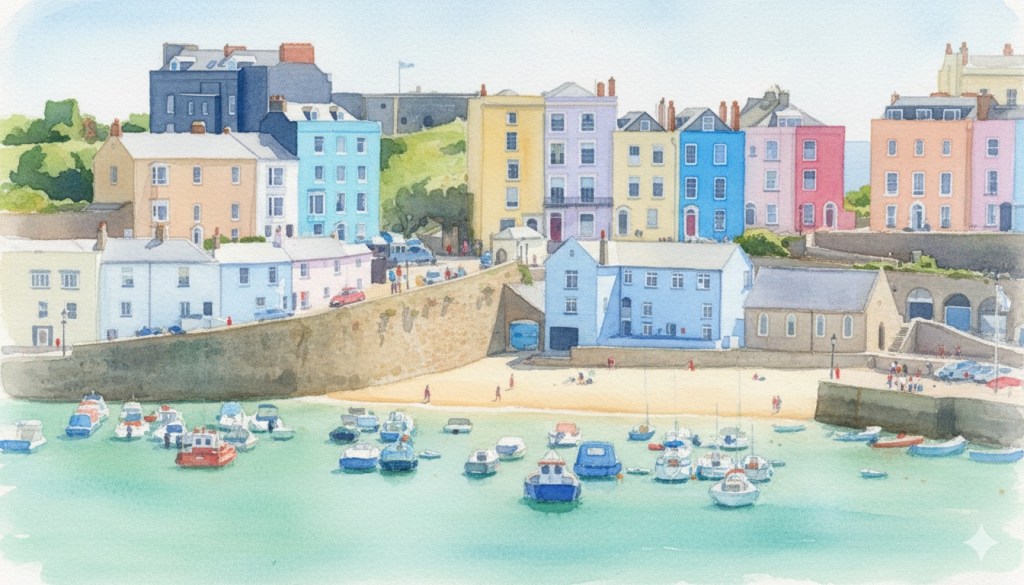
    If you’re dreaming of a coastal escape that blends historic charm with vibrant seaside life, look no further than Tenby. Nestled on the Pembrokeshire coast in Wales, this walled town is an absolute gem, captivating visitors with its stunning beaches, ancient fortifications, and that truly iconic harbour scene. Just look at it! The colourful Georgian and Victorian houses tumbling down to the bustling harbour are a sight to behold. It’s like something straight out of a postcard, or perhaps a particularly delightful watercolour.

    What Makes Tenby So Irresistible?
    The Colourful Harbour: As our image beautifully demonstrates, Tenby’s harbour is its beating heart and most recognisable feature. On a sunny day, the brightly painted houses reflect in the calm waters, where a flotilla of boats bobs gently. It’s the perfect spot for an ice cream, a seafood lunch, or simply to sit and soak in the atmosphere and sun.

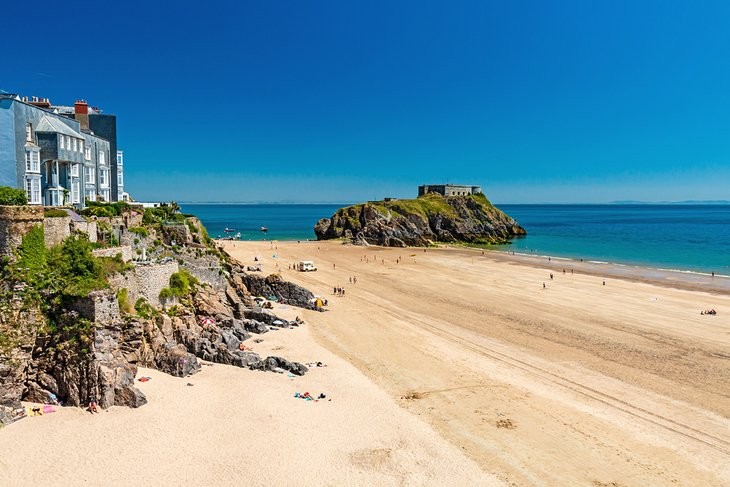
    Golden Sands & Blue Flag Beaches: Tenby boasts not one, but four incredible beaches. North Beach, South Beach, Castle Beach and Harbour Beach all offer pristine sands and crystal-clear waters, ideal for swimming, sunbathing, or building sandcastles. Castle Beach, in particular, with St. Catherine’s Island just offshore, feels like a scene from an adventure novel.

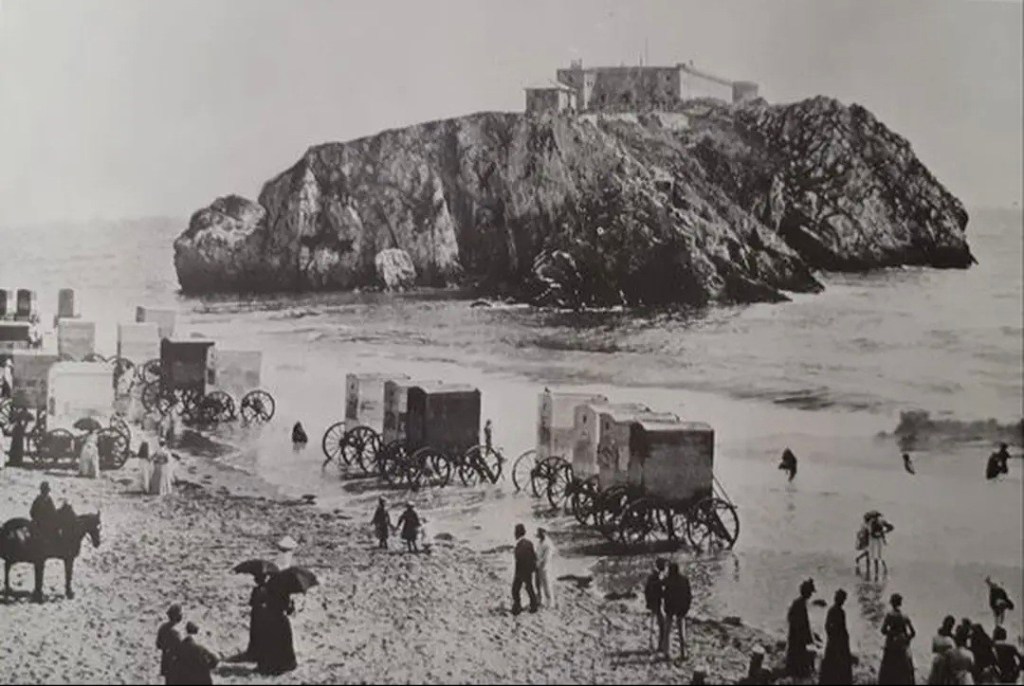
    St. Catherine’s Island
    St. Catherine’s Island 1895

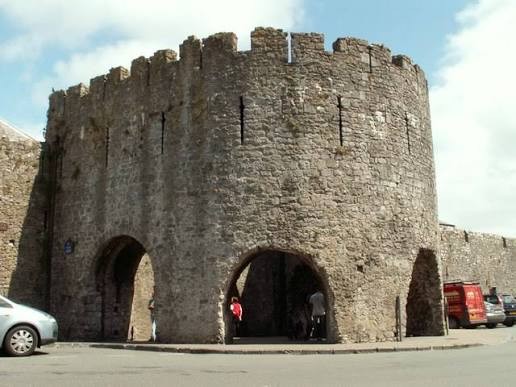
    A Rich History Within Ancient Walls: Step away from the beaches and you’re transported back in time. Tenby is one of the few remaining walled towns in the UK, and you can still walk along parts of its medieval walls. Explore the narrow, winding streets, discover independent shops, and imagine life within these protective ramparts centuries ago. Don’t miss Tenby Castle ruins on Castle Hill for panoramic views.

    Tenby’s Five Arches in the old wall.

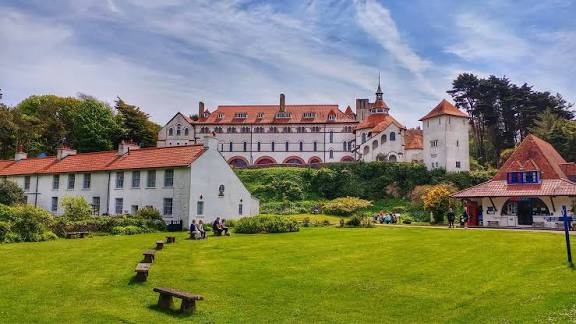
    Island Adventures: From the harbour, you can catch a boat trip to Caldey Island, a tranquil monastic island just a short distance away. Home to Cistercian monks, it offers a unique opportunity to experience peace and solitude, explore beautiful coves, and even buy some of their famous Caldey Island perfume or chocolate.

    Caldey Island Abbey

    Foodie Delights: Being a fishing town, it’s no surprise that Tenby serves up some fantastic fresh seafood. From casual fish and chips by the sea to upscale dining experiences, there’s something to tantalise every taste bud. And of course, no Welsh holiday is complete without trying a traditional Welsh cake!

    Whether you’re looking for an active holiday filled with watersports and coastal walks along the Pembrokeshire Coast Path, or a relaxing break soaking up the charm and history, Tenby delivers. It’s a town that truly has it all – vibrant colours, golden beaches, and a welcoming atmosphere that will make you want to return again and again.


    Have you visited Tenby? What was your favourite part?

    If you find my photography or my writing inspiring and uplifting, consider supporting what I do. Buy me a coffee on Ko-fi.
    Your support makes a difference in my life and helps me create more of what you, and I, like. Thank you!
    Tap here for a list of 100 endangered animals and plants.

    100 endangered plant and animal species

    * Abies beshanzuensis (Baishan fir) – Plant (Tree) – Baishanzu Mountain, Zhejiang, China – Three mature individuals

    * Actinote zikani – Insect (butterfly) – Near São Paulo, Atlantic forest, Brazil – Unknown numbers

    * Aipysurus foliosquama (Leaf scaled sea-snake) – Reptile – Ashmore Reef and Hibernia Reef, Timor Sea – Unknown numbers * Amanipodagrion gilliesi (Amani flatwing) – Insect (damselfly) – Amani-Sigi Forest, Usamabara Mountains, Tanzania – < 500 individuals * Antisolabis seychellensis – Insect – Morne Blanc, Mahé island, Seychelles – Unknown numbers * Antilophia bokermanni (Araripe manakin) – Bird – Chapado do Araripe, South Ceará, Brazil – 779 individuals * Aphanius transgrediens (Aci Göl toothcarp) – Fish – south-eastern shore of former Lake Aci, Turkey – Few hundred pairs * Aproteles bulmerae (Bulmer’s fruit bat) – Mammal – Luplupwintern Cave, Western Province, Papua New Guinea – 150 * Ardea insignis (White bellied heron) – Bird – Bhutan, North East India and Myanmar – 70–400 individuals * Ardeotis nigriceps (Great Indian bustard) – Bird – Rajasthan, Gujarat, Maharashtra, Andhra Pradesh, Karnataka and Madhya, India – 50–249 mature individuals * Astrochelys yniphora (Ploughshare tortoise) – Reptile – Baly Bay region, northwestern Madagascar – 440–770 * Atelopus balios (Rio Pescado stubfoot toad) – Amphibian – Azuay, Cañar and Guyas provinces, south-western Ecuador – Unknown numbers * Aythya innotata (Madagascar pochard) – Bird – volcanic lakes north of Bealanana, Madagascar – 80 mature individuals * Azurina eupalama (Galapagos damsel fish) – Fish – Unknown numbers – Unknown numbers * Bahaba taipingensis (Giant yellow croaker) – Fish – Chinese coast from Yangtze River, China to Hong Kong – Unknown numbers * Batagur baska (Common batagur) – Reptile (turtle) – Bangladesh, Cambodia, India, Indonesia and Malaysia – Unknown numbers * Bazzania bhutanica – Plant – Budini and Lafeti Khola, Bhutan – 2 sub-populations * Beatragus hunteri (Hirola) – Mammal (antelope) – South-east Kenya and possibly south-west Somalia – < 1,000 individuals * Bombus franklini (Franklin’s bumblebee) – Insect (bee) – Oregon and California – Unknown numbers * Brachyteles hypoxanthus (Northern muriqui / Woolly spider monkey) – Mammal (primate) – Atlantic forest, south-eastern Brazil – < 1,000 * Bradypus pygmaeus (Pygmy three-toed sloth) – Mammal – Isla Escudo de Veraguas, Panama – < 500 * Callitriche pulchra – Plant (freshwater) – pool on Gavdos, Greece – Unknown numbers * Calumma tarzan (Tarzan’s chameleon) – Reptile – Anosibe An’Ala region, eastern Madagascar – < 100 * Cavia intermedia (Santa Catarina’s guinea pig) – Mammal (rodent) – Moleques do Sul Island, Santa Catarina, Brazil – 40–60 * Cercopithecus roloway (Roloway guenon) – Mammal (primate) – Côte d’Ivoire – Unknown numbers * Coleura seychellensis (Seychelles sheath-tailed bat) – Mammal (bat) – Two small caves on Silhouette and Mahé, Seychelles – < 100 * Cryptomyces maximus (Willow blister) – Fungi – Pembrokeshire, United Kingdom – Unknown numbers * Cryptotis nelsoni (Nelson’s small-eared shrew) – Mammal (shrew) – Volcán San Martín Tuxtla, Veracruz, Mexico – Unknown numbers * Cyclura collei (Jamaican iguana / Jamaican rock iguana) – Reptile – Hellshire Hills, Jamaica – Unknown numbers * Daubentonia madagascariensis (Aye-aye) – Mammal (primate) – Deciduous forest, East Madagascar – Unknown numbers * Dendrophylax fawcettii (Cayman Islands ghost orchid) – Plant (orchid) – Ironwood Forest, George Town, Grand Cayman – Unknown numbers * Dicerorhinus sumatrensis (Sumatran rhino) – Mammal (rhino) – Sabah, Sarawak and Peninsular Malaysia, Kalimantan and Sumatra, Indonesia – < 100 (more recent estimates suggest 34-47) * Diomedea amsterdamensis (Amsterdam albatross) – Bird – Breeds on Plateuau des Tourbières, Amsterdam Island, Indian Ocean. – 100 mature individuals * Dioscorea strydomiana (Wild yam) – Plant – Oshoek area, Mpumalanga, South Africa – 200 * Diospyros katendei – Plant (tree) – Kasyoha-Kitomi Forest Reserve, Uganda – 20 individuals in a single population * Dipterocarpus lamellatus – Plant (tree) – Siangau Forest Reserve, Sabah, Malaysia – 12 individuals * Discoglossus nigriventer (Hula painted frog) – Amphibian – Hula Valley, Israel – Unknown numbers * Dombeya mauritiana – Plant – Mauritius – Unknown numbers * Elaeocarpus bojeri (Bois Dentelle) – Plant (tree) – Grand Bassin, Mauritius – < 10 individuals * Eleutherodactylus glandulifer (La Hotte glanded frog) – Amphibian – Massif de la Hotte, Haiti – Unknown numbers * Eleutherodactylus thorectes (Macaya breast-spot frog) – Amphibian – Formon and Macaya peaks, Masif de la Hotte, Haiti – Unknown numbers * Eriosyce chilensis (Chilenito (cactus)) – Plant – Pta Molles and Pichidungui, Chile – < 500 individuals * Erythrina schliebenii (Coral tree) – Plant – Namatimbili-Ngarama Forest, Tanzania – < 50 individuals * Euphorbia tanaensis – Plant (tree) – Witu Forest Reserve, Kenya – 4 mature individuals * Eurynorhyncus pygmeus (Spoon-billed sandpiper) – Bird – Breeds in Russia, migrates along the East Asian-Australasian Flyway to wintering grounds in India, Bangladesh and Myanmar – 100 breeding pairs * Ficus katendei – Plant – Kasyoha-Kitomi Forest Reserve, Ishasha River, Uganda – < 50 mature individuals * Geronticus eremita (Northern bald ibis) – Bird – Breeds in Morocco, Turkey and Syria. Syrian population winters in central Ethiopia. – About 3000 individuals * Gigasiphon macrosiphon – Plant (flower) – Kaya Muhaka, Gongoni and Mrima Forest Reserves, Kenya, Amani Nature Reserve, West Kilombero Scarp Forest Reserve, and Kihansi Gorge, Tanzania – 33 * Gocea ohridana – Mollusc – Lake Ohrid, Macedonia – Unknown numbers * Heleophryne rosei (Table mountain ghost frog) – Amphibian – Table Mountain, Western Cape Province, South Africa – Unknown numbers * Hemicycla paeteliana – Mollusc (land snail) – Jandia peninsula, Fuerteventura, Canary Islands – Unknown numbers * Heteromirafa sidamoensis (Liben lark) – Bird – Liben Plains, southern Ethiopia – 90–256 * Hibiscadelphus woodii – Plant (tree) – Kalalau Valley, Hawaii – Unknown numbers * Hucho perryi (Sakhalin taimen) – Fish – Russian and Japanese rivers, Pacific Ocean between Russia and Japan – Unknown numbers * Johora singaporensis (Singapore freshwater crab) – Crustacean – Bukit Timah Nature Reserve and streamlet near Bukit Batok, Singapore – Unknown numbers * Lathyrus belinensis (Belin vetchling) – Plant – Outskirts of Belin village, Antalya, Turkey – < 1,000 * Leiopelma archeyi (Archey’s frog) – Amphibian – Coromandel peninsula and Whareorino Forest, New Zealand – Unknown numbers * Lithobates sevosus (Dusky gopher frog) – Amphibian – Harrison County, Mississippi, USA – 60–100 * Lophura edwardsi (Edwards’s pheasant) – Bird – Quang Binh, Quang Tri and Thua Thien-Hue, Viet Nam – Unknown numbers * Magnolia wolfii – Plant (tree) – Risaralda, Colombia – 3 * Margaritifera marocana – Mollusc – Oued Denna, Oued Abid and Oued Beth, Morocco – < 250 * Moominia willii – Mollusc (snail) – Silhouette Island, Seychelles – < 500 * Natalus primus (Cuban greater funnel eared bat) – Mammal (bat) – Cueva La Barca, Isle of Pines, Cuba – < 100 * Nepenthes attenboroughii (Attenborough’s pitcher plant) – Plant – Mount Victoria, Palawan, Philippines – Unknown numbers * Nomascus hainanus (Hainan black crested gibbon) – Mammal (primate) – Hainan Island, China – 20 * Neurergus kaiseri (Luristan newt) – Amphibian – Zagros Mountains, Lorestan, Iran – < 1,000 * Oreocnemis phoenix (Mulanje red damsel) – Insect (damselfly) – Mulanje Plateau, Malawi – Unknown numbers * Pangasius sanitwongsei (Pangasid catfish) – Fish – Chao Phraya and Mekong basins in Cambodia, China, Lao PDR, Thailand and Viet Nam – Unknown numbers * Parides burchellanus – Insect (butterfly) – Cerrado, Brazil – < 100 * Phocoena sinus (Vaquita) – Mammal (porpoise) – Northern Gulf of California, Mexico – 12 * Picea neoveitchii (Type of spruce tree) – Plant (tree) – Qinling Range, China – Unknown numbers * Pinus squamata (Qiaojia pine) – Plant (tree) – Qiaojia, Yunnan, China – < 25 * Poecilotheria metallica (Gooty tarantula / Metallic tarantula / Peacock tarantula / Salepurgu) – Spider – Nandyal and Giddalur, Andhra Pradesh, India – Unknown numbers * Pomarea whitneyi (Fatuhiva monarch) – Bird – Fatu Hiva, Marquesas Islands, French Polynesia – 50 * Pristis pristis (Common sawfish) – Fish – Coastal tropical and subtropical waters of Indo-Pacific and Atlantic Oceans. Currently largely restricted to northern Australia – Unknown numbers * Hapalemur simus (Greater bamboo lemur) – Mammal (primate) – Southeastern and southcentral rainforests of Madagascar – 500 * Propithecus candidus (Silky sifaka) – Mammal (primate) – Maroantsetra to Andapa basin, and Marojeju Massif, Madagascar – 100–1,000 * Psammobates geometricus (Geometric tortoise) – Reptile – Western Cape Province, South Africa – Unknown numbers * Pseudoryx nghetinhensis (Saola) – Mammal – Annamite mountains, on the Viet Nam – PDR Laos border – Unknown numbers * Psiadia cataractae – Plant – Mauritius – Unknown numbers * Psorodonotus ebneri (Beydaglari bush-cricket) – Insect – Beydaglari range, Antalaya, Turkey – Unknown numbers * Rafetus swinhoei (Red River giant softshell turtle) – Reptile – Hoan Kiem Lake and Dong Mo Lake, Viet Nam, and Suzhou Zoo, China – 3 * Rhinoceros sondaicus (Javan rhino) – Mammal (rhino) – Ujung Kulon National Park, Java, Indonesia – < 100 * Rhinopithecus avunculus (Tonkin snub-nosed monkey) – Mammal (primate) – Northeastern Vietnam – < 200 * Rhizanthella gardneri (West Australian underground orchid) – Plant (orchid) – Western Australia, Australia – < 100 * Rhynchocyon spp. (Boni giant sengi) – Mammal – Boni-Dodori Forest, Lamu area, Kenya – Unknown numbers * Risiocnemis seidenschwarzi (Cebu frill-wing) – Insect (damselfly) – Rivulet beside the Kawasan River, Cebu, Philippines – Unknown numbers * Rosa arabica – Plant – St Katherine Mountains, Egypt – Unknown numbers, 10 sub-populations * Salanoia durrelli (Durrell’s vontsira) – Mammal (mongoose) – Marshes of Lake Alaotra, Madagascar – Unknown numbers * Santamartamys rufodorsalis (Red crested tree rat) – Mammal (rodent) – Sierra Nevada de Santa Marta, Colombia – Unknown numbers * Scaturiginichthys vermeilipinnis (Red-finned blue-eye) – Fish – Edgbaston Station, central western Queensland, Australia – 2,000–4,000 * Squatina squatina (Angel shark) – Fish – Canary Islands – Unknown numbers * Sterna bernsteini (Chinese crested tern) – Bird – Breeding in Zhejiang and Fujian, China. Outside breeding season in Indonesia, Malaysia, Philippines, Taiwan, Thailand. – < 50 * Syngnathus watermeyeri (Estuarine pipefish) – Fish – Kariega Estuary to East Kleinemonde Estuary, Eastern Cape Province, South Africa – Unknown numbers * Tahina spectabilis (Suicide palm / Dimaka) – Plant – Analalava district, north-western Madagascar – 90 * Telmatobufo bullocki (Bullock’s false toad) – Amphibian (frog) – Nahuelbuta, Arauco Province, Chile – Unknown numbers * Tokudaia muenninki (Okinawa spiny rat) – Mammal (rodent) – Okinawa Island, Japan – Unknown numbers * Trigonostigma somphongsi (Somphongs’s rasbora) – Fish – Mae Khlong basin, Thailand – Unknown numbers * Valencia letourneuxi – Fish – Southern Albania and Western Greece – Unknown numbers * Voanioala gerardii (Forest coconut) – Plant – Masoala peninsula, Madagascar – < 10 * Zaglossus attenboroughi (Attenborough’s echidna) – Mammal – Cyclops Mountains, Papua Province, Indonesia – Unknown numbers

    Tap to view my redbubble gallery.
  • Pentre Ifan, Pembrokeshire – The Great Undertaking

    Pentre Ifan, Pembrokeshire – The Great Undertaking

    Journal of Caradoc the Builder

    Pembrokeshire, Pentre Ifan,
    6000 years old and home to the fairies 🙂

    Day 1 – The Command

    The chieftain has spoken. A great tomb must be built—one that will stand for generations, a place where the spirits of our ancestors may rest in peace. I, Caradoc, have been chosen to oversee the task. It is an honor, but also a burden. The stones are vast, heavier than any man should be able to move. How can we, with mere hands and ropes, shape such a monument?

    I wish the fair folk would aid us. The elders say the Tylwyth Teg, the fairies of the hills, move stones with ease, whispering to them in a tongue only the earth understands. If only they would come to our aid, lift these great rocks into place, and spare us the toil ahead. But the fair folk are fickle, appearing only when they choose. We must struggle on without them.

    Day 5 – The Stones Resist Us

    The men are weary. We have stripped the strongest oaks to make rollers, twisted the toughest hides into ropes. Yet the stones barely shift. The great capstone, the largest of them all, refuses to move. It is as if the land itself grips it, unwilling to let it rise.

    The night is cold, the wind howling over the hills. I swear I hear laughter in the dark, soft voices on the wind. The fair folk are watching. Do they mock us, or do they test our resolve? If they wished, they could lift the stones as if they were feathers. Yet they remain silent, unseen, leaving the burden to us.

    Day 12 – The Earth Swallows Our Efforts

    The rains have come, turning our labor into a futile struggle. The earth drinks the water greedily, turning to mud, swallowing our stones and filling the pits we have dug. We lose men to exhaustion, to wounds from failing ropes and shifting rock. The tomb fights us at every step.

    At dusk, I leave an offering—honey, fresh milk, and bread—on the highest stone, a gift for the Tylwyth Teg. If they have any mercy, if they still care for the deeds of men, let them aid us now.

    Day 20 – A Change in Fortune

    Something is different. The rains have ceased, the ground has hardened. The men move with renewed strength. Today, we raised the last of the uprights, the stones sliding into place as if the earth finally allows it. Perhaps our offerings have been accepted, or perhaps the fair folk simply tired of watching us struggle.

    Tonight, as the fire crackles, I hear the faintest laughter again, carried on the wind. A whisper, almost playful. Did they push the stones when we were not looking? Or did they merely lift our spirits, lending us unseen strength? I do not know. But I feel their presence all the same.

    Day 25 – The Final Stone

    The capstone rests upon its pillars at last. A gateway between worlds, standing as it should. The tomb is complete. The men cheer, but I say nothing. In the silence of the evening, I sense something beyond us, something watching.

    Perhaps it was never just our strength that built this place. Perhaps, when we were at our weakest, unseen hands helped us. Or perhaps the fair folk simply wished to remind us—magic is not only in the whispers of the wind, but in the determination of men who dare to move the unmovable.

    If you find this content inspiring and uplifting, consider supporting what I do. Buy me a coffee on Ko-fi.
    Your support makes a difference in my life and helps me create more of what you, and I, like. Thank you!
    Tap to view my redbubble gallery.
  • At Nevern, Time Doesn’t Pass—It Pools Around Your Feet

    At Nevern, Time Doesn’t Pass—It Pools Around Your Feet

    A lone traveler stands beneath the towering yew tree in the churchyard of Nevern, Pembrokeshire. The air is thick with the scent of damp earth and resin, and the soft hush of wind through the branches is the only sound. A second figure stands beside them, clothed in a long woolen cloak, feet calloused from the road, eyes bright with devotion. Though centuries separate them, they see the same sacred place, feel the same weight of history pressing on their shoulders.

    “Do you see?” The medieval pilgrim gestures toward the Bleeding Yew, the deep red sap weeping from its bark. “They say it bleeds for justice, and it will not stop until the world is fair.” Their voice is heavy with belief.

    The modern visitor runs a hand over the rough bark, watching the slow seep of crimson. “I’ve read about it—some say it’s just a natural phenomenon, something about the tree’s resin reacting to wounds. But still… standing here, it feels like more than that.” They hesitate, then add, “Maybe it does bleed for something. Maybe it always will.”

    The pilgrim nods, satisfied. “Come. There is more to take in.”

    Never, yew tree
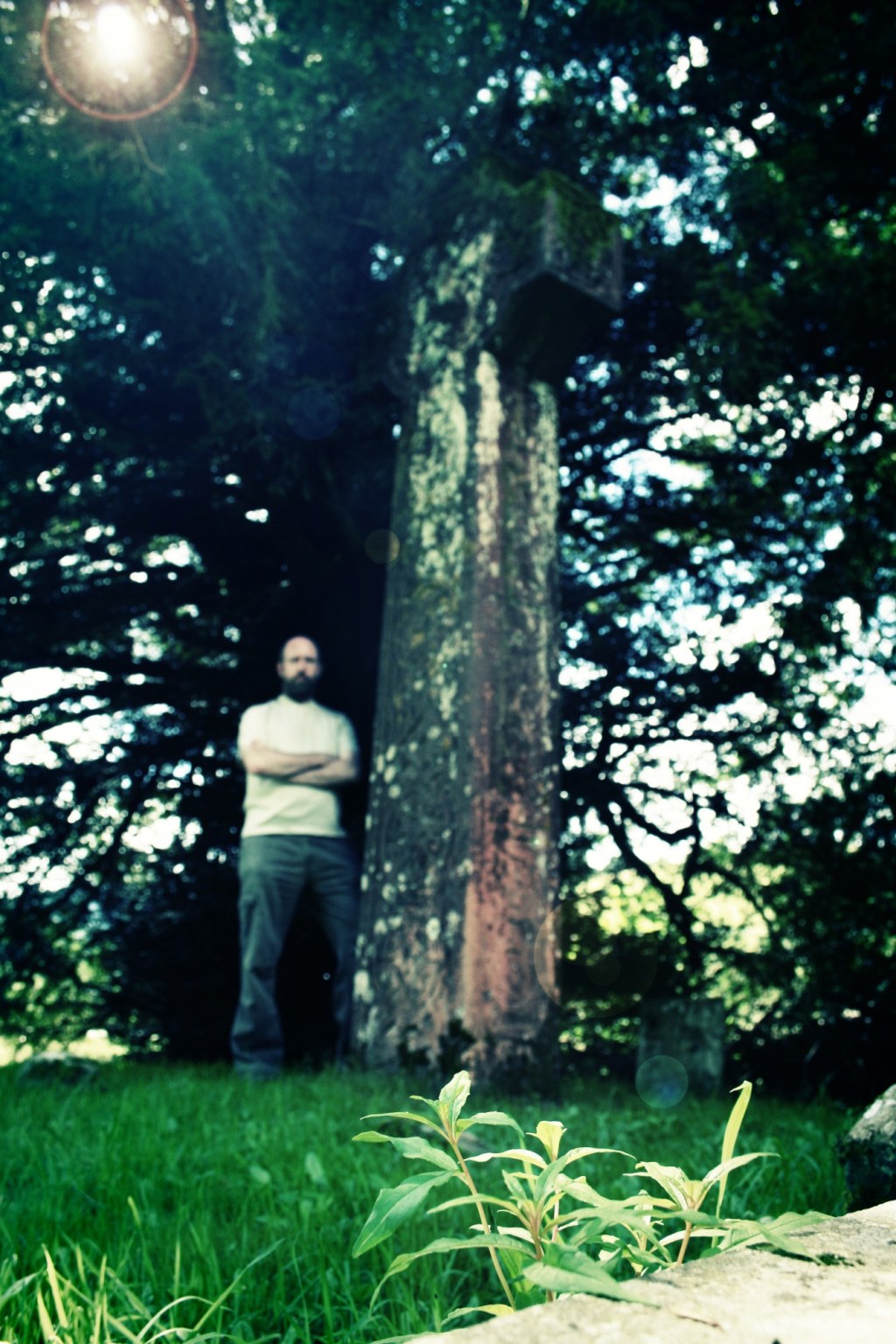
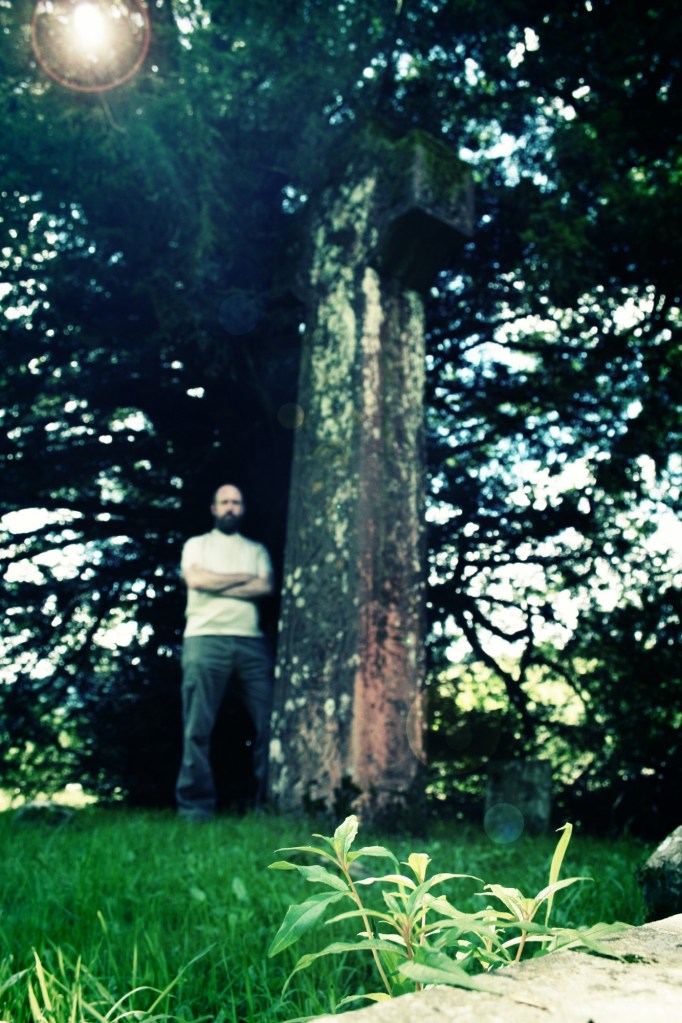
    Me and the great Celtic cross

    Together, they walk toward the Great Celtic Cross, its weathered stone rising 13 feet defiantly into the sky. The pilgrim reaches out, tracing the loops and knots carved into its surface. “This is eternity,” they murmur. “No beginning, no end. Just faith, winding on forever.”

    The visitor studies the carvings, fingers brushing lightly over the stone. “It’s amazing. To think of the hands that made this, how many people must have stood before it, just like we are now. Even after all this time, it still stands.”

    “As it should,” the pilgrim replies. “A signpost for those on the road to St David’s. A beacon for the weary pilgrim.”

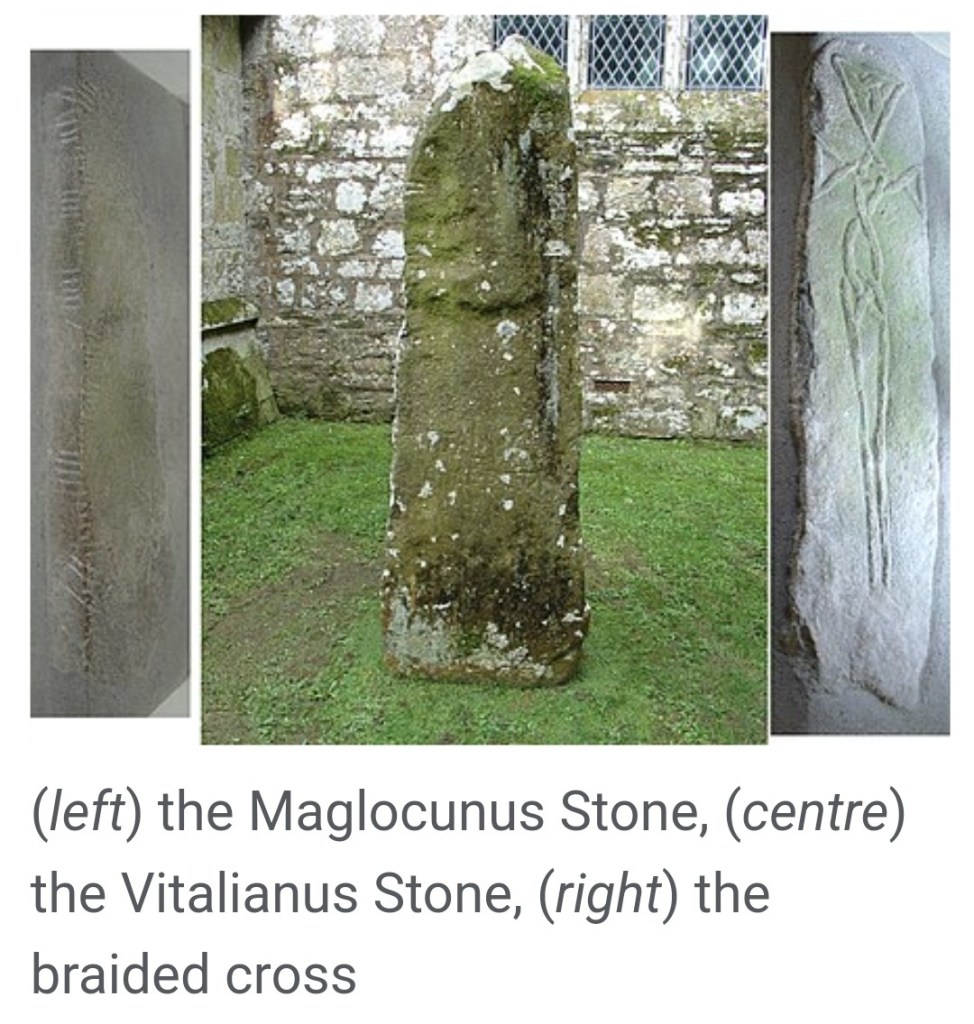
    Just outside the church. The Vitalianus Stone, carved into a pillar in Ogham and Latin the words “VITALIANI EMERTO” suggests the resting place of an important man named Vitaliani. The two languages hint at ancient connections between pagans and Christians. Its inscriptions whispering secrets from the past that we may never understand. The pilgrim kneels before it, tracing the letters. “He was a leader once, a man of faith and strength. His name endures in stone, even as his body has long turned to dust.”

    The visitor leans in, examining the Latin and Ogham script. “It’s strange. We carve our names into things, thinking it will make us last forever. But in the end, it’s the stories that survive, not the physical marks.”

    The pilgrim smiles. “You understand.”

    Inside the church, cool air wraps around them, thick with the scent of wax and old stone.  On one of the windowsills, they see the Megalocnus Stone, where the marks of the older tongue carve deep into the rock. Megalocnus is referenced as far back as the sixth century, affirming the stone’s age. The visitor shakes their head in wonder. “This writing—Ogham—it’s like the language of the land itself, growing up from the stone.”

    The pilgrim rests a hand against it. “We mark the world, and the world marks us.”

    On another windowsill, they find the Pilgrim’s Cross, shallowly etched into the stone. The modern visitor touches the carving, feeling its rough edges. “So many hands must have traced this over the years.”

    “I made my own mark,” the pilgrim admits, voice quiet. “And those after me, and those after them. We all do. All hoping to pass through life, to the next, peacefully.”

    They pause before the Norman-era Rood Screen, its carved wood forming a delicate boundary between the sacred and the earthly. The visitor runs their hand along its surface. “It’s so intricate. So much work must have gone into this.”

    “Devotion is in the small detail as well as the bigger view,” the pilgrim replies. “In all things, we find the divine.”

    At the 700 year old Medieval Baptismal Font, the pilgrim dips their fingers, letting the cool water trickle over their skin. “A new beginning,” they whisper.

    The visitor hesitates, then does the same. The water is cold against their fingertips, sending a shiver through them. “Some things never change,” they murmur.

    Outside, the old Sundial catches the last light of the afternoon. The visitor laughs softly. “Hundreds of years ago, someone stood right here, checking the time by the same sun we’re looking at now.”

    The pilgrim nods. “And after another thousand, others will do the same.”

    A short walk uphill leads them to the second Pilgrim’s Cross, carved deep into the rock behind the church. The view stretches below them, the land rolling away toward the river. The pilgrim kneels, bowing their head in prayer.

    The visitor stands in silence, breathing in the crisp air. “It must have been hard,” they say at last. “Walking so far, carrying all your hopes with you.”

    The pilgrim exhales, voice full of quiet conviction. “Hope is never a burden. It is the reason we walk.”

    As they walk toward the ruins of Nevern Castle, the shadows grow long. The stones stand witness to battles and prayers lingering in the air.

    “Time is strange here,” the visitor muses. “It doesn’t feel like it’s passing. It just… is.”

    The pilgrim smiles. “At Nevern, time doesn’t pass—it pools around your feet.”

    The modern traveller, now seeped in the church’s history, looking down to their feet, feels a pull to join the age-old pilgrimage. Looking up, they see the ancient pilgrim is making their way–fading into the distance. “God bless!”

    (not my photo)
    If you find my photography or my writing inspiring and uplifting, consider supporting what I do. Buy me a coffee on Ko-fi.
    Your support makes a difference in my life and helps me create more of what you, and I, like. Thank you!
    Tap to view my redbubble gallery.
  • Wasted in Stagnation

    Wasted in Stagnation

    River flows away,
    Yet I linger, bound by sludge,
    Wasted, still, unseen.

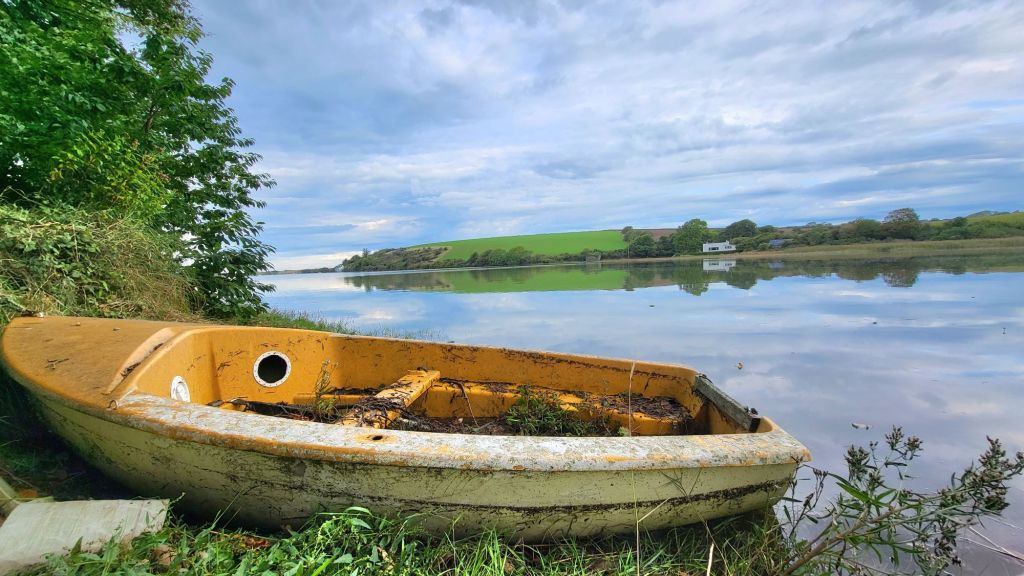
    How do I even begin to explain it? I feel like a boat—one built to cut through waves, to explore uncharted waters, to sail under the open sky with the wind pushing me forward. I was designed to move, to journey, to experience life in all its unpredictability. But here I am, rotting in the mud at the side of the river, stuck in the stagnant shallows while the current of life rushes by without me.

    It’s infuriating. I’m meant to be out there, feeling the pull of the tide, facing storms and basking in the sunlight on my deck. But instead, I’m trapped in this pit of muck, with nothing but decay around me, sinking deeper into the filth. My hull was once sleek, my sails full of promise, but now? Now I’m just a forgotten vessel, rusted and brittle, abandoned to the elements.

    The river flows past, mocking me with every ripple. I should be part of that, navigating its twists and turns, but I’m stuck on the sidelines, watching as life carries on without me. Every day that passes is another day lost, another opportunity wasted, another inch deeper into this miserable sludge.

    I feel the weight of it all, the heaviness pressing down on me, and it’s suffocating. The dreams, the plans, the purpose—they’re all still there, buried deep inside, but they’re smothered by this mire that’s holding me back. It’s not that I’ve lost my will; it’s that I’m being choked by this godforsaken mud, this unrelenting stagnation.

    I wasn’t made for this! I wasn’t built to rot away in some forgotten corner, becoming part of the landscape of failure. But here I am, powerless against the relentless drag of this miserable place. It’s like being betrayed by your own potential, knowing you were meant for so much more but being held back by forces you can’t control, by circumstances that refuse to let you go.

    I’m angry—angry at the mud, angry at the river for carrying on without me, and most of all, angry at myself for not finding a way to break free. Because I know I was meant to sail, to thrive, to conquer the open waters of life. But instead, I’m left here to decay, to watch the world pass me by while I waste away in this stagnant, suffocating bog.


    If you find this content inspiring and uplifting, consider supporting what I do. Buy me a coffee on Ko-fi.
    Your support makes a difference in my life and helps me create more of what you like. Thank you!
    Tap to view my redbubble gallery.
  • Beyond the White Veil

    Beyond the White Veil

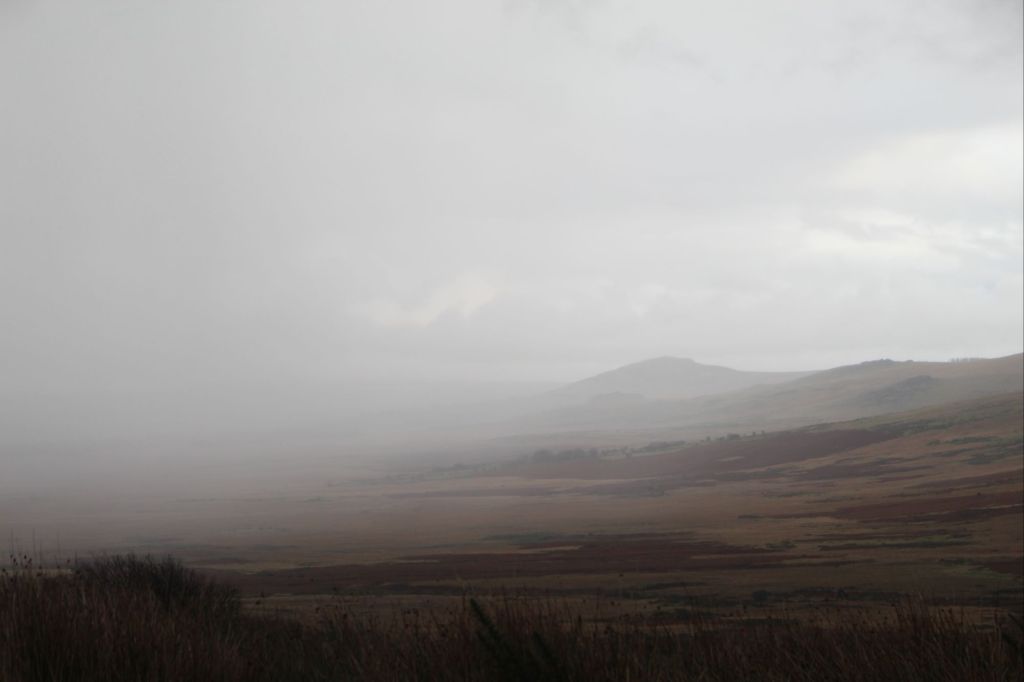
    The author tapped their pen against the worn notebook, frowning at the blank page. Outside, the hills of west Wales slumbered in an afternoon lull. They were supposed to be writing about wild hills, about the way the mist rolled in, swallowing everything whole. But the words wouldn’t come. Was it because the real hills outside looked so tame, bathed in a weak spring sunshine? Or was it because the very idea of writing about the wildness, the untamed nature of the world, felt utterly inauthentic?

    Preseli Hills, Pembrokeshire, Wales

    Pen searches for truth,
    Wild landscape in the mind blooms,
    More real than the mist.

    Anthony

    In the fictional world they were trying to build, the mist rolled in with a purpose, a living entity driven by some unknown force. It wasn’t the kind of mist that rolled in most afternoons, shrouding the valleys in a milky haze. This mist was hungry, it devoured the landscape whole, leaving only the skeletal outlines of trees and the ghosts of forgotten ruins.

    But here, in the real world, the mist ambled in, a lazy afterthought of a sea breeze. It did little more than dampen the enthusiasm of the ramblers, forcing them to pull on their waterproofs a little earlier. The author sighed. How could they write about a mist that devoured the world when the most dangerous thing the real mist devoured was a tourist’s picnic plans?

    An idea flickered. What if the wildness wasn’t in the mist itself, but in the way it exposed the wildness within the characters it touched? The author started to write. The first line came easily: “The mist rolled in, uninvited, as it always did.”  This time, the mist wasn’t a malevolent force, but a catalyst. It seeped into the cracks of their lives, revealing the buried anxieties, the unspoken desires. The characters, a young couple on a weekend retreat, found themselves arguing over neglected chores and unspoken resentments, their petty squabbles echoing in the muffled landscape.

    The author smiled. The wildness wasn’t in the mist, but in the way it held up a mirror to the human heart. And perhaps, that was a wilder thing after all.

    Tap to view my redbubble gallery.
  • How the Lifeboat Gem Saved 11 Lives

    How the Lifeboat Gem Saved 11 Lives

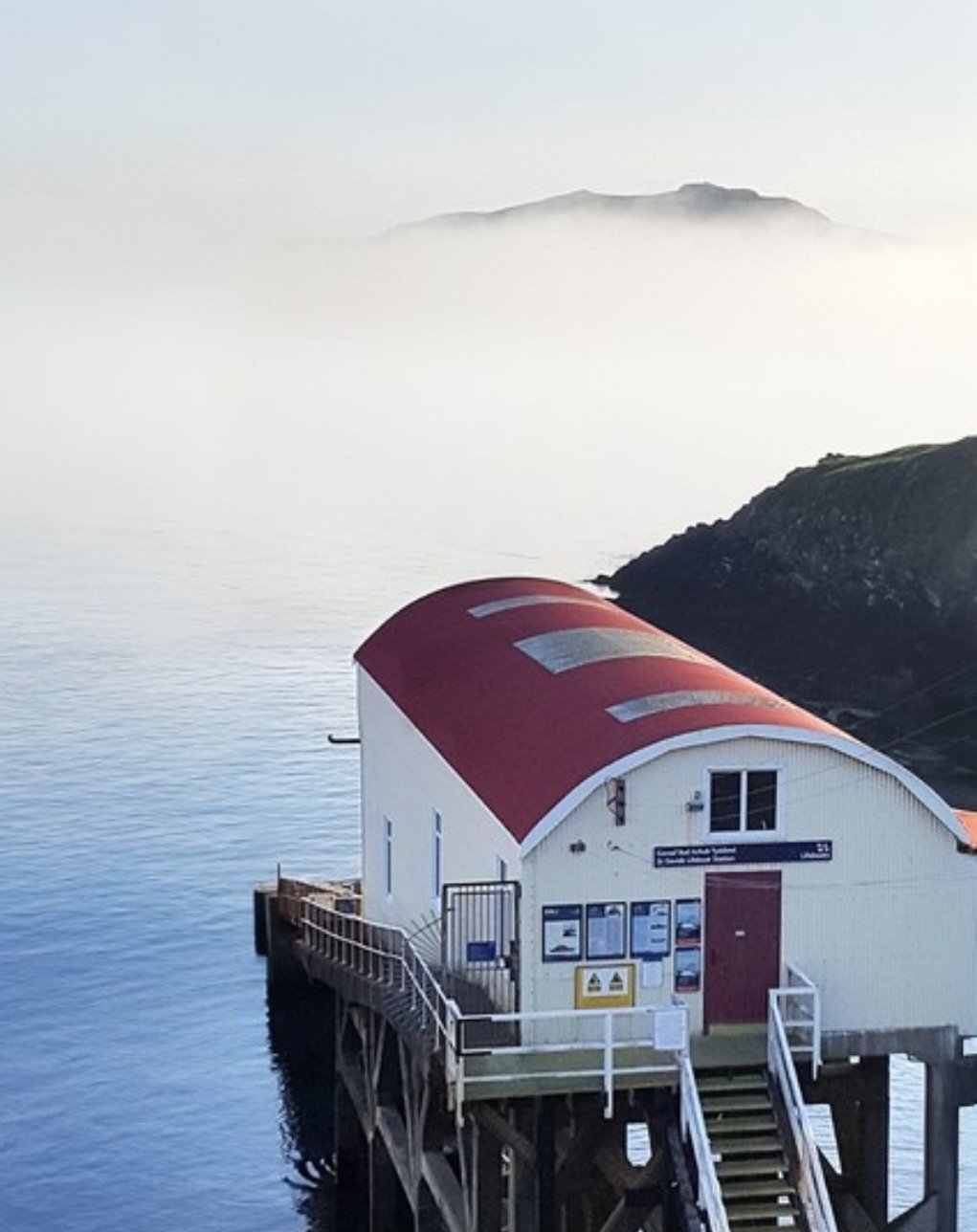
    The lifeboat house at St Justinian’s harbour is the current St Davids Lifeboat Station, which has been operating since 1869 and has been involved in saving over 360 lives at sea. The station has both an all-weather and an inshore lifeboat and is run by the Royal National Lifeboat Institution (RNLI). The station has received 14 medals for gallantry for its brave rescues. The harbour is also used for boat trips to Ramsey Island and other activities such as kayaking and speedboating.

    They answer every call for help No matter what the cost They are the guardians of the coast They are the lifeboat men we trust

    St Justinian’s lifeboat station
    Tap to view my redbubble gallery.

    Imagine being stranded on a capsized lifeboat in the middle of a stormy sea, with no hope of survival.

    Saving Oscar

    One notable piece of history about the St David’s lifeboat station is the rescue of the Norwegian barque Oscar on 9 December 1894. The Oscar was a sailing ship that was wrecked on the rocks near St David’s Head. The ship was on its way from Cardiff to Norway with a cargo of coal, when it encountered a severe storm and lost its rudder. The captain tried to anchor the ship, but the anchor chain broke and the ship drifted towards the shore. The crew of 11 men abandoned the ship and took to the lifeboat, but the lifeboat capsized in the rough waves. The men clung to the overturned boat and shouted for help.

    Fortunately, their cries were heard by some fishermen on the shore, who alerted the St Davids Lifeboat Station. The station launched its lifeboat Gem, which was a 10-oared self-righting boat that had been in service since 1885. The lifeboat crew braved the gale and heavy seas and reached the wrecked ship, where they found the survivors clinging to the lifeboat. The lifeboat crew managed to rescue all 11 men and bring them safely to land. The rescue was made in difficult conditions and required great skill and courage from the lifeboat crew.

    The rescue of the Norwegian barque Oscar was one of the most notable achievements of the St Davids Lifeboat Station in its history. The lifeboat crew received silver medals from the Royal National Lifeboat Institution (RNLI) for their bravery. The captain of the Oscar also presented a gold watch to the coxswain of the Gem, John Rees, as a token of gratitude. The wreck of the Oscar can still be seen at low tide near St David’s Head.

    Tap to view my redbubble gallery.
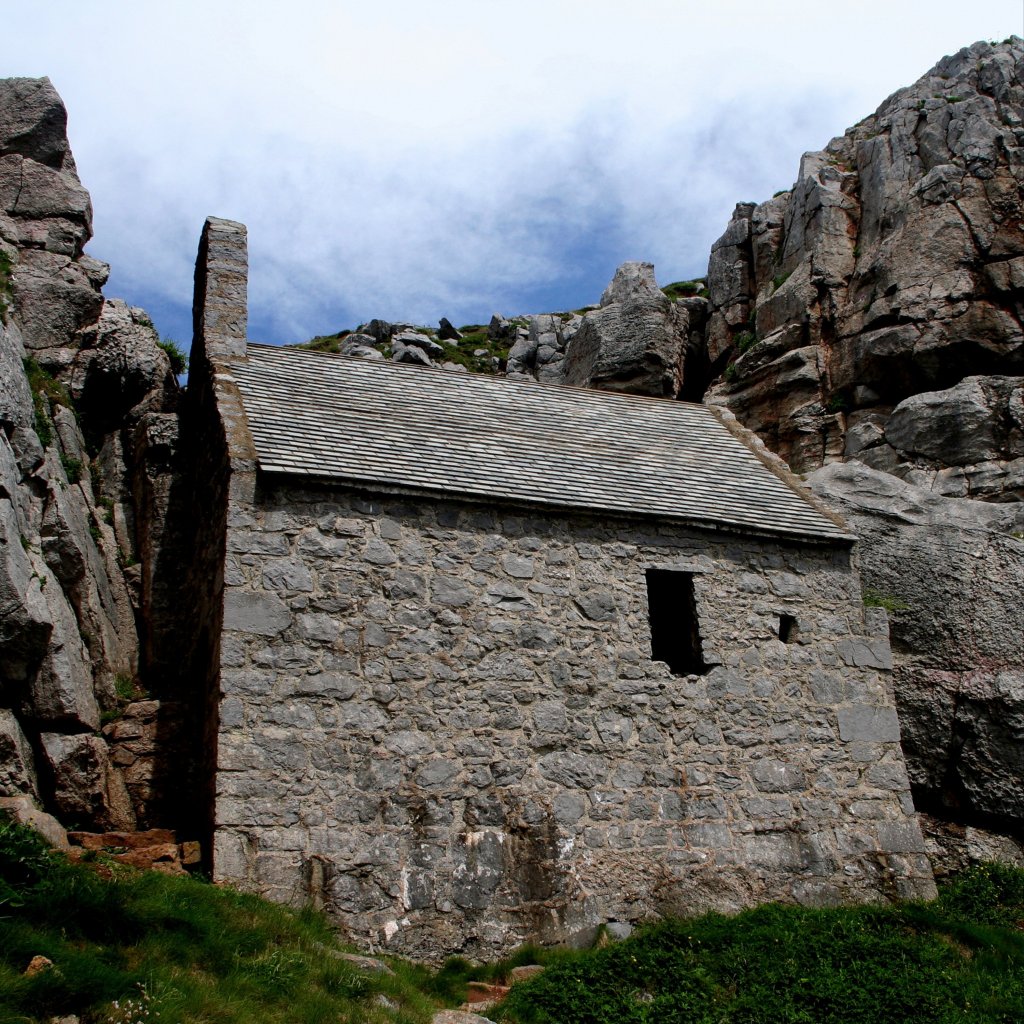
  • Legends of Pembrokeshire: Saint Govan’s Sacred Refuge

    Legends of Pembrokeshire: Saint Govan’s Sacred Refuge

    In the early 6th century, in the rugged, windswept cliffs of Pembrokeshire, where the sea meets the land, there lived a hermit named Saint Govan. He had found solace in the natural beauty of the coastal landscape and the spiritual connection it offered.

    Tap to view my redbubble gallery.

    One fateful day, as Saint Govan knelt in prayer within his humble chapel, a band of fearsome pirates descended upon the rocky shores. They sought to plunder the nearby village and destroy the hermit’s sacred sanctuary. The hermit, a man of unwavering faith, continued to pray for protection.

    In a miraculous turn of events, the very cliffs that cradled Saint Govan’s chapel began to open up, forming a narrow cleft in the rock face. It is said that this cleft was just wide enough to shelter the hermit from the marauding pirates. As the band of outlaws approached, they were unable to locate the hidden entrance to the chapel, and their attempts to reach Saint Govan were thwarted by the hand of God.

    With awe and amazement, the pirates eventually gave up their pursuit and departed, leaving Saint Govan unharmed. It was a divine act of protection, and the hermit saw it as a sign of God’s grace.

    From that day forward, Saint Govan continued his life of contemplation and prayer in the tranquil solitude of his chapel, grateful for the miraculous shelter provided by the very cliffs that he had come to love. The legend of Saint Govan’s miraculous escape and his unwavering devotion continues to be told and cherished in the heart of Pembrokeshire, a testament to the power of faith and the wonders of nature.

    Tap to view my redbubble gallery.
Design a site like this with WordPress.com
Get started