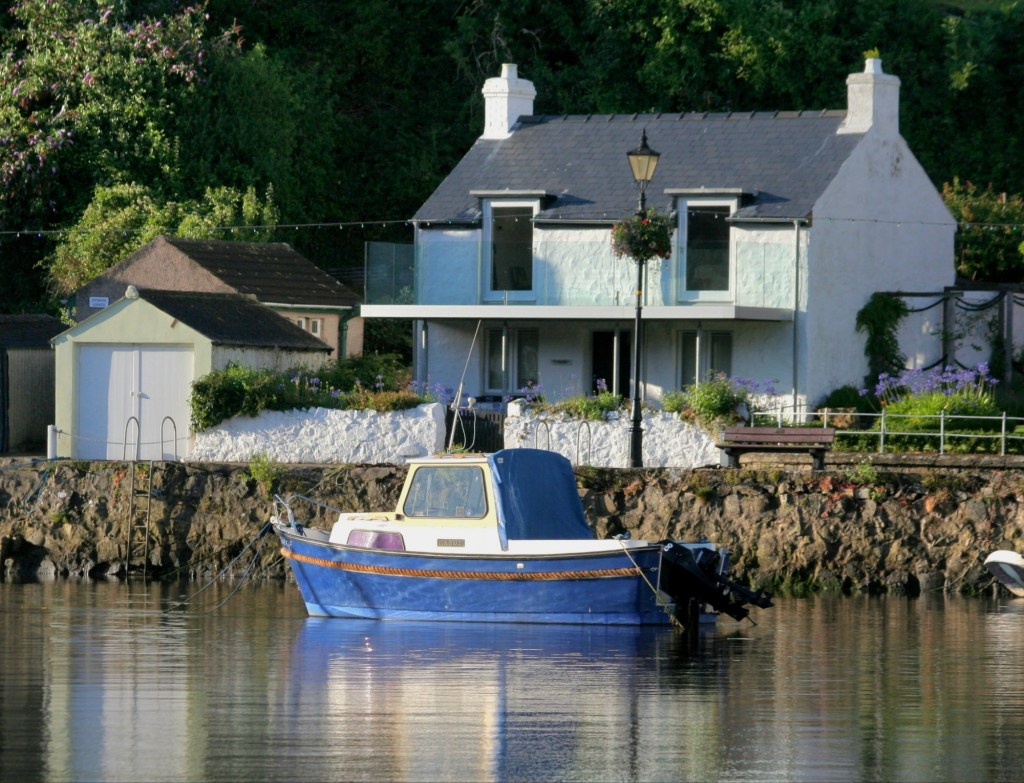
The blue boat sits alone,
Quiet on the glassy sea,
No ripples, just the tone
Of stillness setting free.
In the city, Isabelle’s palette was dictated by quarterly reports. Her canvases were billboards, her medium, marketing slogans. She painted desires, not dreams. Once, art had been her sanctuary, a place where she could lose herself in colour and form, but now it was a transaction—each brushstroke carefully calculated for maximum impact. The aggressive red of SALE, the sterile blue of TRUST, the shimmering gold of LUXURY—they weren’t colours, they were commands.
Her studio, a pristine white cube perched above a canyon of concrete and steel, was as lifeless as the work she produced. Outside, the city pulsed with a restless urgency, but inside, she sat staring at her latest commission, feeling nothing. Had it always been like this? Had she always felt this hollow? She couldn’t remember the last time she painted something just because she wanted to.
When she first saw the cottage in the online listing, it was nothing more than a blurry thumbnail, yet something about it stopped her scrolling. It wasn’t charming in the way holiday rentals usually were. The walls leaned slightly, weather-beaten and unapologetic. The loch behind it stretched out into the mist, quiet, infinite. It was not picturesque, but it was still. And suddenly, stillness was all she wanted.
The journey there felt like shedding a second skin. As the train rattled away from the city, the skyline fading into the distance, something inside her loosened, though she wasn’t sure what. At first, she kept reaching for her phone—out of habit more than anything—but the further she got from mobile towers, the quieter her mind became. It wasn’t just the absence of notifications, emails, deadlines. It was a deeper silence, like a pond settling after a stone has been thrown in.
The cottage smelled of damp wood and time. It creaked when she walked through it, like an old thing waking up. There was no WiFi, no signal. Just the steady lap of the loch against the shore, the whispering reeds, the occasional call of a distant bird. At first, the quiet unnerved her. She found herself pacing, feeling the itch of a life spent in perpetual motion. Her mind kept trying to measure productivity, to assign value to this pause. What are you doing? Wasting time? What if they forget you? What if you come back and there’s nothing left?
On the third day, restless and aimless, she wandered down to the shore, her boots sinking slightly into the wet earth. The loch stretched out before her, a perfect mirror of the grey sky. And there, in the shallow water, rocked a small blue boat. Faded, chipped at the edges, the kind of blue that had been softened by years of wind and rain. Something about it pulled at her. It wasn’t just a boat. It was a contrast—a quiet rebellion against the greyness of everything around it.
She crouched by the water’s edge, picking up a smooth grey stone and rolling it between her fingers. She thought of the screens she used to touch every day, the digital world she had lived in. The cool weight of the stone was real, solid in a way the city never was.
The next morning, she woke to the sound of rain, soft and insistent against the slate roof. She stood by the window, watching the loch blur and ripple under the downpour. The blue boat rocked gently, unfazed. It was such a small thing, and yet she couldn’t look away. The colours before her weren’t the ones she used in the city—no neon, no artificial sheen. Just deep, shifting greys, softened greens, the quiet persistence of the blue.
She picked up a brush without thinking. Not the sleek, expensive sable she used for client work, but a worn-out one she found in a drawer. There was no canvas, so she used a piece of driftwood. She didn’t try to replicate the scene exactly. Instead, she let the colours guide her, pulling from something deeper than observation—something she had ignored for too long. The grey of the sky bled into the grey of her exhaustion. The green of the hills became a longing for something real. The blue of the boat—steady, resilient—was a hope she hadn’t known she still carried.
When she stepped back, her breath caught. It wasn’t a masterpiece. It was raw, uneven, imperfect. But it was hers. A tear slid down her cheek, but she didn’t wipe it away. It wasn’t sadness. It was something closer to relief.
Not all days were easy. Some mornings she stared at a blank page for hours, frustration gnawing at her ribs. Some nights, the city’s voice whispered in her ear, reminding her of deadlines and expectations, of the career she was leaving behind. What if you never make it back? What if this is a mistake?
But then there were moments—standing by the loch, feeling the wind in her hair, watching the way light changed the water—that made it clear she was exactly where she needed to be.
Her work began to shift. She stopped thinking about what people wanted and started painting what she felt. She no longer cared about marketability. She cared about honesty. The colours on her brush became softer, more grounded, pulled from the land around her rather than the demands of a client brief. She painted the hush of the loch at dawn, the weight of the rain-heavy clouds, the steadfast blue of the little boat that never drifted too far.
She wasn’t painting products anymore. She was painting silence. She was painting solitude. She was painting her way back to herself.

Your support makes a difference in my life and helps me create more of what you, and I, like. Thank you!

- Darkness, Power and Beauty
 Horse’s steady gazeStrengthful eyes that dare to meetChallenge accepted Courage is the strength to face… Read more: Darkness, Power and Beauty
 - The Daffodil’s Song: A Lyrical Tribute to the Wonders of Spring
 Daffodil so brightGolden petals, sunshine’s kissHope blooms anew As I wander through the garden, the… Read more: The Daffodil’s Song: A Lyrical Tribute to the Wonders of Spring
 - Acanthus: A Versatile Plant with a Rich Cultural Heritage
 The Graceful Lines of an Acanthus Leaf. Acanthus is a genus of flowering plants native… Read more: Acanthus: A Versatile Plant with a Rich Cultural Heritage
 Anthony's Literary Lens
You must be logged in to post a comment.