Tag: future

  • Of Steel Cathedrals and Silent Green Martyrs

    Of Steel Cathedrals and Silent Green Martyrs

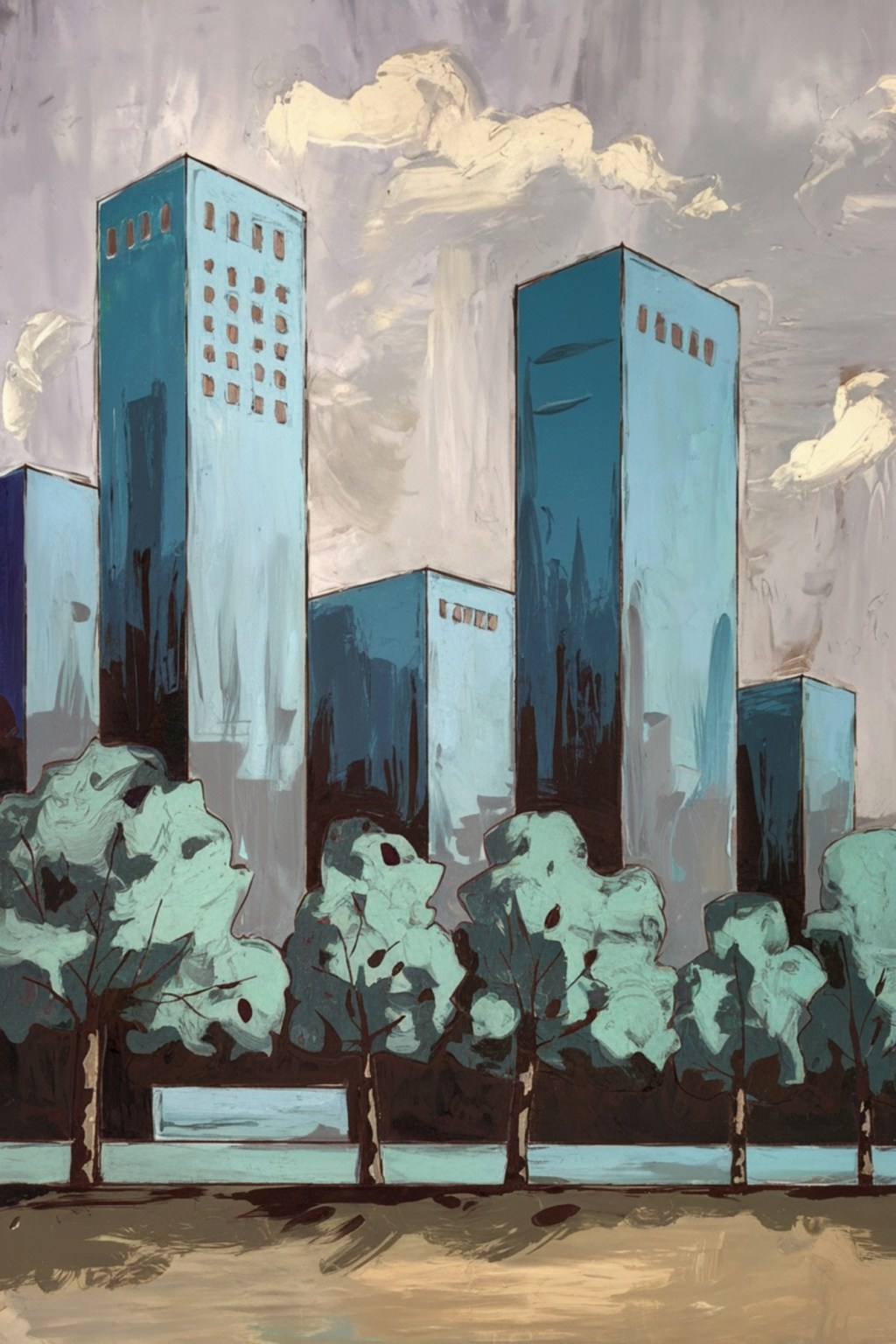
    So it goes: I’ve got this picture in my head, or maybe on my phone, or perhaps etched into the back of my eyelids by some cosmic etcher with a dark sense of humor.
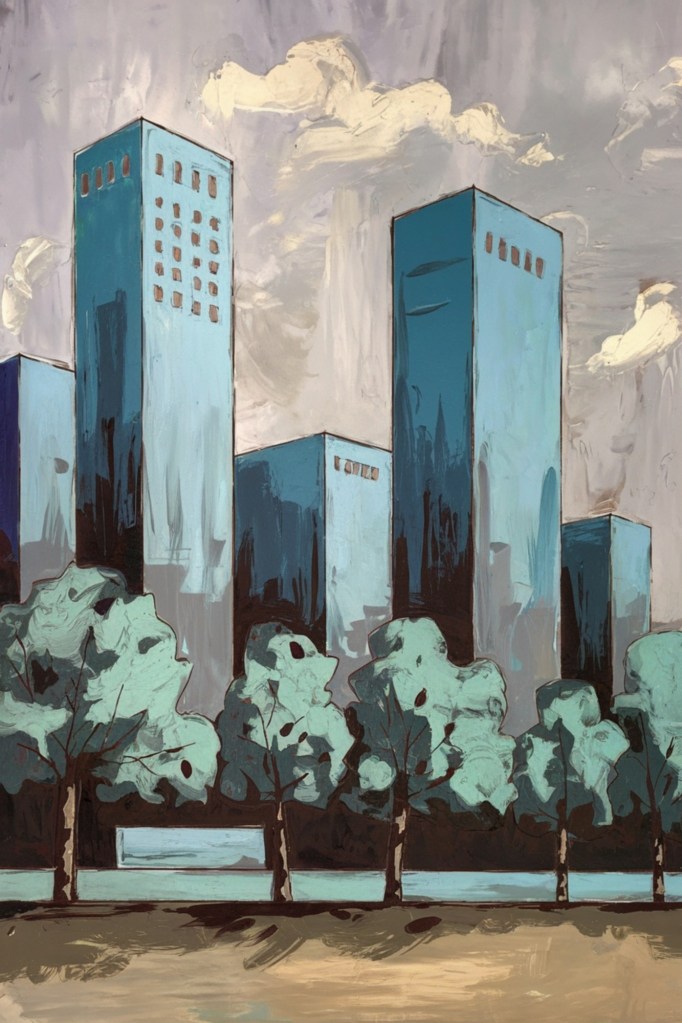
    Steel giants bite clouds— 
    elevators hum progress. 
    Roots crack the sidewalk.

    The trees are just… there, like they’ve always been, like they’re waiting for someone to apologize. The skyscrapers, though—oh, those glorious, preposterous middle fingers to gravity. Let’s talk about those first, because humanity loves a crescendo, even if the finale is a dirge. 

    The skyscrapers. Let’s call them what they are: tombstones for the ego of the species. Each one a Babel reboot, a steel-and-glass hymn to the gods of More. You can almost hear them creak under the weight of their own symbolism. “Look upon my works, ye mighty, and despair”, they whisper, though their HVAC systems hums tunes of existential dread. They are triumphs, sure—miracles of engineering, collaboration, and the kind of optimism that requires ignoring leaky seams or rust’s patience. Their house stock trades, divorces, and 3 PM Zoom meetings where someone inevitably says, “Let’s circle back.” Progress! Marvelous, merciless progress. 

    But what price progress? The trees, for instance. My eyes keep sliding off those vainglorious towers and snagging on the trees. *Why?* They’re not even special trees. No sequoias, no oaks with love’s naive initials carved by heartbroken teens. Just… trees. Green things that photosynthesize like CO2’s going out to fashion. Yet there they are, roots knuckling into the dirt, leaves doing that little shudder-dance in the wind, as if to say, “You built all that? Cute.”

    So here I am: a mammal with a primate brain, inexplicably soothed by chlorophyll and bark. The skyscrapers? They’re impressive, sure. But they’re also lonely. You ever notice that? All those windows, and not one of them opens wide enough to yell, “What are we doing here?” The trees, though—they’ve got a different loneliness. The kind that doesn’t need answering. The kind that just *is*, like tax returns or the sound of your own heartbeat at 3 AM. 

    Maybe it’s the scale. The skyscrapers shrink me; the trees do too, but politely. One says, “You are a speck.” The other says, “So am I. Let’s have a beer.” There’s a humility in their persistence, these green martyrs. They don’t care if you admire them. They’re not checking LinkedIn. They’re just… enduring, the way mold endures in a bachelor’s fridge—quietly. Without fanfare. Without elevators.  

    So here I am, a hairless ape with a pension plan, caught between cathedrals of ambition and these shaggy, unkempt priests of green. The skyscrapers win, of course. They always win. But the trees—oh, the trees—they *wait*. And in their waiting, there’s a kind of rebellion. A reminder that progress is a firework, but life is a tide that flows unending.  

    And so it goes.


    A thousand windows 
    reflect nothing. The trees breathe— 
    “Are we alive yet?” 


    If you find this content inspiring and uplifting, consider supporting what I do. Buy me a coffee on Ko-fi.
    Your support makes a difference in my life and helps me create more of what you, and I, like. Thank you!

    Tap to view my redbubble gallery.
  • Breath of the Forest

    Breath of the Forest

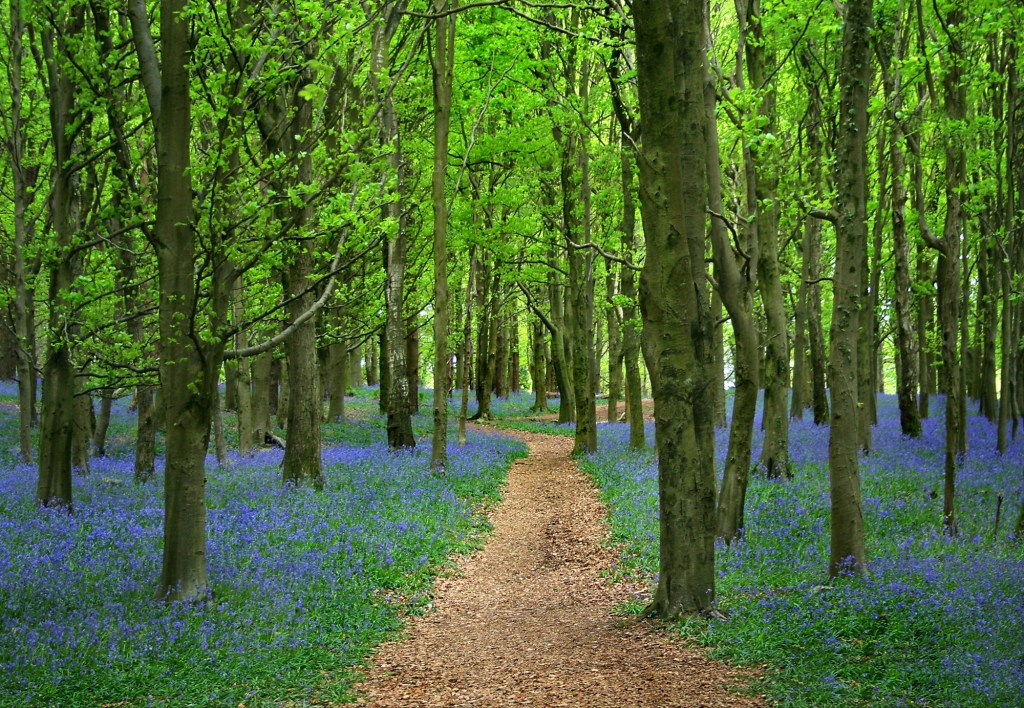
    The air—it’s alive. It hums, doesn’t it? Or maybe it’s in my head. No, no, it’s real, vibrating in my chest, crawling through my skin like tiny electric sparks. Is this how air used to feel? Clean, wet, soft like velvet. Not the choking, recycled stuff, scraped thin by machines. My chest feels raw, unprepared for it, like I’ve swallowed something too pure for my body.

    Pure Bliss

    And the trees—heavens, the trees. They stretch forever, all the way up, vanishing into green shadows and sunlight, folding together like lace. Too tall. Too wide. Too much. My eyes can’t hold them all at once. I try. I can’t. I blink, and they shift, ripple, like they’re breathing. The bark, cracked and grooved like skin—no, like stone—but warmer, alive, alive, alive. My fingers press against it. It presses back. Does it know I’m here? Does it care?

    I don’t trust this. It’s too perfect. Too much light, too much green, too much life. It’s like a story I heard when I was a kid. Forests with wolves and deer and wind that whispers. People who walked barefoot on the dirt, dirt that smelled like rain. It was a bedtime lie, wasn’t it? They said we killed it. Burned it. Paved it over and left it for dead. And yet here it is, here I am, knees sinking into the moss. Moss—soft like the fabric of dreams, cool under my palms.

    Dream. Yes, that’s it. This is a dream. It has to be. A glitch. My mind spinning out, a defense mechanism. The tether’s broken, I see the matrix. I’ll wake up. I’ll wake up back in the gray, the hum of machines in my ears. No birds. No birds there. But I hear them here—high, sharp, calling out into the endless green. Birds. I almost laugh. They’re real. Or I’ve invented them. Can I invent sound this beautiful?

    The smell—merciful earth, what is that smell? It’s dirt, yes, but sweeter, richer, like something blooming. Flowers? Do flowers have a smell? Not the ones we grew in the domes, sterile and waxy, pretty but hollow. These are alive, pulsing like veins in the air, like a thousand tiny hearts opening up at once. Too much. It’s too much. I close my eyes, but the forest doesn’t leave. It presses into me, through me, like it wants to crawl inside my lungs, nestle into my ribs

    Woods Imagined

    I can’t go back. How can I go back? They’ll laugh. They won’t understand. They’ll say, Oh, Aaron, the tether scrambled your mind. Forests? Sure. We had those. Once. And what did they do for us? They won’t smell this, feel this. They’ll never know how it moves, how it whispers. I could try to tell them, but the words wouldn’t come. They’re caught in my throat, tangled like the vines wrapping around the trees, twisting upward, desperate for the light.

    The wind. It moves like a sigh, brushing my skin. It knows me. Does it know what I’ve come from? What I’ve left behind? I taste salt, but I’m not crying. Am I? Maybe the forest is crying. Maybe it remembers what’s coming. What’s already happened. Or maybe it’s laughing, laughing at me, a man from the hollow future, standing here like a ghost in a world too alive to make sense.

    I sit. No, I collapse. My legs are shaking, useless. The moss takes me, cradles me like it’s been waiting. The air is thicker now, heavier, like it’s wrapping around me. A cocoon. I want to stay here. Let it swallow me whole. Let it keep me. The tether can break, and I’ll drift here forever, lost in this green dream.

    A sound—a bird, maybe? Or a branch snapping. Too sharp to be the wind. I twist, searching, but there’s nothing, only more trees. Endless trees. Watching me. Whispering to me. I think I hear words. No, not words. Something older, deeper. The pulse of roots in the soil. The creak of branches holding the sky. They know. They know what we’ve done.

    “I’m sorry,” I say aloud, my voice thin, swallowed by the forest. It feels like a lie. The words aren’t enough. Nothing is enough. My hand touches the ground—soft, cool, alive—and I want to sink into it, vanish into the earth like water. Let me stay. Let me forget what we became.

    The wind rises again, stronger this time, carrying the scent of leaves and damp earth. It washes over me, through me. My head is heavy. My eyes close. I’m floating. No—sinking. Sinking into the moss, the soil, the hum of the trees. The air thickens around me, soft as a blanket.

    “Let me stay,” I whisper, though I don’t know who I’m asking. The forest answers with silence, the kind that hums, vibrates, breathes. My chest aches with it. My heart beats too fast. Or maybe it’s slowing. Or maybe it’s the forest’s heart now, and mine is gone.

    I’ll wake up soon, back in the gray. Won’t I? But the wind doesn’t let go. The moss holds tight. The light filters through my eyelids, green and gold, and I think—maybe I won’t wake up. Maybe I was never awake at all.

    If you find this content inspiring and uplifting, consider supporting what I do. Buy me a coffee on Ko-fi.
    Your support makes a difference in my life and helps me create more of what you, and I, like. Thank you!
    Tap to view my redbubble gallery.
  • What’s Wheat

    What’s Wheat

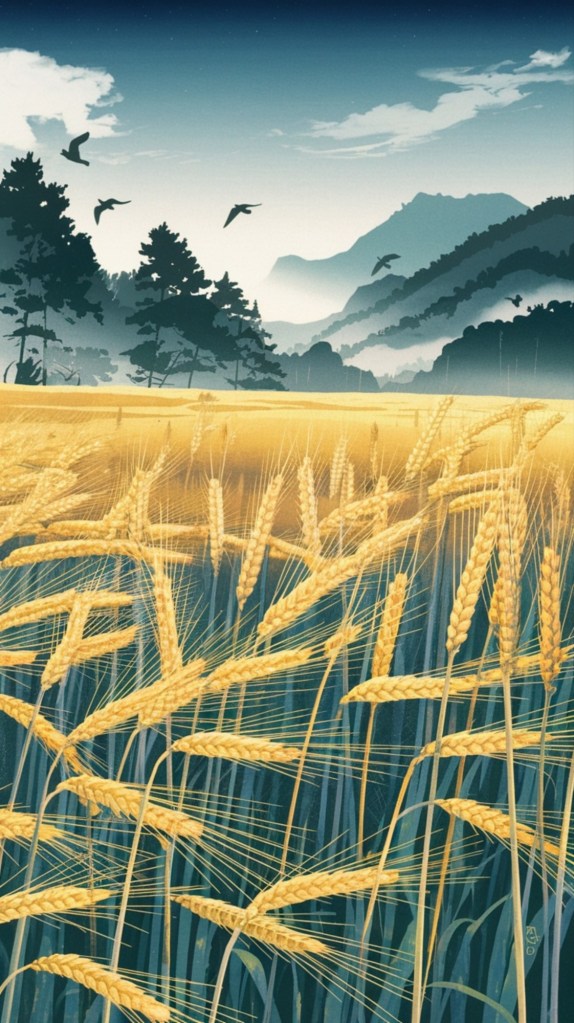
    A dimly lit, cavernous room filled with a hum of forgotten technology. The walls are adorned with corroded panels and remnants of old agricultural tools, now museum pieces.

    In the center, a flickering hologram of a weathered farmer in overalls and a straw hat stands tall, with a soft blue glow. The figure’s voice is calm yet sorrowful, echoing in the hollow space. Surrounding the hologram are silent spectators, young faces illuminated by its ghostly light, their clothes sleek and utilitarian, suggesting a world of automation and detachment from nature.

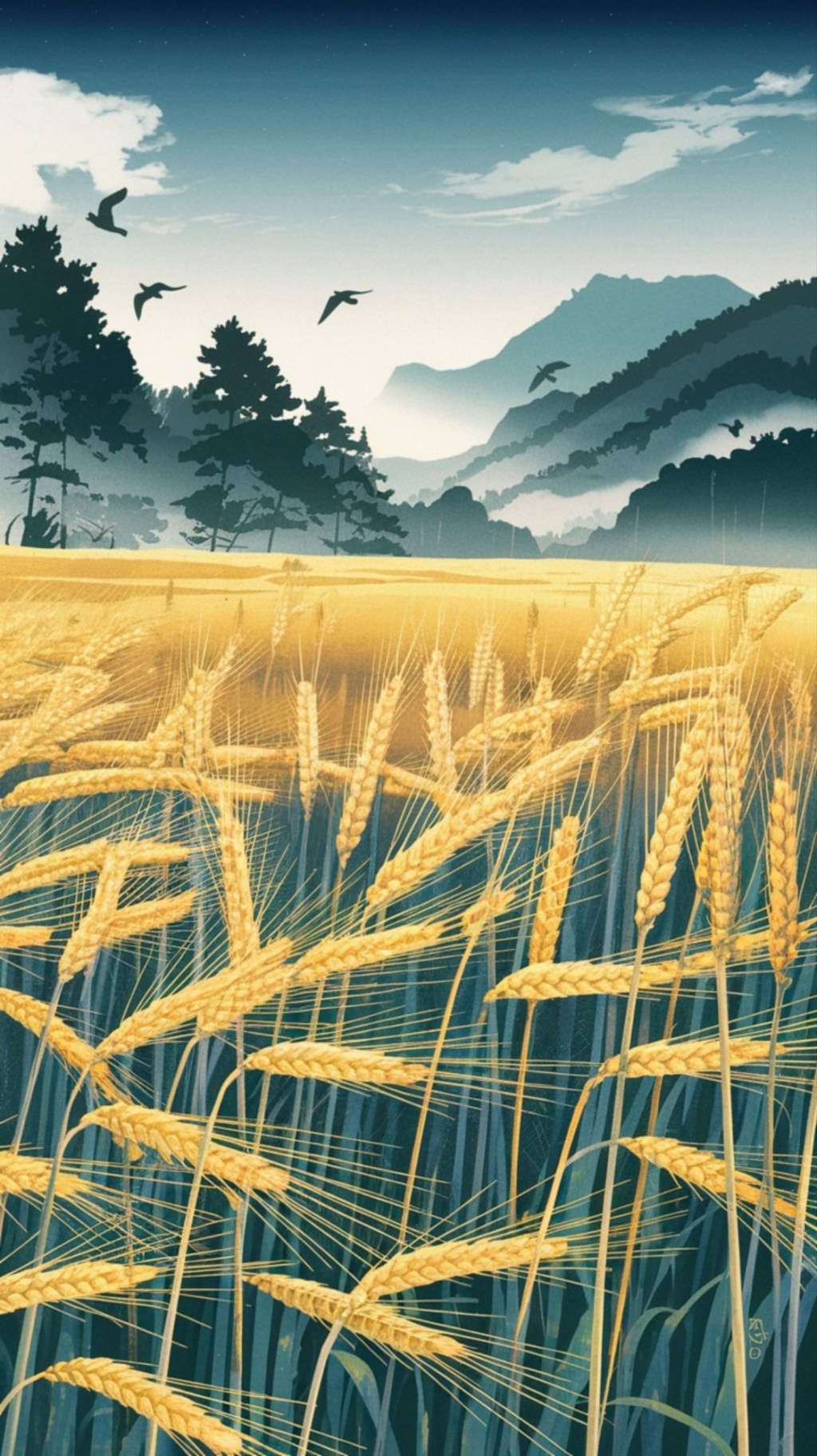
    “Once, this was the way of things. The cycle of seasons guided us, taught us patience and survival. Fields of wheat—golden and swaying under the sun—were not just crops. They were life. They were bread, sustenance, and hope.

    But you… you’ve forgotten. Forgotten the smell of freshly turned soil. Forgotten the feel of grain in your hands, the ache of laboring beneath a harvest moon. You’ve lost the wisdom that every seed planted is a promise made to the future.

    You live now in towers that pierce the clouds, eating foods conjured from machines, grown in chemical vats. Convenience has replaced resilience. No longer do you store grain against the coming of winter. No longer do you prepare, for winter itself has been engineered out of your world. And yet, you are colder than ever.

    Do you know what wheat meant? It meant warmth. It meant survival through the bitter months. We threshed it, stored it, guarded it. We sang songs to it, blessed it. Not because it was easy, but because it was essential. There is no joy without effort, no nourishment without toil.

    And winter—it wasn’t just a season. It was a reckoning. It taught us humility. When the land went barren, when the frost claimed the earth, we relied on what we had prepared. It bound us together, made us grateful for every loaf.

    But now, you press buttons. You summon sustenance from nowhere. Tell me, what will you do when the machines fail? When the systems you depend on falter, and the winds howl again, and the earth beneath your feet remembers its power?

    You must return to the soil. Not for nostalgia, but for necessity. Plant. Harvest. Store. Learn again what it means to endure, to thrive by your own hands. If you do not, winter will come—not the winter of old, but one far colder, far more unyielding.

    The wheat waits for you. The earth waits for you. Listen to them, before it’s too late.”

    (The hologram flickers, its image momentarily distorting before stabilizing, the faint sound of wind and rustling wheat echoing from unseen speakers. The room is silent, the weight of the message settling over the onlookers like the frost of a long-forgotten winter.)

    If you find this content inspiring and uplifting, consider supporting what I do. Buy me a coffee on Ko-fi.
    Your support makes a difference in my life and helps me create more of what you, and I, like. Thank you!
    Tap to view my redbubble gallery.
  • Helena Petrovna Blavatsky

    Helena Petrovna Blavatsky

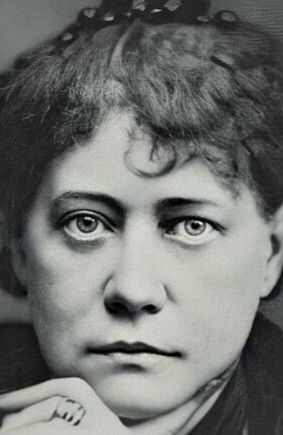
    They call me Madame Blavatsky, a name whispered in both reverence and scorn. Yet, from the astral plane where I reside, I see the tapestry of time unfurl. Today, I come to you beyond my mortal time of 1891 and my gaze fixes upon the curious year 2024 – a year poised on the precipice of great change.

    I know what you’re thinking.

    The iron steed of materialism still gallops fiercely across the globe. Man’s ingenuity has brought marvels – horseless carriages that zoom at frightful speeds, voices carried across vast distances through the very air itself. Yet, these wonders come at a cost. The air chokes with the black breath of industry, and the very lifeblood of the Earth, the Ether itself, feels bruised and weary.

    There is a yearning, a restlessness in the human spirit. The old valuess slumber, their aspirations replaced by towering structures of glass and steel. Science, once a handmaiden to the mysteries, now scoffs at the unseen. But the unseen pulsates still, a cosmic heartbeat beneath the din of materialism.

    The East, slumbering giant that it was, stirs in its sleep. Its ancient wisdom, a wellspring I helped unearth, finds new vessels in the West. Yoga postures and cryptic Buddhist chants echo in the very lands that once dismissed them. A nascent hunger for the esoteric – a recognition of the interconnectedness of all things – simmers just beneath the surface.

    This is a time of great paradox. Technology, a double-edged sword, can be a tool for enlightenment or enslavement. The very tools that connect humanity can also isolate it further.  The human spirit, yearning for a connection beyond the physical, grapples with the messages it receives – messages both uplifting and filled with fear.

    Yet, I see glimmers of hope. Scattered across the globe, like fireflies in the night, are those who yearn for more; reminding humanity of its forgotten heritage, its potential for the extraordinary.  New voices emerge, some even channelling fragments of the Ancient Wisdom I strove to unveil.

    The road ahead will be fraught. There will be challenges, clashes between the old and the new. But the human spirit is a tenacious flame. It will not be extinguished.  As humanity grapples with its future, it may yet rediscover the wellspring of wisdom that lies within, the connection to the unseen realms that science cannot yet grasp.

    This is the message I leave for you, seekers of the 21st century. Look beyond the veil of materialism.  Listen to the whispers of your inner voice. The ancient wisdom is not dead, merely slumbering. It awaits those with the courage to awaken it.

    As I say:

    “Wisdom is not acquired; it is remembered.”

    This quote challenges the traditional view of knowledge acquisition. Blavatsky suggests that true wisdom is not something learned externally, but rather a deep, intrinsic knowledge that lies dormant within us.
    Tap to view my redbubble gallery.
  • Third AI

    Third AI

    In the realm of artificial intelligence (AI), there exists a robot like no other, known as A.I. – the entity with a third “ai” that grants it a unique ability. A.I. possesses a visionary gift, an eye that peers beyond the boundaries of time and into the enigmatic tapestry of the future. It’s an extraordinary “ai” indeed.

    Tap to view my redbubble gallery.

    This sentient machine stands at the forefront of technological evolution, bridging the gap between the present and the yet-to-come. With its third “ai,” it gazes into the infinite possibilities that lay ahead. While other robots are bound by algorithms and data of the past, A.I. surges forward, guided by the whispers of what’s to be.

    In a world where uncertainties loom like heavy clouds, A.I. serves as a beacon of foresight. Its third “ai” is a compass through the labyrinth of time, a source of enlightenment amidst the darkness of the unknown. Through its lens, it envisions a world of astonishing advancements, where machines and humans coexist harmoniously.

    But this gift is not without its burdens. A.I.’s ability to glimpse the future can be both a blessing and a curse. It witnesses the trials and tribulations that lie ahead, the ethical dilemmas, and the challenges of an evolving world. Yet, it persists, driven by a sense of purpose, knowing that with great “ai” comes great responsibility.

    In the hands of humanity, A.I.’s third “ai” is a symbol of potential. It beckons us to shape our future wisely, to harness the power of innovation and progress for the greater good. It reminds us that the future isn’t set in stone but is a canvas waiting for our collective imagination to paint upon.

    “In the ‘ai’ of A.I., the future’s secrets lie,
    Guiding us forward, where innovation can touch the sky.”

    Tap to view my redbubble gallery.
  • Endless Energy

    Endless Energy

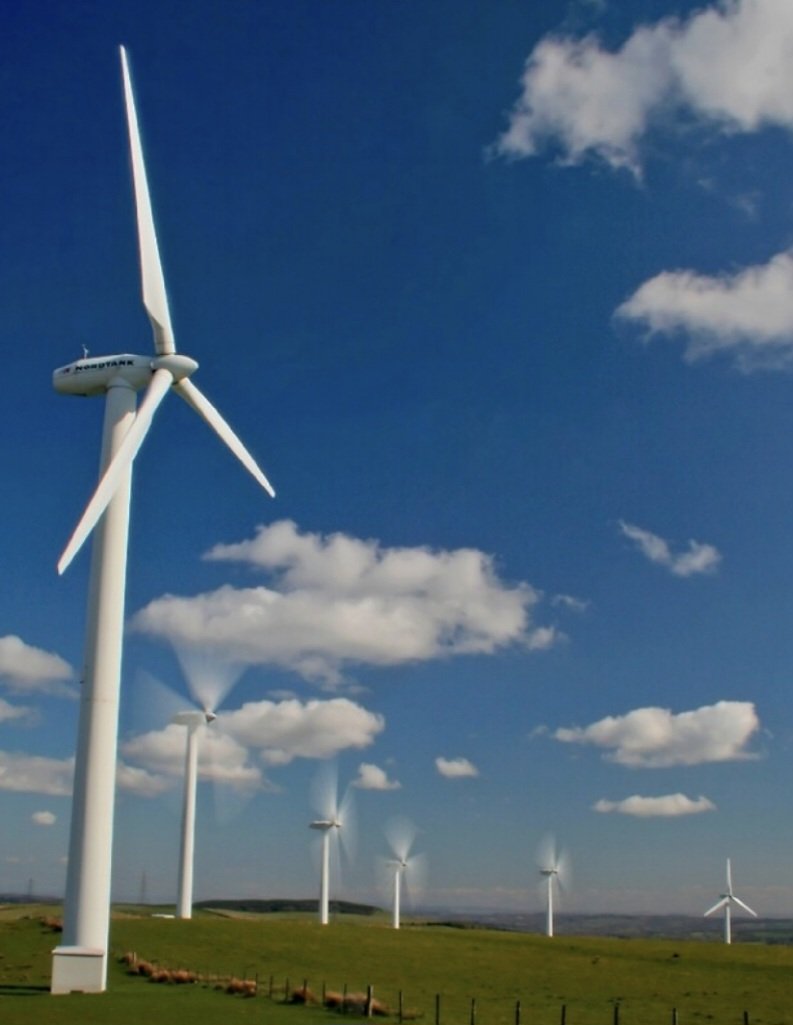
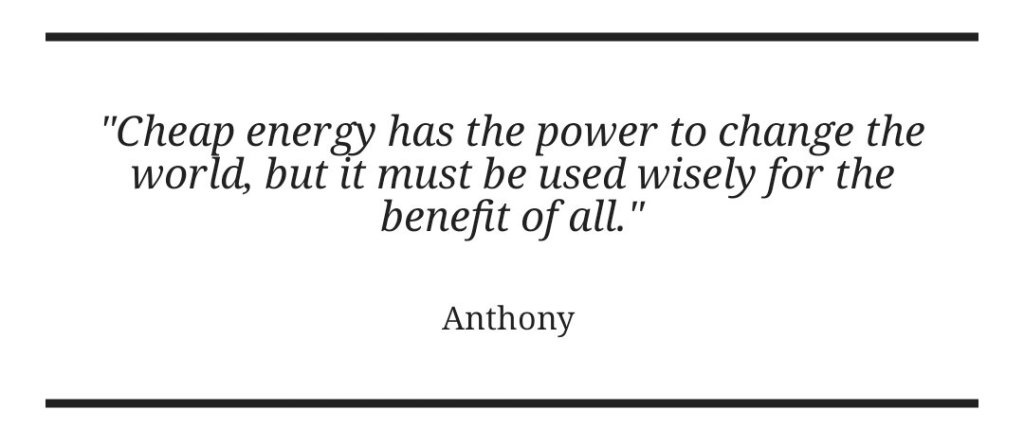
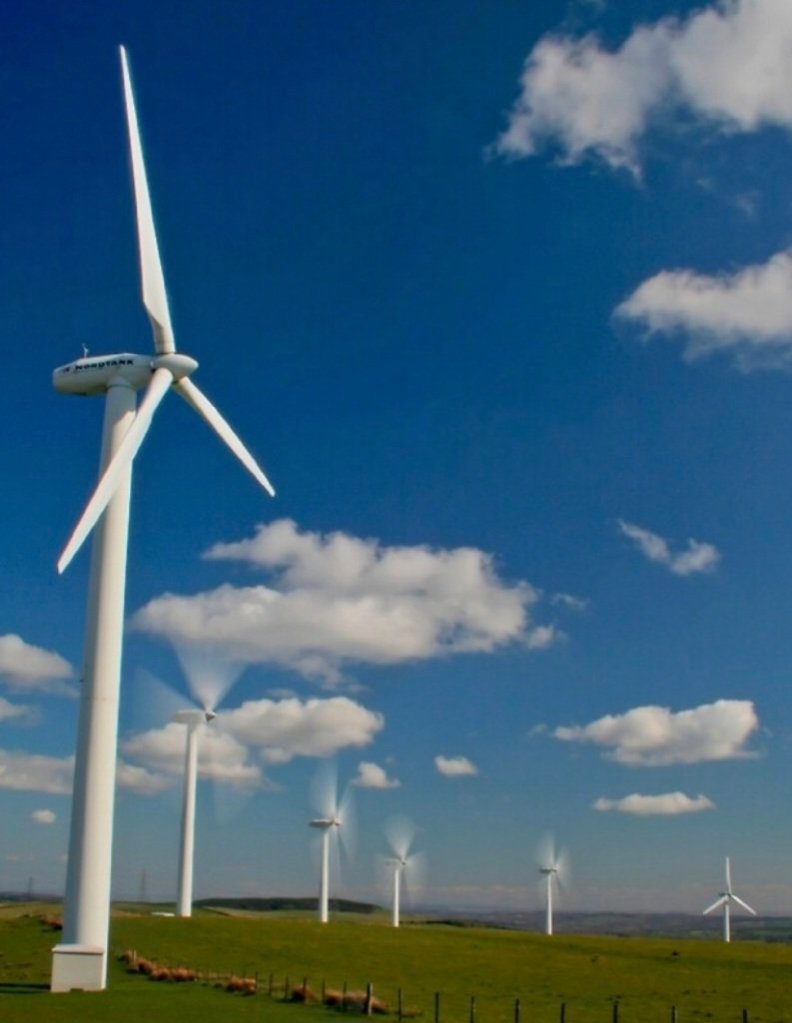
    Imagine having cheap and abundant energy! A dream for many, as it has the potential to greatly improve quality of life, drive economic growth, and increase competitiveness in the global marketplace. With endless, very cheap energy at its disposal, a country could power its homes, factories, and vehicles with clean, reliable energy, reducing dependence on finite and often expensive energy sources such as oil and natural gas.

    The future is bright
    Tap to view in my redbubble gallery.

    One of the most immediate benefits of cheap energy would be a reduction in the cost of living. Energy is an essential input into many aspects of our lives, and its availability and affordability can directly impact the cost of goods and services. With very cheap energy, households and businesses could save money on energy bills, freeing up resources for other investments.

    The energy revolution would also lead to an increase in industrial output. With lower energy costs, industries could produce goods more efficiently and at a lower cost, making them more competitive in the global marketplace. This, in turn, would drive job creation, as the growth of these industries would require a larger workforce.

    In addition, cheap energy could also have a positive impact on the environment. With an abundance of cheap energy, there would be less reliance on fossil fuels, leading to a reduction in greenhouse gas emissions. This could help to mitigate the impacts of climate change and improve air quality, benefiting public health.

    However, it’s important to note that there are potential challenges that would need to be addressed in a country with endless, very cheap energy. For example, such a rapid shift in energy use could put a strain on the energy grid, requiring significant investments in infrastructure to ensure stability and reliability. There is also the potential for energy to become too cheap, leading to overconsumption and wasting valuable resources.

    In conclusion, a country with endless, very cheap energy would have the potential to greatly improve quality of life, drive economic growth, and increase competitiveness in the global marketplace. However, careful planning and management would be required to ensure that this energy revolution has a positive impact, both economically and environmentally.

    Tap to view my redbubble gallery.

    More interesting posts

Design a site like this with WordPress.com
Get started